
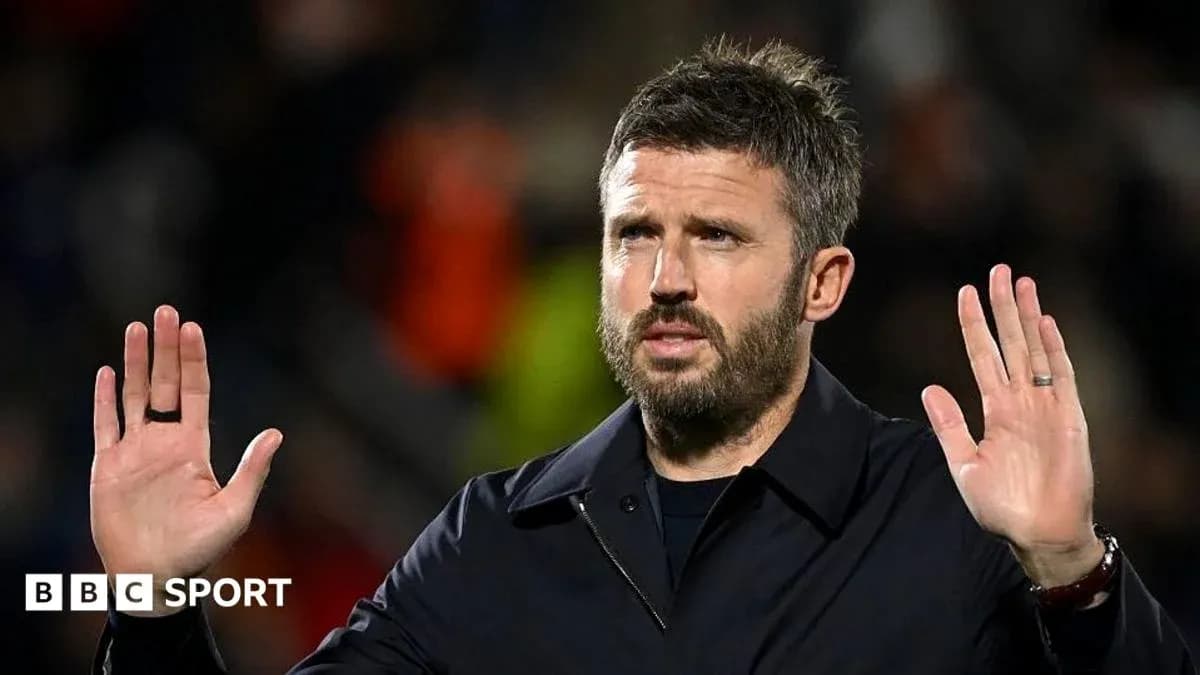
The cycle has come for all of them. Now it has Michael Carrick by the throat.
On a bleak Champions League night in Como, Carrick raised his hands towards the away end in apology, mirroring Ole Gunnar Solskjaer’s gesture after that 4-1 collapse at Watford in November 2021. Same scoreline. Same sense of humiliation. Same feeling of inevitability.
He is the seventh full-time manager to walk into this job since Sir Alex Ferguson walked away with 38 trophies and an era that now feels like mythology. Every one of his successors has arrived with a plan, a pedigree or at least a promise. Every one has left with a payoff.
The managers keep falling. The problems stay put.
From David Moyes to Louis van Gaal, Jose Mourinho to Solskjaer, Erik ten Hag to Ruben Amorim and now Carrick, the pattern has hardened into something close to tradition: a brief surge, some thin silverware or flickers of hope, then the slide, the mutiny, the sack.
There have been interims, too – Ryan Giggs, Ralf Rangnick, Ruud van Nistelrooy, Darren Fletcher – but no-one has tamed the beast.
Van Gaal delivered the FA Cup in 2016. Mourinho followed with the League Cup and Europa League in 2017. Ten Hag stunned Manchester City to win the FA Cup in 2024. Slim returns for a club that used to measure itself in eras, not afternoons at Wembley.
Carrick’s plight feels horribly familiar. Results are poor, the dressing room is fractured, and the public cracks are widening. After the Champions League defeat at Atletico Madrid, Lisandro Martinez turned his fire on director of football Jason Wilcox. In Como, captain Bruno Fernandes questioned the tactical approach.
When players start aiming upwards, it usually means something deeper is rotting.
So the questions grow sharper. Is it really just the managers who should stand in front of those supporters and shoulder the blame? Or is this now a story about the people who hire them, sack them and chart the club’s course?
Have Manchester United, through a decade of drift, decay and dreadful decision-making, turned themselves into the unmanageable club?
A superclub that keeps missing its managers
United’s hierarchy has tried almost every template to recreate Ferguson’s magic.
Moyes, handpicked by Ferguson, arrived from Everton and found the job simply too big. Van Gaal and Mourinho came as serial winners, proven at Europe’s superpowers. Solskjaer was the nostalgic gamble, the anti-Mourinho, chosen after a feelgood interim bounce rather than a compelling CV. Ten Hag rode in on the back of that vibrant Ajax side that reached a Champions League semi-final. Amorim arrived from Sporting as one of Europe’s hottest young coaches.
All of them left the same way. Sacked. Overwhelmed by the scale, the scrutiny and the muddle around them.
The decline did not begin with Carrick, or even with Ten Hag or Solskjaer. It began the moment the succession to Ferguson was botched and never truly recovered.
The most damning image of United’s modern era came in December 2019. Carlo Ancelotti, Pep Guardiola and Jurgen Klopp were all working within 35 miles of Old Trafford. None of them worked there. Ancelotti was at Everton. Guardiola at Manchester City. Klopp at Liverpool. United had Solskjaer – a romantic appointment that lasted less than three years.
Now Carrick looks like Solskjaer Mark II. A popular former player. A steady caretaker who did well enough to be made permanent. A previous managerial career that ended in a sacking at Middlesbrough, just as Solskjaer’s had at Cardiff City.
The club has arrived at an uncomfortable crossroads. Since Ferguson left, has it ever felt worse than this? Has hope ever been thinner? Has morale, inside and outside the dressing room, ever been lower?
The badge still shines. The job doesn’t.
United will always find someone to sit in the dugout. The name still carries weight, the stadium still looms, the history still seduces. But the job is no longer the irresistible summit it once was.
They cannot simply pick from the very top shelf and assume the answer will be yes. Any elite manager will now ask a harder question: is there a future at Old Trafford that ends in anything other than another dismissal?
Given the current squad, there is no guarantee that even the most decorated coach could fix this quickly – or at all – without a vast injection of cash and clarity.
Carrick fronts the operation and, on this evidence, will pay the price. Like Solskjaer, he was the easy option after steering United back into the Champions League, a comfort choice for a fanbase that already loved him. That comfort has been ripped away by the results.
But the blame does not stop at the dugout door.
Power, money and a club at war with itself
The list of culprits stretches higher, with Sir Jim Ratcliffe now at the top.
Supporters have railed against the Glazer family since their leveraged takeover in 2005 saddled the club with debt. They remain the majority owners, unmoved by years of protest and anger. Ratcliffe’s arrival as part-owner, far from soothing the fury, has extended it. Many fans see him as a willing partner to the Glazers, not a saviour.
Ratcliffe, like many billionaires before him, has discovered that football does not obey the logic of his other businesses. He has talked about delegating big football calls to Wilcox and chief executive Omar Berrada, yet instability and poor decisions have multiplied on his watch.
The handling of Ten Hag was a case study in chaos. United were ready to sack him before the 2024 FA Cup final. He beat City at Wembley, survived, then received a contract extension and around £200m to spend. Six months later, he was gone. The payoff to him and his staff topped £10m.
Financially reckless. Football-wise, incoherent.
Then came the Dan Ashworth saga. United pursued him aggressively, sold him as a coup, and waited while he sat on gardening leave at Newcastle United. He finally arrived in July 2024, widely regarded as one of the shrewdest sporting directors in the game. Five months later, he was sacked after a behind-the-scenes dispute.
The optics were brutal. Ashworth spent roughly as long waiting to join United as he did actually working for them.
Whispers suggested he was blamed for backing Ten Hag’s stay. Another theory was that he wanted to target English managers such as Graham Potter and Gareth Southgate rather than Amorim. Either way, United lurched on, chasing Amorim despite his rigid commitment to a 3-4-3 system – the same tactical obsession that had already cooled Liverpool’s interest and nudged them towards Arne Slot.
Amorim lasted 14 months. His reign sank under that inflexibility and ended with a parting shot at the hierarchy and a hostile meeting with Wilcox.
By the time Carrick arrived, morale around Old Trafford was already low. Ratcliffe’s aggressive cost-cutting had driven out staff and stripped away what many inside the club saw as its soul. The mood among supporters darkened further when United launched a ticket-touting investigation in the summer. The club admitted it had underestimated how many fans shared account details and softened some of its threats about confiscating season tickets, but stood by the process. The damage, for many, was done.
Money up, debt unmoved
On the pitch, the football has underwhelmed. Off it, Ratcliffe’s promise to sharpen the finances has produced a mixed picture.
Figures released in September showed overall debt still standing at £1bn despite the cost-cutting. United did, however, post record revenue of £678m and a £23m operating profit – a dramatic swing from the £113m loss in 2023-24, especially in a season without European football.
They also spent £64m on land for a new stadium, the centrepiece of Ratcliffe’s vision of his legacy. Berrada said in August that the club remained on track for a 100,000-capacity arena, with an estimated price tag north of £2bn.
The ambition is vast. The reality on the pitch is grim.
Right now, the club is defined less by grand plans and more by a grim cocktail: bad decisions behind the scenes and a lack of success on it. Managers come and go, systems are ripped up and rewritten, but the churn never stops.
As Carrick stands alone in front of another furious away end, United’s rivals are not just pulling away. They are disappearing over the horizon.





