
Michael Carrick is running out of road.
Manchester United have stumbled into the international break inside the relegation zone, and the minority owners Ineos, with Sir Jim Ratcliffe now calling the shots on football operations, are weighing up a fourth permanent manager in three years. The mood has turned toxic at Old Trafford, and the man who briefly looked like a long-term solution is suddenly fighting for his job.
Carrick’s impressive interim spell last season bought him time and goodwill. Both have evaporated. United have opened the campaign with their worst start in 40 years, defending with a kind of chaotic fragility that reached a new low against Aston Villa. Two goals down, booed, and seemingly broken, they somehow clawed back a 4-4 draw. The comeback masked the crisis on the scoreboard, not in the stands or the boardroom.
Next up? Liverpool away. Hardly the ideal fixture for a side trying to clamber out of the bottom three. Then comes a trip to Lisbon in the Champions League. The calendar offers no hiding place.
The issues, as Lisandro Martinez bluntly pointed out after the defeat to Atletico Madrid earlier this month, go well beyond the head coach. The squad looks disjointed, the recruitment scattergun, the structure fragile. Yet Carrick has not escaped direct fire. United captain Bruno Fernandes has questioned aspects of the tactical approach, and the Portuguese playmaker has not come close to the form that delivered the PFA Player of the Year award and a league assist record last season.
So United edge towards another familiar cliff. If they jump again, who lands in the dugout at Anfield and beyond to drag a superclub out of a relegation scrap?
Mauricio Pochettino – the big swing
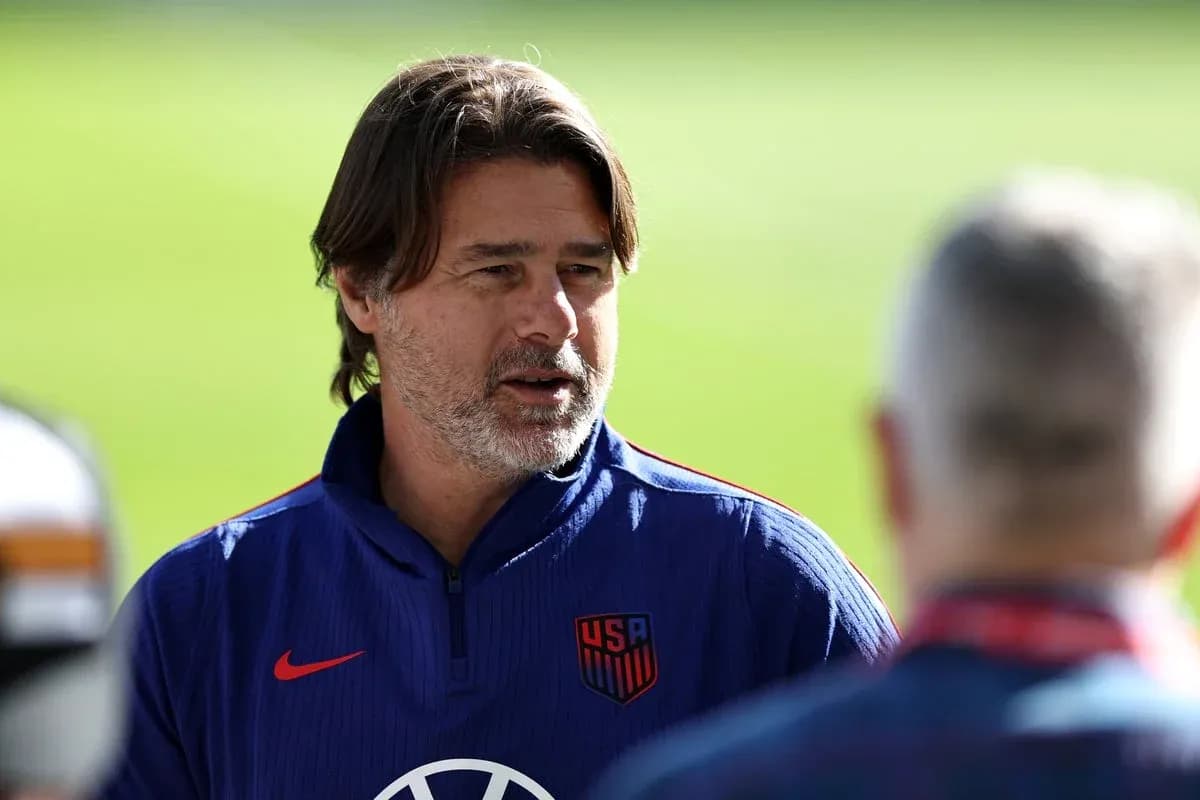
The bookmakers’ early favourite is Mauricio Pochettino, identified as a key target. The problem? He is locked into a contract with the United States national team through to the 2030 World Cup. Any move would require compensation north of £7m.
United may not like that figure. They may not have a choice. The club is desperate, the dressing room drained of inspiration, and Pochettino’s presence alone could jolt the place. His aura has dimmed since his peak years at Tottenham, and his Chelsea tenure ended just as a promising run was beginning to hint at something more coherent. Yet his track record of building intense, aggressive, front-foot sides still carries weight.
His World Cup cycle with the USMNT began with optimism before the Folarin Balogun scandal and a heavy last-16 defeat to Belgium stripped away much of the early gloss. Now the question hangs over him: can he still shape a top club side, under suffocating pressure, in what would surely be the hardest job of his career?
Eddie Howe – the English rebuild specialist
If United want a Premier League-proven rebuilder, Eddie Howe sits near the top of the list. He stunned Newcastle United in the summer by walking away, saying he needed a break from management. Three months later, the chance to take charge at Old Trafford would test that resolve.
Howe’s stock in English football remains high. He inherited a Newcastle side in the relegation zone and turned them into Champions League qualifiers, delivering the club’s best league finish in 20 years and their first domestic silverware in seven decades. Twice he took them into Europe’s elite competition, doing it with a high-intensity, front-foot style that would be welcomed by a crowd starved of identity.
He is, unsurprisingly, prominent in the betting markets. The question is whether United’s chaos appeals to a manager who has just stepped away to breathe.
Fabian Hurzeler – the bold, Brighton blueprint
Look down the league table and you find the season’s most coherent project at Brighton, where 33-year-old Fabian Hurzeler has turned the Seagulls into a fearless, modern side capable of bullying the country’s elite.
Their 3-0 dismantling of champions Arsenal was a tactical masterclass, a snapshot of a team drilled in every phase. At Old Trafford, Hurzeler’s Brighton knocked United out of the Carabao Cup with a sharp, ruthless 3-2 win. That night did not go unnoticed. The Independent’s chief football writer Miguel Delaney has reported that Hurzeler is admired at Old Trafford.
The obstacles are obvious. Brighton would demand serious compensation for their highly rated German coach, and United’s finances are already stretched. Hurzeler also works within one of the most aligned clubs in Europe, where recruitment, data, and coaching pull in the same direction. At United, he would be stepping into the opposite: a club still trying to work out what it wants to be.
Hurzeler himself tried to cool the noise on Friday. “I’m fully focused on my job here. I’ve got no time to think about these rumours because we play every three days,” he said. He praised Carrick as “a great human being, a great personality,” and spoke passionately about the “journey” at Brighton, the time and trust required to build connections and turn a pressure business into a people business. It sounded like a man in no rush to throw away what he has.
Julian Nagelsmann – the fallen prodigy
Julian Nagelsmann was on United’s radar when they sacked Ruben Amorim at the start of the year, pencilled in as a potential summer option after the World Cup. That plan collided with reality.
Germany crashed out in the last 32 to Paraguay, a disaster that dented the reputation of a coach once hailed as the future of European management. At 39, Nagelsmann still offers tactical innovation, a modern training-ground edge, and experience at Bayern Munich and RB Leipzig.
He would, naturally, be interested in the United job. There is a built-in connection too: United’s director of recruitment Christopher Vivell worked with Nagelsmann in the Red Bull system. The fit on paper is clear. The risk, after a bruising international campaign, is equally obvious.
Unai Emery – the architect in Birmingham
Unai Emery has quietly built something formidable at Aston Villa. Champions League qualification and a Europa League triumph have ended Villa’s long wait for both elite competition and silverware, restoring the club’s status as a genuine force.
That success makes him hugely attractive to United. It also makes him incredibly difficult to prise away. Villa are in the early stages of their Emery-era rebuild, having rebuilt the spine of the team over the summer. The Spaniard enjoys full control of his project at Villa Park, a luxury he would not be granted at Old Trafford.
He is under contract until 2029. Any move would require a substantial compensation package and a persuasive pitch. Right now, Emery looks energised by the idea of constructing a second competitive Premier League side in claret and blue, not abandoning it for another club’s mess.
Antonio Conte – shock therapy
When a team looks passive, slow and predictable, the temptation to call Antonio Conte grows. United are no exception.
Conte remains one of the most demanding coaches in the game. His teams play with a ferocity and urgency that this United side sorely lacks. His CV is not up for debate: Serie A titles with Juventus, Inter Milan and Napoli, plus a Premier League crown with Chelsea. When he arrived at Tottenham five years ago, he dragged a floundering side straight back into the Champions League.
He brings impact. He also brings volatility. Conte’s sharp tongue and refusal to tolerate what he sees as incompetence above him are legendary. His Tottenham exit in March 2023 came after a remarkable press conference at Southampton in which he eviscerated the club’s culture.
On Friday, Conte moved to distance himself from the Old Trafford speculation. In a statement, he described talk of “advanced negotiations” with any club as “speculation” and said he would take time to decide “how and when to return to management”. Reports of financial demands, requests for full control and concerns over his “strong personality”, he insisted, were “unfounded” because “there is currently no concrete basis for such assessments”.
United would be playing with fire. But there are not many coaches of his calibre on the market.
Cesc Fabregas – the visionary outsider
Cesc Fabregas has quietly become one of Europe’s most intriguing young coaches. His Como side gave Old Trafford a brutal reminder of that by dismantling United in the Champions League on Wednesday night, a statement win that underlined his tactical clarity and authority.
The Spaniard, a former star at Arsenal, Barcelona and Chelsea, appears deeply committed to the Como project. He owns a stake in the Serie A club, and their debut Champions League campaign offers both emotional and financial incentive to stay put.
At 39, his reputation is rising fast. The pull of a future return to one of his former clubs, particularly Barcelona, could encourage patience. Jumping into the United storm now might not fit his long-term plan.
The old reflex: go back to the badge
If none of the big names can be prised away mid-season, United could once again turn inwards. They have done it repeatedly in recent years.
Under-18s coach Darren Fletcher stepped in to oversee a draw with Burnley and an FA Cup third-round defeat to Brighton before Carrick took the reins in January. Before that, Ruud van Nistelrooy bridged the gap between Erik ten Hag’s dismissal and Amorim’s appointment. Go back further and Ole Gunnar Solskjaer rode the same wave of nostalgia, hope and eventual burnout that now shadows Carrick.
The club is never short of former players willing to remind an underperforming dressing room what the badge is supposed to mean. Fletcher is still in the building. Sir Alex Ferguson is still a phone call away.
United must now decide: do they reach for another short-term fix, another jolt of sentiment and symbolism, or finally commit to a manager and structure capable of dragging them out of this spiral?
The next appointment will answer that – and determine whether this is a temporary flirtation with the relegation zone, or the moment a giant finally admits it has lost its way.





