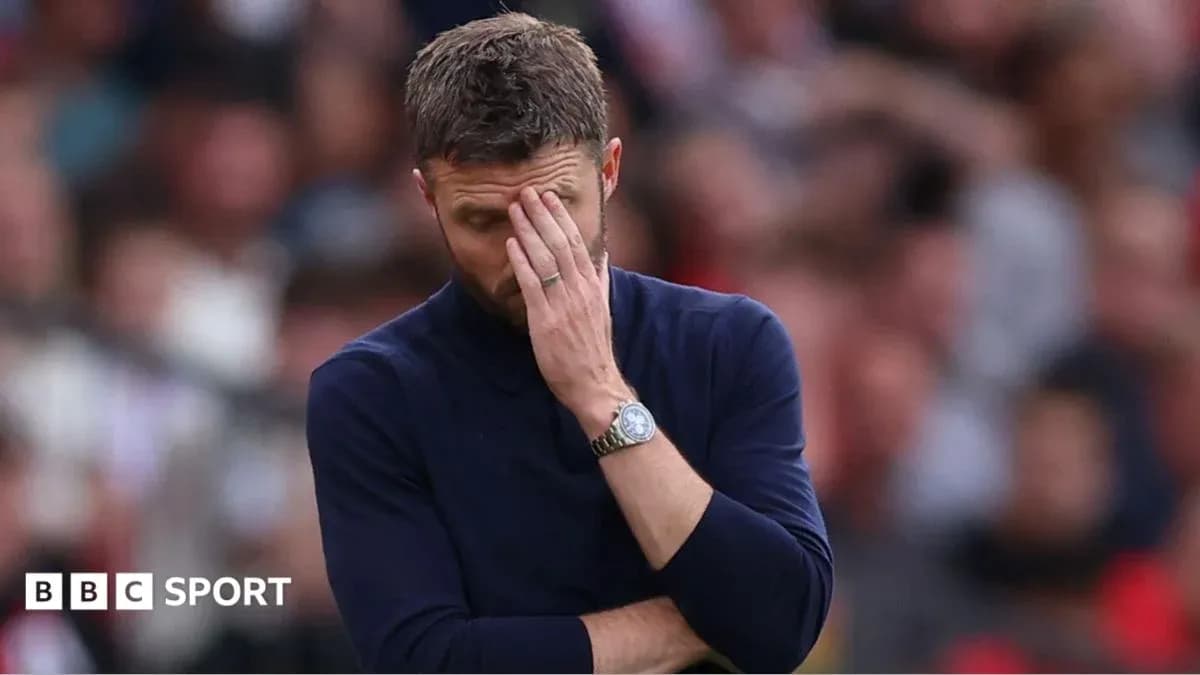
For the third time in less than 10 months, Manchester United walked off beaten by a side down to 10 men before half-time. Once is unfortunate. Twice is troubling. Three times feels like a pattern that cuts far deeper than a single refereeing call.
The post-mortem after the 1-0 defeat to Manchester City has been dominated by Pro Ref’s apology to United, an admission of “an error of judgement” around Erling Haaland’s winner. That controversy will rage on talk shows and phone-ins. At Carrington, the conversation will be far more uncomfortable.
Carrick’s reality check
A week ago at Everton, Michael Carrick bristled at the idea that four points from three games represented a poor start. After City, the tone shifted. Four points from four, one win – at home to newly-promoted Ipswich – and the head coach now concedes “there is no getting away” from the fact this is well below expectations.
He knows what comes next. Questions. Not one or two, but a queue of them: recruitment, team selection, substitutions, tactics – and, inevitably, Carrick himself.
“We don't need a break or a restart,” he insisted. “We've just got to move on and get winning again.”
The calendar offers him no hiding place. Brighton visit Old Trafford in the Carabao Cup on 16 September, followed by a trip to Fulham four days later. Two games that suddenly feel like a stress test of the entire project.
Carrick cannot afford a limp response. If United stumble into the next three-week international break, the vacuum will be filled by external inquests into what, exactly, is going wrong at Old Trafford.
Ten men, same problem
On the touchline, new City boss Enzo Maresca cut a more satisfied figure, even as he acknowledged Phil Foden’s red card had complicated his afternoon.
He also explained why it complicated United’s.
“They are a team that loves transitions and space in behind,” he said. “With 10 players, we just dropped and waited for them, so we didn't concede any transitions and didn't concede any space in behind. That is why the game became more difficult for us and for them.”
The pressure finally told – on United, not City. Once again, a numerical advantage turned into a tactical trap.
This is not a new story. Since Jose Mourinho’s arrival more than a decade ago, United have been at their most dangerous when the game breaks open and space appears. Ole Gunnar Solskjaer tried to turn them into a more proactive, front-foot side but never fully escaped the counter-attacking identity.
Erik ten Hag and Ruben Amorim arrived with reputations built on dominating domestic leagues, imposing structure and control. They never truly transplanted that dominance to Old Trafford. Carrick, as a player, thrived on taking the ball, recycling it, dictating tempo. It is no stretch to believe he wants his team to do the same.
But wanting the ball and doing something with it are not the same thing.
Possession without penetration
Keeping possession is the easy part. The real test comes when opponents sit in, deny space, and refuse to be lured out of their shape. United are still failing that test too often.
The club’s summer business targeted the heart of the team. The midfield was meant to be rebuilt, refreshed, re-energised. On paper, £155m worth of investment should have changed the picture.
On the pitch, it has barely smudged it.
Youri Tielemans has yet to find anything close to his best form. Carlos Baleba is still waiting to make his debut. Andrey Santos started the opening game at Hull, then slipped to the bench and did not feature at all against City. For a window built around the middle of the pitch, the early returns are meagre.
At the back, the issues feel more familiar. Luke Shaw’s run of 41 consecutive Premier League starts finally ended, and the lack of fresh cover at left-back – widely expected, never delivered – has been exposed. One injury, and the entire balance of the defence tilts.
Then came the 83rd minute against City. Marcus Rashford off, Joshua Zirkzee on – one of only two substitutions Carrick made. Zirkzee had been available for transfer all summer. His late introduction, in a game crying out for a different attacking idea, underlined a stark truth: the overall depth of this squad is not where it needs to be.
The weight on Fernandes
No player symbolises United’s recent era more than Bruno Fernandes. Last season he was the heartbeat and the headline act, sweeping the PFA and Football Writers’ Player of the Year awards after a campaign of nine goals and a Premier League record 22 assists. He dragged games towards him.
This season, the numbers tell a different story. Three goals and one assist is a respectable return in isolation, but it does not match the influence he exerted last year. More worrying for United is the sense that his overall impact has dipped.
Against City, some observers felt he looked tired, his usual spark dulled. That perception only sharpened scrutiny of Carrick’s decision-making in midweek.
United’s Champions League return, against Azerbaijan champions Sabah FK, looked tailor-made for sensible rotation. Despite Sabah’s lowly ranking, it was understandable that Carrick went strong from the start, wary of any complacency after a two-year absence from Europe’s elite competition.
By half-time, United were three goals up. The job was effectively done. A three-day turnaround to a derby with City loomed. The stage seemed set for Fernandes to come off, rest his legs, and hand responsibility to others.
Carrick chose a different script. He used all five substitutes – and left his captain on the pitch for the full 90 minutes.
Now Fernandes enters the final year of his contract, with United holding an option to extend to 2028, and the pattern is hard to ignore. Once again, too much rests on his shoulders. Once again, United look like a side that do not quite know how to function when he is not at his best.
Carrick talks about moving on and winning again. To do that, he must find a way to build a team that doesn’t collapse into the same old habits whenever the space disappears and the stakes rise.