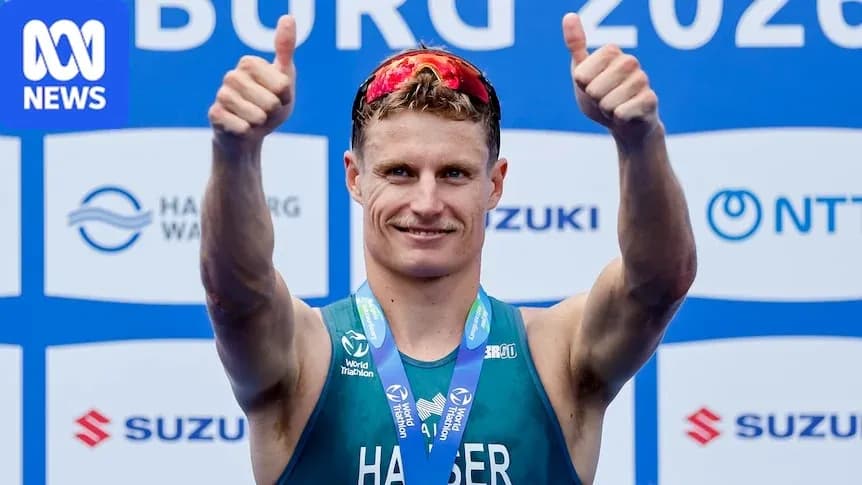
Matt Hauser didn’t just win in Wollongong. He yanked Australia back to the top of world triathlon.
On home roads, in front of home voices, his victory snapped a 15-year wait for an Australian world title and felt like a line in the sand for a nation that once owned this sport. Yet even as the celebrations rolled around him, Hauser’s eyes were already fixed two years down the road, on a start line in Los Angeles and an Olympic race that will define this era of his career.
From contender to the man everyone is chasing
Heading into the next leg of the World Triathlon Championship Series in Weihai on August 29, Hauser sits third in the standings. Only Brazil’s Miguel Hidalgo and Portugal’s Vasco Vilaça are ahead of him, and both have raced one more event.
That detail matters, because Hauser has been perfect. Three starts, three wins: Yokohama. Hamburg. London. A clean sweep that has turned him from dangerous outsider into the man the rest of the field now studies, tracks and tries to break.
“It’s a bit of a pinch me moment, honestly,” he told ABC Sport at the AusTriathlon Performance Hub at Miami on Queensland’s Gold Coast. The words spill out like someone still adjusting to the view from the summit. He knows this form won’t last forever, knows he has to “capitalise” while he can. But he also knows something else now: he belongs.
That realisation hasn’t come from a single breakout season. It has been built the hard way.
“It doesn’t feel like a big sudden jump,” Hauser said. “It feels like a lot of smaller goals and processes” stacking up into what he calls, almost shyly, a “world champion persona”. The foundation has been a decade-long partnership with coach Dan Atkins on the Gold Coast, where they’ve built what Hauser describes as a “daily performance environment” — the kind of relentless routine that quietly forges world-beaters.
A new standard, and a new wave behind him
Hauser’s surge has arrived in the slipstream of the Paris Olympics, in a moment when some of his fiercest rivals have stepped away to test themselves elsewhere.
Gold medallist Alex Yee has been chasing marathon history, clocking 2:06:38 to record the second-fastest time ever by a British man behind Mo Farah. Silver medallist Hayden Wilde has turned to longer-distance triathlons in the T100 series. On the women’s side, Olympic champion Cassandre Beaugrand has been tearing up the track, setting French records over 3,000m and 5,000m and starring in the Diamond League, plus a national best over 10km on the road.
Hauser watches all that and doesn’t see a distraction. He sees validation.
“It’s very inspiring to see those guys go off and do what they do outside of the sport,” he said. Performances like that, he argues, show the world that triathletes are not just decent at three disciplines, but world-class in each. It lifts the whole sport.
He has chosen a different path: stay locked into the World Triathlon Championship Series, sharpen the craft, master the chaos of one of the most tactical formats in endurance sport. While others diversify, he doubles down.
That commitment has made him a beacon for the next generation at home. Nineteen-year-old Aspen Anderson, one of Australia’s brightest prospects, sees more than just results.
“Matt’s definitely led the way,” she told ABC Sport. “You can kind of look at them and say, well, yeah, if they can do it, then I can do it too.” For a nation with a rich triathlon history but a recent gap at the very top, that belief is gold.
Rewriting how the race is won
Triathlon has always been a balancing act on a knife edge. Add too much upper-body muscle in the pool and you pay for it on the bike and run. Chase run speed at all costs and the swim starts to slip. Everyone in the sport grows up hearing the same mantra: you can’t win the race in the swim, but you can lose it there.
For a while, the sport tilted towards the runners. Races often bunched through the swim and bike, before the pure runners detonated the field over the final kilometres.
Hauser is helping drag the sport back in another direction.
He has been attacking from the gun, driving the pace in the water, then pressing on the bike to rip the race apart before the runners can settle in. It’s a style that echoes the great British era of Alistair and Jonathan Brownlee, whose brutal swim-bike assaults forced the field to make a choice: hang on or get blown away.
“The dynamics change from year to year,” Hauser said. He namechecks the Brownlees and their trademark breakaways, then contrasts them with the era of Mario Mola, Jake Birtwhistle and the big, condensed packs that once dominated the series.
Now, he feels the tide turning again. Front packs are back. Breakaways are biting. And Hauser is often the one at the front, head down, stringing the field out and “limiting the strengths of those stronger runners” behind.
“There’s a lot of momentum now and there’s a lot of belief that you don’t have to be like one of the best runners to win a race now,” he said. It’s not just tactics. It’s a mindset shift — one he’s riding better than anyone else right now.
The Olympic gap in Australia’s story
For all its heritage, Australian triathlon carries a glaring omission. Emma Snowsill’s gold in Beijing remains the country’s only Olympic title in the sport. Michellie Jones, Loretta Harrop, Emma Moffatt and Erin Densham have all stood on Olympic podiums.
No Australian man ever has.
That statistic hangs over every conversation about Los Angeles 2028. Hauser doesn’t hide from it. He carries it.
“I think the Olympics is always in the back of my mind,” he said. Every world championship race, every training block on the Gold Coast, every tactical call he makes now feeds into a single goal: to arrive in LA at his absolute peak.
Only a few years ago, he knew he could produce big performances, but not often enough to be considered a genuine front-runner. Consistency was the missing piece. This season, that has changed. He is not just winning; he is winning repeatedly, in different conditions, on different courses, under different pressures.
Now he wants that level to feel normal.
When the Olympic gun goes in 2028, his plan is simple: execute the same way he has been executing for years. No magic. No reinvention. Just a body of work so deep that even an “average” day still lands him in the fight for medals.
“Trying to peak for one race every four years” is the reality of the Olympic cycle. Hauser knows he can’t live only for that one day. The process — the “notches in the belt” he talks about — matters just as much. Each race between now and LA is a rehearsal, another layer of proof that he can deliver when it counts.
The road through Weihai and beyond
Next comes Weihai, China, on August 29, then the series final in Pontevedra, Spain, on September 23. Two more chances to harden his racing edge, two more tests of whether this new, aggressive front-pack style can hold when the stakes rise.
Australia has waited a long time to see one of its own back on top of world triathlon. The drought is over. The question now is whether Matt Hauser can turn this surge into something even bigger — the moment an Australian man finally climbs onto an Olympic podium, and maybe, just maybe, stands on the very top step.