
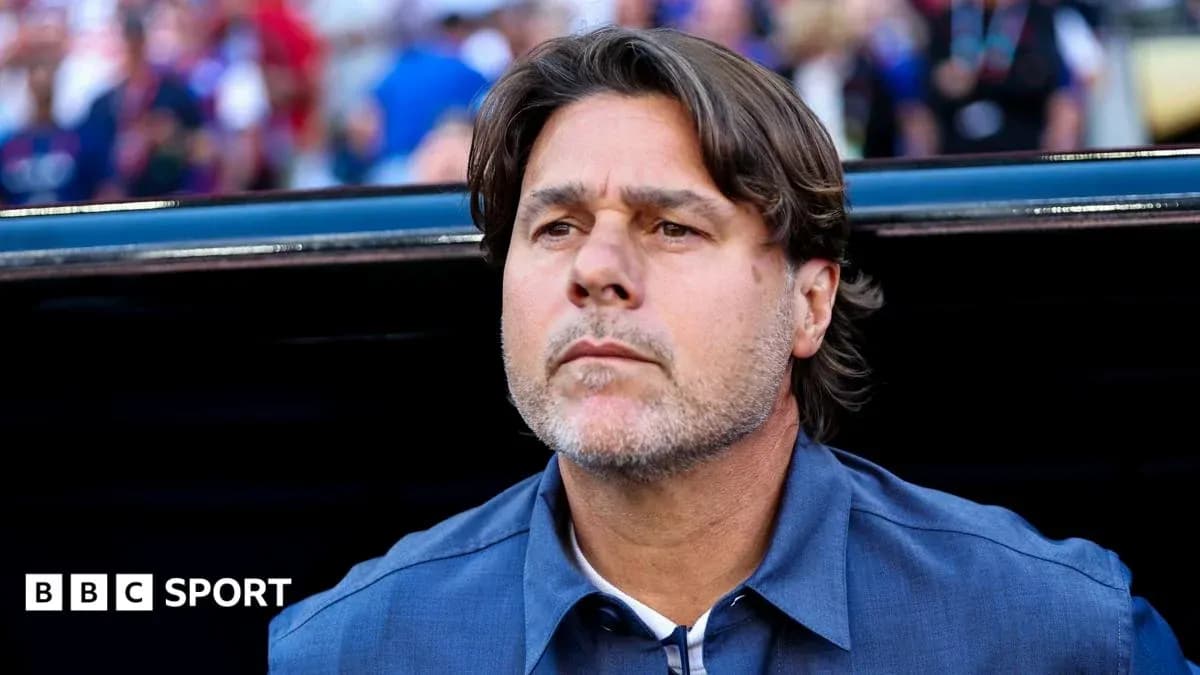
Mauricio Pochettino’s whirlwind week ends with a television backdrop of palm trees and US crests. His future, though, lies under the grey skies of Manchester.
The Argentinian has been confirmed as Manchester United’s new head coach, a move that drags one of the game’s most coveted managers back into the Premier League spotlight and rips him away from a USA project he has reshaped in little more than a year.
Before Old Trafford, though, comes Haiti.
On Friday at around 14:15 GMT, Pochettino will sit in front of the cameras for a pre-match news conference ahead of the USA’s Concacaf Nations League fixture. Every word will be parsed. Does he talk about Liverpool away, Sporting in the Champions League and Brentford at Old Trafford? Or does he ring-fence the moment and talk only about his current players, his current badge, his current job?
For a few more days, he has to live in both worlds.
A manager in demand, a club in turmoil
Manchester United have spent the past decade cycling through ideas, philosophies and personalities. Pochettino will be the 12th different person to take charge of a United side in a Premier League game since the 2013-14 season. Only Chelsea (14) and Crystal Palace (13, pending Pierre Sage’s replacement) have chopped and changed more.
That number alone tells the story. United haven’t just been searching for a manager; they’ve been searching for themselves.
Pochettino arrives with a reputation that fits the scale of the job. High-intensity pressing. Aggressive, attacking football. A track record of turning talented players into hardened, elite performers. From Espanyol to Southampton, from Tottenham Hotspur to Paris St-Germain and Chelsea, his teams have carried a clear identity, even in the most volatile environments.
At Tottenham, he turned a promising squad into Champions League regulars, securing top-four finishes in four consecutive seasons and leading them to a Champions League final in 2019. At PSG, he added silverware: Ligue 1, the Coupe de France, the Trophee des Champions. With the USA, he took a young side to the World Cup last 16 on home soil and into a Concacaf Gold Cup final.
United now ask him to do something bigger: impose order on a club that has lived in permanent flux.
A brutal start at Old Trafford
There will be no easing-in period.
Pochettino officially takes over on 18 November, after the current international window. His first game? Liverpool at Anfield, a week on Sunday. A baptism of fire, even for a manager used to intense rivalries and hostile atmospheres.
From there, the schedule barely relents. United fly to Portugal to face Sporting in the Champions League, then he walks out at Old Trafford for his first home match against Brentford in the Premier League on 28 November. Every tactical tweak, every selection call, every substitution will be measured against a decade of frustration.
United’s statement leans on his pedigree and his style. The club highlights his “high-intensity, attacking” approach, his commitment to “strong, cohesive teams” and his “outstanding record of developing individual players.” They know what they are buying. The question is whether they can give him the stability and structure he has often lacked elsewhere.
USA tenure ends with respect – and regret
Across the Atlantic, there is a different mood. A mix of disappointment and gratitude.
Pochettino only took the USA job in September 2024, but he has left a clear imprint. In 35 games, his side won 21 and lost 12. They reached the round of 16 at last summer’s World Cup as co-hosts and pushed through to the final of the 2025 Concacaf Gold Cup. Results matter, and those were respectable. The deeper impact, though, has been cultural.
US Soccer chief executive and secretary general JT Batson praised the way Pochettino and his staff “raised standards, strengthened our culture and created clearer connections from the youth national teams to the senior team.” Those changes, Batson stressed, are now “embedded” in how the federation operates.
Pochettino’s own parting words were heavy with affection. He called representing the USA crest “one of the greatest honours” of his career, thanked the players, fans and federation, and spoke of “tremendous talent” running through the American player pool, from youth level to the senior side. “You will always have a special place in our hearts,” he said, promising to support the teams whenever they play.
This is not a messy divorce. It is a clean break between two parties who would probably have stayed together longer in a less ruthless sport.
The search begins in America
US Soccer has moved quickly to show there is a plan.
Steve Cherundolo, the current men’s Under-23 coach, will lead the December camp for the men’s national team as an interim figure. Behind the scenes, a wider search is already taking shape, with a notable mix of voices at the table.
US women’s team head coach Emma Hayes, one of the most respected English coaches of her generation, and former USA and Sheffield Wednesday defender Oguchi Onyewu will both play a role in identifying Pochettino’s successor. The federation says it will draw on leaders “across US Soccer and the global soccer landscape” and will consider candidates from “a broad range of backgrounds.”
The message is clear: this will not be a closed, old-boys’ process. The bar, set high by Pochettino’s standards and structures, is not coming down.
Two games, one farewell, and a new storm brewing
Before the handover, there is work to do.
Pochettino and his staff will remain in charge for the USA’s Nations League matches against Haiti on 14 and 17 November. They will prepare as they always have, drill the details, set the press, demand intensity. The players know it is the end, and that can sharpen focus or blur it. The camp will tell its own story.
Once those games are done, the Argentinian steps through the doors at Carrington and into a different kind of pressure. A fractured giant. A fanbase desperate for clarity and identity. A club that has burned through almost a dozen managers in just over a decade and still feels no closer to the certainty it once took for granted.
Pochettino has left a lasting mark on the USA. Now he walks into Manchester United, where legacies are measured not in words or culture shifts alone, but in trophies, titles and nights when the stadium shakes.
He has wanted a job like this for years. Now he has it. What he does with it will define the next chapter of his career – and, perhaps, the next era at Old Trafford.





