
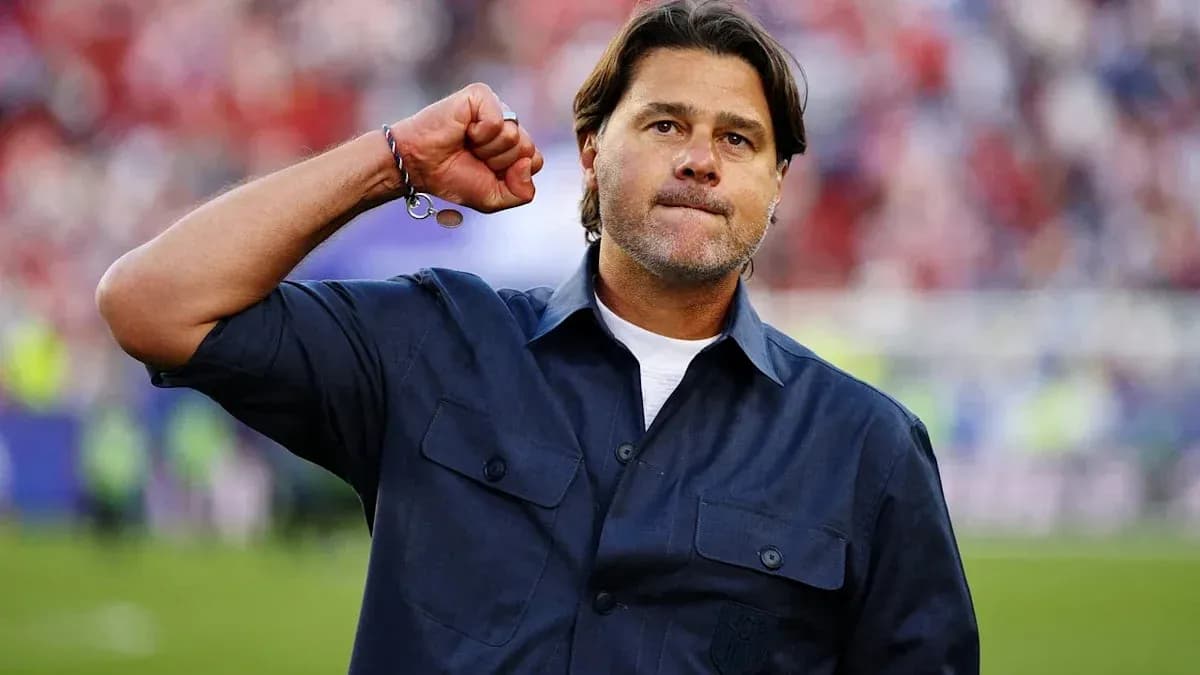
Mauricio Pochettino walks into Manchester United with the volume already turned up to maximum. New job, old rival, and a table that makes grim reading. His first act as head coach is not a gentle introduction at Carrington or a home banker at Old Trafford. It is Anfield. It is Liverpool. It is a team in 18th place trying to look something like Manchester United again.
The Michael Carrick interlude is over. The margin for error is gone.
A brutal starting point
Ten league games. One win. That solitary victory came against newly promoted Ipswich Town. Around it: five draws, four defeats, 19 goals conceded and the kind of hesitant football that drags big clubs into small conversations about relegation battles.
That is where United are. That is the mess Pochettino inherits.
On the other side, Liverpool are moving in the opposite direction. Andoni Iraola has them accelerating, not yet at full title-challenger speed, but close enough to smell it. They play with aggression, tempo and a front line built to run at you all afternoon. Anfield will not be patient. It will expect.
So how does Pochettino walk into that storm?
The safe play: tweak, don’t tear up
The most logical answer is that he does not rip everything up in week one. Not at Anfield. Not with a squad already short on confidence and rhythm.
That points towards continuity: a fluid 4-2-3-1, a mid-block out of possession, and a front line asked to press in short, intense bursts rather than in wild, unsustainable waves. It is the shape the players know. Pochettino can change the details without changing the entire picture.
Senne Lammens is nailed on in goal. The real surgery is in front of him. Nineteen goals conceded in ten matches is not just a bad number; it is a warning siren. The new manager has to decide whether he trusts experience or gambles on youth in one of the most unforgiving fixtures in European football.
At right-back, Diogo Dalot and Noussair Mazraoui are the obvious candidates. Both have the legs to get up and down, both can step into midfield. At centre-back, the romantic – and risky – idea is a bold leap towards the future: Ayden Heaven and Leny Yoro as a young pairing, with teenager Harry Amass at left-back because Luke Shaw is injured and there is no other specialist.
That would be a statement. It would also be a huge roll of the dice.
More likely, Pochettino leans on players who have lived these games before. Harry Maguire’s leadership, Lisandro Martinez’s aggression, Matthijs de Ligt’s reading of the game: some combination of that trio feels a safer bet in the Anfield cauldron. On the left, Patrick Dorgu might edge Amass despite doubts over his defensive reliability. Pochettino may decide that a bit of attacking thrust from full-back is a price worth paying.
Midfield first, fitness later
In the long term, Pochettino will want this United side to look like his best teams: fit, relentless, covering more ground than almost anyone else in the league. That cannot be built in a fortnight. What he can build now is a platform.
Midfield security comes first.
Youri Tielemans offers control, angles, and a calm passing range. Next to him, Kobbie Mainoo is the kind of young, adaptable midfielder Pochettino has always trusted. He can receive under pressure, he can carry the ball, and he can follow instructions. That matters when the opposition’s press is coming in waves.
With that double pivot in place, the attacking question becomes less about shape and more about personnel.
Bruno Fernandes will operate as the No.10. That is non-negotiable. He remains United’s main creative outlet, the player who can turn a half-chance into a real one with a single pass. To his left, Matheus Cunha looks the likeliest starter ahead of Marcus Rashford, whose form has dipped. Cunha brings industry, link play and the willingness to work backwards – all essential away to Liverpool.
Up front, Pochettino must decide what kind of focal point he wants. If he backs Joshua Zirkzee as his central striker, Bryan Mbeumo can slide back to his natural right-wing berth, stretching the pitch and threatening in behind. The alternative is to use Mbeumo through the middle, freeing up a spot on the flank for Amad Diallo, whose ability to drift inside and combine could offer a different kind of problem for Iraola’s defence.
None of these dilemmas are new. Carrick wrestled with the same combinations. The difference now is that every choice Pochettino makes will be seen as a marker of what this “new era” might look like.
A likely 4-2-3-1 at Anfield could read: Lammens; Dalot, Yoro, Maguire, Dorgu; Tielemans, Mainoo; Diallo, Fernandes, Cunha; Mbeumo.
The bolder route: three at the back, five without the ball
But what if he tears up the script?
Pochettino knows exactly how fragile United have been defensively. He has also never been afraid to flip a system if the occasion demands it. And Anfield, with Cody Gakpo, Florian Wirtz, Alexander Isak, Bradley Barcola and Rio Ngumoha all capable of attacking at speed, is precisely the kind of place that punishes open spaces.
One way to close those spaces is to add a defender and sacrifice a little in possession.
A 3-4-3, with wing-backs dropping into a back five out of possession, would compress the pitch, reduce the gaps between the lines and give United more bodies in their own box. It is a pragmatic, almost cynical approach – and it might be exactly what this fixture requires.
There is a catch. It is called Bruno Fernandes.
United have experimented with a back three under Ruben Amorim before, but in that setup Fernandes drifted away from his best zones, shunted into roles that blunted his influence. Pochettino would have to find a way to keep his captain central to the attack, not lost on the periphery.
Even so, the temptation will be there. Three centre-backs – Yoro, Maguire, Martinez – shielded by a hardworking midfield and protected by wing-backs who track Liverpool’s wide threats all the way back. Dalot and Dorgu could operate high when United have the ball, then snap into a back five when they lose it. Mainoo and Tielemans would patrol the middle, while Mbeumo, Fernandes and Cunha try to make the most of rare, precious counterattacks.
On paper, that 3-4-3 looks like this: Lammens; Yoro, Maguire, Martinez; Dalot, Mainoo, Tielemans, Dorgu; Mbeumo, Fernandes, Cunha.
It is not glamorous. It is not expansive. But it might just drag the game into the kind of contest United can survive.
Underdogs at Anfield – with something to prove
Whatever shape he settles on, Pochettino will send out a side branded as heavy underdogs. Liverpool are at home, in form, and sniffing an opportunity to push themselves into the title conversation. United are trying to climb out of the bottom three.
Yet this is where a season can twist.
A disciplined, aggressive performance, even without the perfect result, can change the mood around a club. A clear structure, a visible idea, players looking like they understand their roles again – that is the minimum United fans will demand from this first glimpse of the Pochettino era.
Anfield has buried plenty of United teams in recent years. Pochettino’s task is not just to avoid another burial. It is to walk out of that stadium with evidence that this version of Manchester United is finally ready to fight its way back.





