
Mauricio Pochettino is on the brink of walking into one of the most volatile dugouts in European football, with Manchester United poised to hand him a two-and-a-half-year contract after agreeing to trigger his £7.4m release clause, according to The Athletic.
The timing is brutal, even by Old Trafford standards. On Thursday morning, United confirmed Michael Carrick’s departure, ending a fraught spell in which the 45-year-old lurched from reprieve to dismissal watch on an almost weekly basis.
Carrick had survived the kind of results that usually end a manager’s tenure overnight. Heavy defeats to Como in the Champions League and Bournemouth in the Premier League last month should have been terminal. A spirited win over AS Roma in Europe briefly bought him time, but a single point from six in the league left United marooned in the relegation zone and the mood inside the club turned.
At that stage, the decision-makers moved. Jason Wilcox and Omar Berrada concluded that the slide could not continue, and Sir Jim Ratcliffe agreed. The former Middlesbrough boss was told to go on Thursday, but the succession plan was already in motion.
United had been working behind the scenes on Pochettino for days. On Wednesday night, GIVEMESPORT sources revealed that the club had reached an agreement in principle on personal terms with the 54-year-old, clearing the way for his return to the Premier League.
Pochettino’s Next Giant Rebuild
Pochettino arrives with a CV shaped by high-profile near-misses and demanding projects. He left Southampton in May 2014 to take over at Tottenham Hotspur, transforming Spurs into a Champions League force and reaching the 2019 final, only to be sacked six months later that November. In May 2024, he departed Chelsea by mutual agreement after a single season in charge.
His career then took a different turn. In September 2024, he was appointed United States head coach ahead of the home World Cup, a role he extended in August 2026 by signing a new US Soccer deal through 2030 after a strong World Cup run.
Now comes the twist. An announcement on his United appointment could land as early as Friday, but he is still expected to lead the United States in both of their upcoming fixtures against Haiti — on Saturday and in the early hours of Wednesday morning — before flying to England to prepare for a baptism of fire: Liverpool away at Anfield.
United are not just hiring a name. They are hiring a philosophy. And that is already sending ripples through the dressing room.
Who Fits Pochettino’s United?
Inside the club, the debate has already started: who will thrive under Pochettino, and who will be left scrambling to impress?
According to the Telegraph, which spoke to someone close to the Argentine, certain players are already viewed as strong fits.
“He’ll like Rashford, Bruno, Mainoo, Baleba, Shaw, Amad and Dorgu. They are all players who have qualities he usually likes and fit the way he likes his teams to play. Some of the others might have to prove themselves to him,” the source said.
The list is revealing. Marcus Rashford’s direct running, Bruno Fernandes’ creativity and relentlessness, Kobbie Mainoo’s composure, and Luke Shaw’s intelligence in advanced areas all dovetail neatly with Pochettino’s high-energy, aggressive-possession blueprint. Carlos Baleba and Patrick Dorgu, with their athleticism and versatility, also tick obvious boxes.
Equally telling are the names not mentioned: Bryan Mbeumo, Matheus Cunha, Youri Tielemans and Shea Lacey. None of them are written off, but they are not seen as automatic centrepieces of the new regime.
Lacey’s Reality Check
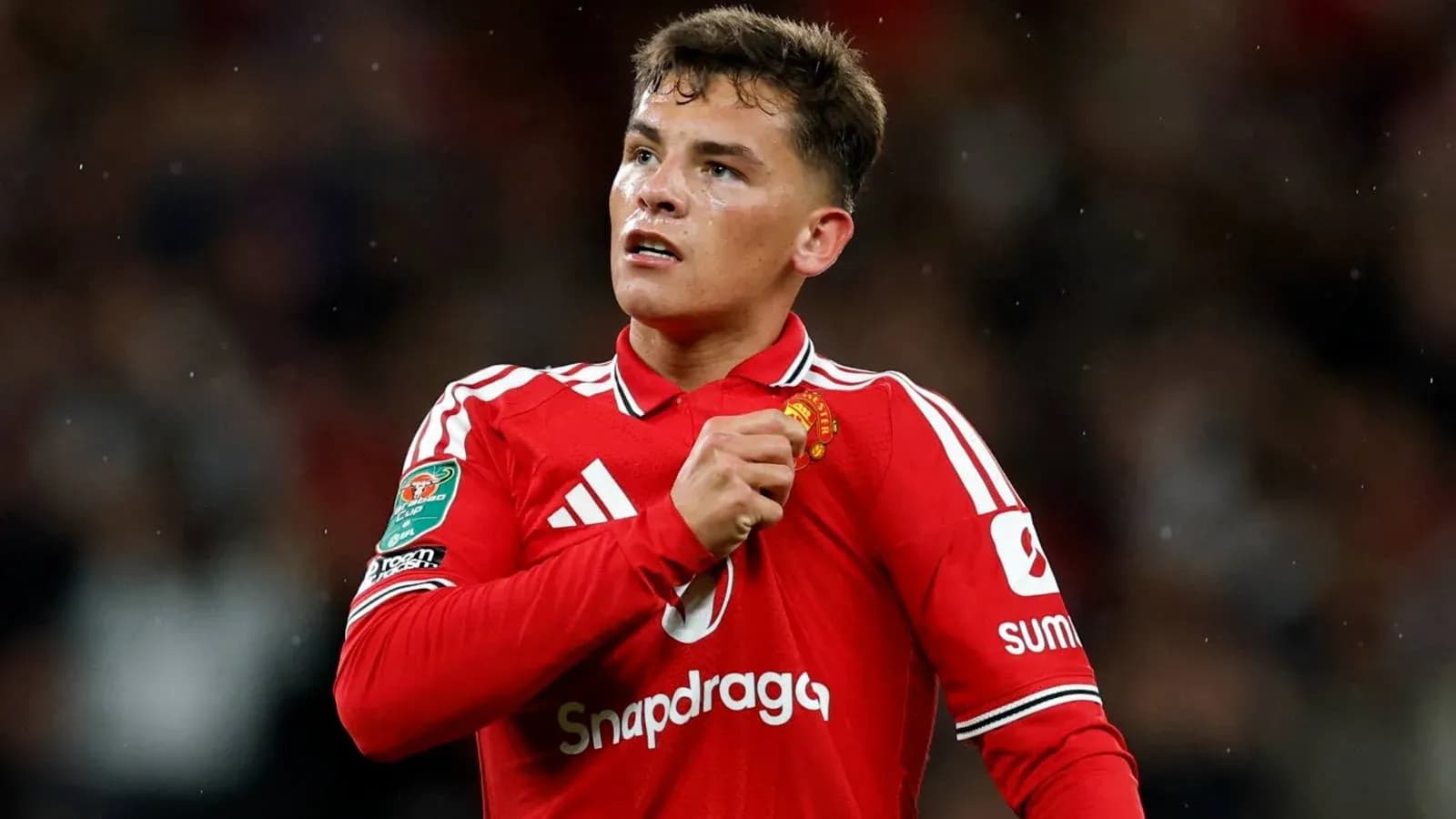
For Shea Lacey, the message lands with particular force.
Pochettino has a long-standing reputation for trusting and improving young English talent — Luke Shaw and Dele Alli are obvious examples — so it would have been easy for the 19-year-old to imagine a fast-track into regular first-team football under the new manager.
This week’s noise suggests otherwise. The source might simply have omitted him, but the clear backing for Rashford and Amad Diallo on the flanks underlines the scale of Lacey’s task.
Tactically, the challenge is straightforward and ruthless. Pochettino’s preferred shapes are 4-2-3-1 and 4-3-3, systems that usually deploy a right-sided forward or winger in Lacey’s natural zone. That role, though, is already heavily contested.
Amad favours that right-hand channel, drifting inside to combine, press, and attack the box. If the insider view is right and Pochettino sees him as a natural fit, then Lacey is starting from behind in the queue.
Amad’s numbers, however, are not untouchable. The Ivory Coast international has gone 11 months without a goal for United, his last coming against Bournemouth in December of last year. In that time he has produced just two assists — one on the final day against Brighton last season, and another in the 4-1 defeat to Como last month.
Then there is Bryan Mbeumo. The winger has featured regularly off the right, both last season and when Amad was sidelined through injury. If Pochettino looks at the squad and decides that Mbeumo and Amad are his primary options on that flank, Lacey’s path to minutes becomes even narrower.
A Fight Worth Having
None of that erases what Lacey has already shown. When he has come off the bench in recent weeks, the teenager has offered flashes of real quality — sharp touches, bravery in tight spaces, and a willingness to take responsibility in the final third.
He is unlikely to walk straight into Pochettino’s first XI. That much is clear. But his route into the team will be familiar to anyone who has watched the Argentine’s work before: win the manager’s trust on the training pitch at Carrington, absorb the physical demands, and force the issue.
For United as a whole, the equation is even starker. A club drifting dangerously close to the bottom of the table is about to hand control to a coach whose best work has come when he is allowed to build, press, and demand.
Pochettino will land in Manchester with Liverpool away looming, a fractured squad to sort, and a fanbase desperate for identity as much as results.
The question now is not whether he will change this team. It is how quickly he can drag it up to his level — and who survives that climb.





