
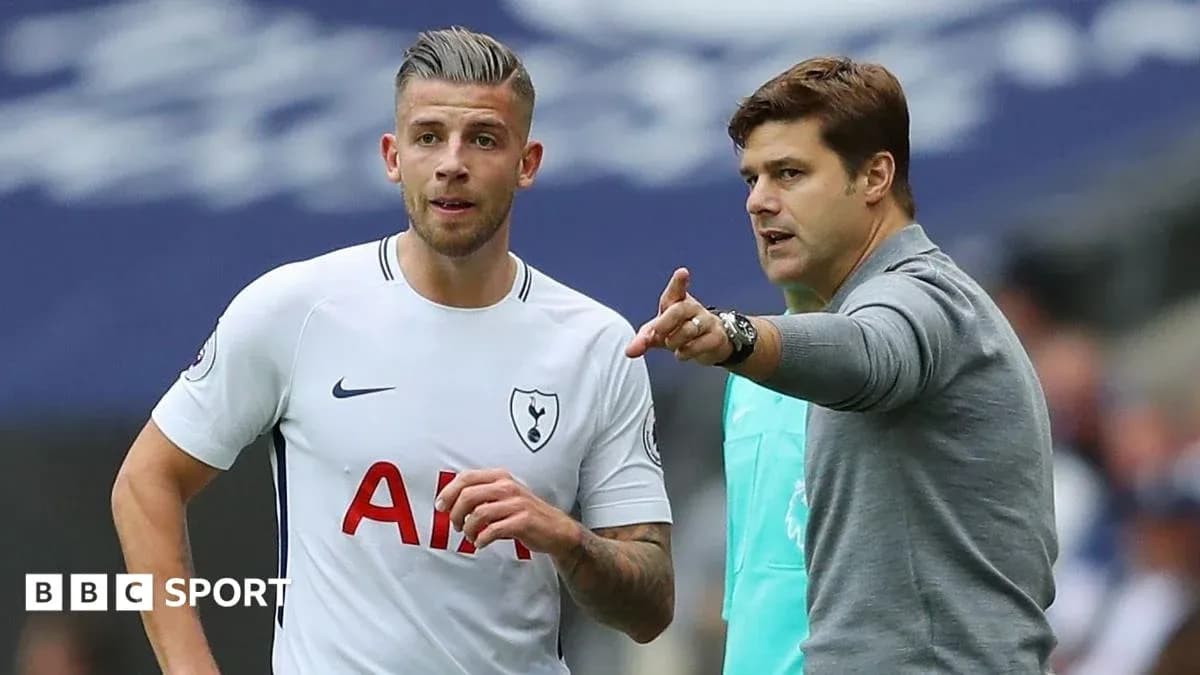
Mauricio Pochettino is coming to Old Trafford with a stopwatch in one hand and a scalpel in the other.
Manchester United confirmed on Friday that the Argentine will take over on 18 November, replacing Michael Carrick on a deal running until June 2029. The length of that contract tells its own story: this is not a caretaker, not a patch-up job. This is a reset.
And if Toby Alderweireld’s memories are any guide, United’s players are about to discover what a real reset feels like.
‘Brutal’ doesn’t begin to cover it
Alderweireld spent four years under Pochettino at Tottenham, a spell that dragged Spurs from nearly-men into Champions League finalists and Premier League title contenders. He is 37 now, but the first thing that comes back to him isn’t the tactics, the press conferences or the romance of that run to Madrid.
It’s the running.
“Pre-season was brutal,” he recalls. Not tough. Not demanding. Brutal.
Pochettino’s football lives off the front foot: high line, suffocating press, relentless intensity. That doesn’t happen by accident. It’s built, day after day, on training pitches where 100% isn’t a cliché, it’s the minimum entry fee.
United, this season, have looked a long way from that standard. They sit in the bottom five in the league for distance covered and high-intensity runs. The numbers have backed up what supporters’ eyes have been telling them: this is a team that doesn’t run enough, often enough.
That is about to collide with a manager whose number one demand is exactly that.
“You need to run,” Alderweireld says. “You need to be capable of running and be capable of high intensity runs – the basic is to be fit.” Under Pochettino, that isn’t a slogan pinned to a dressing-room wall. It’s a daily non-negotiable.
‘Team, team, team’ – or you’re out
Fitness is only part of it. The other pillar is control.
Pochettino is approachable, Alderweireld insists, but only within clear lines. You can talk to him about your life, your situation, your problems. You will be heard. Then you will be reminded of the order of things.
Team first. Always.
“You need to think about team, team, team. If you're thinking about yourself, you're gone,” Alderweireld says. There is no grey area there, no soft landing for big reputations. Follow the plan or step aside.
“If you don't follow his plan, you go on the side and you're not coming back any more,” he adds. For a United dressing room that has too often looked like a collection of individuals, that message could cut deep.
Pochettino doesn’t pretend every player will love his ideas. “Maybe you agree with them or don't, that's up to you,” as Alderweireld puts it. The choice is simple: buy in, or move on. “He's the main man.”
This is precisely what United have been accused of lacking – a hard edge at the top, a big character who sets a clear direction and refuses to bend with the wind of dressing-room politics. Under Pochettino, there is no committee. There is a manager, a plan, and consequences.
The control freak who sees everything
At Spurs, the coaching staff had their roles, but make no mistake: the manager was everywhere.
“He knows everything,” Alderweireld says. If Pochettino wasn’t on the grass, he was buried in video and data. Training habits, physical numbers, behaviour on and off the pitch – nothing slipped past him. “The players will be watched.”
This is not surveillance for its own sake. It’s part of a philosophy that treats the body as a weapon that must be sharpened every single day. In Alderweireld’s words, Pochettino is “in a positive way, a control freak”, obsessed with ensuring that weapon is ready to perform.
United’s players, used to a different tempo and different demands, will feel that shift instantly. “The players are going to feel straight away that it's a different level,” Alderweireld says. “This is every day at the training ground, it's 100% – that's what he asks, what he demands.”
The reward, he insists, comes just as quickly. “They're going to see results there straight away.” The question is whether they are prepared to endure the pain before the payoff.
‘Us against the world’
Pochettino’s authority doesn’t stop at the training pitch. He understands the theatre around a club of United’s size, and he knows how to use it.
“He's a very smart man, knows how to talk to the press and what to say,” Alderweireld says. That public calm feeds a private siege mentality. He builds an environment that feels closed, tight, fiercely bonded.
“He will create an environment like 'it's us against the world' – we are getting fit, we are together as a team. It doesn't matter what people say, let's work together and get results together.”
For a club that has often felt exposed and fragmented, every bad result sparking another storm, that kind of internal shield could be priceless. But it only works if everyone inside the circle is pulling the same way.
Amsterdam, 3-0 down, and a manager who said one thing
If you want to understand Pochettino’s core belief, go back to one night: the Champions League semi-final in Amsterdam.
Spurs trailed Ajax 3-0 on aggregate at half-time. They were being outplayed, outpassed, outclassed. That is the moment for a grand tactical lecture, a whiteboard full of arrows, a total reset.
Pochettino didn’t do that.
“He didn't have a tactical half-time talk,” Alderweireld remembers. The message was brutally simple: “You're going to be physical, you're going to fight, you only need one goal to be back in the game, believe that everything is possible.”
No magic system. No reinvention. Just intensity, duels, and a question: how badly do you want it?
Spurs turned the tie on its head, Lucas Moura completing the comeback in stoppage time. Alderweireld still goes back to the turning point. “We were nowhere near Ajax at that time, especially in that game. But we changed everything by intensity, by duels. I remember the long ball to [Fernando] Llorente and just fighting and asking 'how badly do you want it?' It changed from that moment.”
That is Pochettino in one scene: tactics matter, but mentality and physicality are the fuse. Light that, and anything feels possible.
Now he walks into Old Trafford, a club weighed down by history, expectation and a recent habit of falling short in the biggest moments. The players have been warned: the running starts, the excuses stop, and the team comes before everything.
How many of them are ready to live with that?





