
Among managers with real mileage in the Premier League – more than 290 games – only the five giants of the modern era sit above Mauricio Pochettino on points per match: Alex Ferguson, Arsène Wenger, José Mourinho, Jürgen Klopp and Pep Guardiola. That is the company he keeps. Whatever else is said about him, he belongs in the elite.
His rise in England was built the hard way. Pochettino walked into Southampton midway through 2012-13, the club’s first season back in the top flight after seven years in the wilderness. They were still feeling their way. He turned them into an eighth‑placed side in his only full campaign, a team that punched well above its financial weight and played with a clear identity.
Tottenham were the next beneficiaries. Under him, Spurs finished second in 2016-17 and third in the seasons on either side, a sustained spell of relevance they have not matched since. He dragged them to the 2019 Champions League final, a landmark night that still frames his reputation. Wherever he went in that period, the trajectory bent upwards.
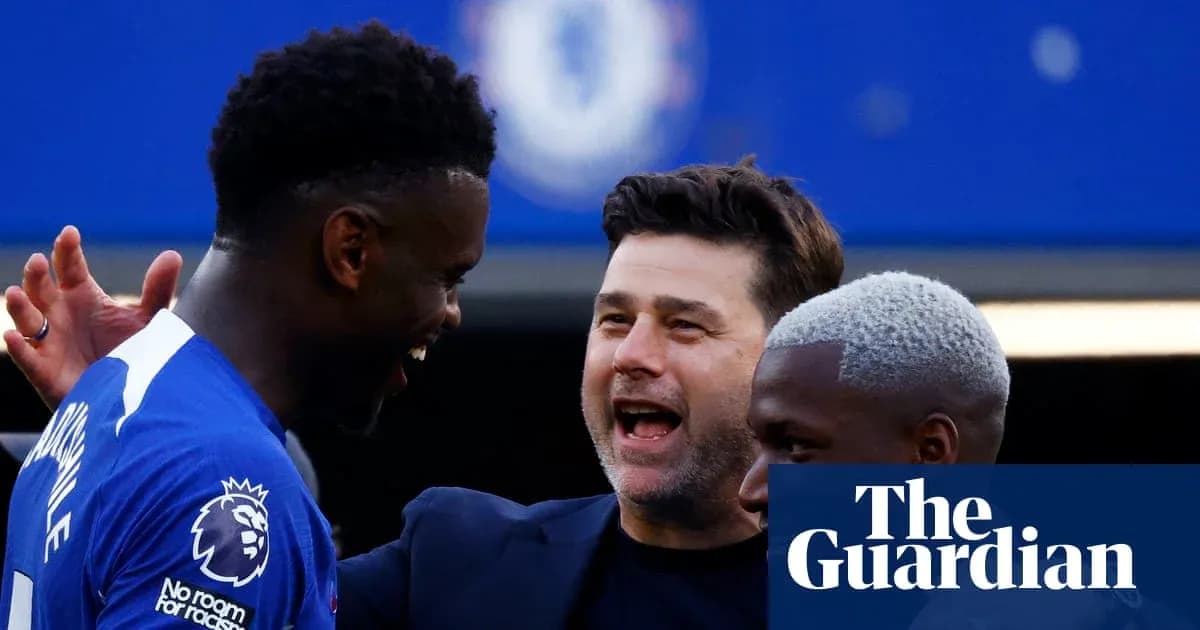
Then came the pause. Across the past six Premier League seasons, Pochettino has appeared in only one. A trophy-laden but strangely hollow 18 months at Paris Saint‑Germain – Ligue 1 and the Coupe de France secured almost by default – did little to illuminate what he might bring to a struggling superclub. The more telling case study for any Manchester United decision‑maker is Chelsea 2023-24, a year that left as many doubts as it did data points.
Chelsea had finished 12th the previous season, the chaotic first year of the Todd Boehly/Clearlake Capital project. Pochettino was always likely to lift them off the floor. He did. But how much of that rise was his, and how much was the inevitable correction of a club too big, too expensive, to languish in mid-table for long?
The numbers cut both ways. Opta’s projection had Chelsea pegged for sixth in 2023-24; they finished exactly there. On that measure, Pochettino did what the models expected. Yet by October 2023, Transfermarkt rated his squad as the third most valuable in the league. With that level of talent, “par” can feel like underachievement.
The context was wild. Chelsea’s squad value had been inflated by an extraordinary burst of spending. Across the three transfer windows from summer 2022 to summer 2023, no club in Europe’s big five leagues spent more. Pochettino walked into a dressing room assembled at breakneck speed, a collage of expensive prospects and half-built ideas. Working under Boehly was an immersion course in modern ownership volatility, a useful primer for the political noise at Old Trafford, even if the chequebook in Manchester is unlikely to open quite as freely.
Forging a coherent side from that churn is no simple task. Pochettino managed to shape a team that, beneath the chaos, posted the fifth‑best expected points total in the division. Chelsea’s 63.4 xPoints sat some distance behind Arsenal (81.2), Manchester City (79.3) and Liverpool (76.2), but for a first season in a rebuild, it was respectable. The skeleton of a top‑six side was there in the metrics.
The flesh on that skeleton was far messier. Chelsea conceded 63 league goals, their worst defensive record of the Premier League era. At the other end they scored 77, a figure only twice bettered in the club’s history at this level. They slightly outperformed their expected goals both for and against, but not by enough to dismiss the basic truth: this was a team living at the extremes.
Even the xG story had caveats. Chelsea were awarded 12 penalties, the joint-second-highest tally by any club across the last 10 Premier League seasons. Since Pochettino’s departure they have had 14 penalties in 86 league games, underlining how unusual that single-season haul was. Defensively, they gave away five penalties and racked up 22 Opta-defined defensive errors leading to shots – the joint-most in the league. Risk and reward sat side by side, often in the same phase of play.
The volatility was laid bare in April 2024. Across three matches they drew 2-2 with bottom‑placed Sheffield United, obliterated Everton 6-0 and were then dismantled 5-0 at Arsenal. Earlier in the campaign they had produced a similarly dizzying run: a 4-1 defeat at Tottenham, a 4-4 thriller with Manchester City, then a 4-1 loss at Newcastle. By the end of the season, Chelsea had set a Premier League record for games in which one team both scored and conceded at least two goals in a 38‑match campaign: 12. How do you pin a manager’s grade to something that erratic?
The emotional low point came at Wembley. After losing the 2024 Carabao Cup final to Liverpool, Gary Neville branded Chelsea “billion-pound bottle jobs” on live television. The nuance – that Chelsea had created enough chances to win the game – vanished in the noise. Pochettino carried the blame. Less than three months later, he was out.
All this has unfolded while the Premier League itself has shifted. Arne Slot arrived, won a title, and moved on. Guardiola’s exit has stripped the league of its dominant tactical reference point. Coaches have leaned more aggressively into man‑to‑man schemes across the pitch, and set pieces have started to decide an uncomfortable number of games. The margins, already thin, have narrowed further.
Into that landscape steps Pochettino’s probable new side. Opta’s data suggests they move the ball upfield more quickly than his Chelsea, but press with less intensity. Any reunion between coach and league will demand adjustment from both. The question is not whether he is capable of change – his record suggests he is – but how quickly he can bend his methods to a new reality.
That doubt is sharpened by whispers from his Chelsea tenure. One well‑placed source described his training sessions as “antiquated”, a loaded word in an era obsessed with marginal gains and micro‑cycles. If that perception lingers, he will need to confront it head‑on at his next elite job.
What remains beyond debate is his body of work. Pochettino’s Premier League record commands deep respect, his teams almost always punching close to, or above, their weight. The puzzle for Manchester United in 2026-27 is not whether he has been a top manager. It is whether the version they would be hiring is still ahead of the curve – or chasing it.





