
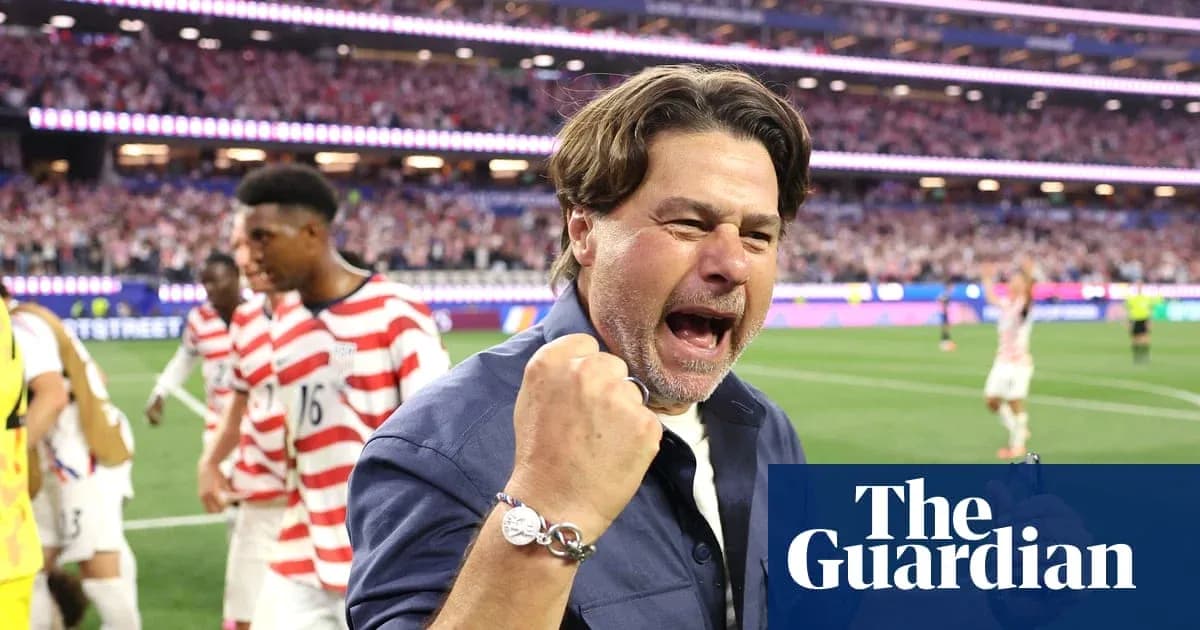
Mauricio Pochettino walked into New York like a man ready to rewrite a country’s footballing story.
High above the Hudson River, on the 24th floor, freshly installed as head coach of the US men’s national team after the wreckage of a disastrous 2024 Copa América, he didn’t bother with modesty. With a home World Cup looming in 2026, he went straight for the nerve.
“We need to believe that we can win,” he said that September day. “That we can win not only a game: We can win the World Cup.”
It was the kind of line that lands with a thud and a thrill in American men’s soccer. A declaration fans are desperate to hear, and just as quick to dismiss with a weary roll of the eyes. For decades, the USMNT has lived with an inferiority complex – battered by results, mocked by global perception, overshadowed at home by a women’s program that actually knows how to lift the trophy he was invoking.
Even now, with US players scattered across Europe’s elite clubs, the idea of the men winning a World Cup still feels, to most, like fantasy dressed up as ambition.
Pochettino didn’t care. Or at least, he said he didn’t. He kept hammering the same line in public and in private: the US could make a miraculous run in 2026 and win the whole thing. He sold that dream to anyone who would listen, from fans to federation officials – even to Donald Trump, a conversation that may yet go down as a political assist turned sporting own goal.
Belief, he knew, is a powerful drug. It can drag in the casuals, the Apple TV viewers who only know an American coach from a streaming series and a punchline. For a moment, he made the USMNT feel like a story again.
But belief, on its own, has a short shelf life. And Pochettino’s actions rarely matched the sermon.
One eye on Manchester
From almost the moment he took the job, the rumor mill never stopped. England. The Premier League. A return to club football. His name floated constantly around vacancies, and he never exactly rushed to shut anything down.
In truth, this comes with the territory. Hire a coach of his stature and you accept the noise. It’s like dating a supermodel and being shocked people keep staring. Still, too often it felt as if Pochettino wasn’t just tolerating the speculation – he was feeding it.
American fans would wake up to another clip from Europe: Pochettino praising the Premier League, talking about how much he loved it, openly musing about going back one day. All while being paid to galvanize a nation before the biggest tournament it had hosted in three decades.
None of this was unforgivable. Football is ruthless, jobs are fragile, and smart people keep doors open. But for a fanbase conditioned to feel like a stepping stone, it stung. The USMNT needed a standard-bearer. Too often, it got a man who seemed to be glancing at the departure board.
Frustrated by the job he signed up for
The disconnect ran deeper than transfer gossip. Pochettino also bristled at the very realities he had been hired, in part, to confront.
After losing the 2025 Gold Cup final to Mexico in Houston, he took aim at the crowd. A US team, on US soil, drowned out by Mexican support. It’s an old story in American soccer, one that predates him by generations. Anyone who had spent an afternoon reading about the sport in this country could have told him that.
He pushed on structural issues too. He questioned the lack of real stakes in Major League Soccer. He argued that US players are coddled in their youth development. On the football side, many of those criticisms had teeth. But he also bristled when the scrutiny turned toward him.
When the US lost to Turkey in the World Cup group stage this summer, media dared to ask about the implications. Pochettino pushed back, as if the questions themselves were out of bounds. The irony: in the US job, he faced a fraction of the pressure he would endure in almost any major footballing nation. This was the soft landing, and still it seemed to grate.
The cumulative effect was hard to ignore. The coach who demanded belief often looked like he didn’t fully believe in the project around him.
Highs, lows, and whiplash
And yet, just when the doubts hardened, he’d pull the country back in.
The 4-1 demolition of Paraguay at the World Cup changed the temperature instantly. It was the USMNT’s finest World Cup performance by any measure: bold, confident, ruthless. For once, the talk of belief felt grounded in something real.
On the touchline and in the aftermath, Pochettino looked all-in. He sang “Country Roads” with the fans, voice cracking, eyes glistening. He spoke warmly about America, about the game here, about what it could become. For a night, it felt like a shared mission rather than a temporary contract.
Then came Belgium.
The last-16 tie turned into a 4-1 humiliation, one of the worst World Cup displays in US history, and certainly the most scarring of the modern era. All the optimism from Paraguay evaporated in 90 brutal minutes. The team froze, the plan disintegrated, and the gulf in class looked as wide as ever.
That was the Pochettino era in miniature: soaring hope, then a brutal crash. A rush of dopamine, followed by a thudding reminder of the gap still to be closed.
A legacy written in half-ink
Ask players or coaches about their legacy and you usually get a grimace. The word sounds like a retirement speech, a career in the rearview mirror. Legacies are messy, fragile things. They take years to form and can be erased in a season.
Pochettino is different. He has always seemed comfortable thinking in big, sweeping terms about his work. Even so, when the Guardian asked him on Friday to define his lasting impact on the US program, he stalled.
“I am not arrogant,” he said, with a smile and a laugh. “Well, not arrogant enough. I am a little bit arrogant.”
Eventually, he found his footing. His answer didn’t focus on tactics, or trophies, or a bold new identity. It came back to people.
“The most valuable feeling that we get isn’t one victory, or that we helped in the program,” he said. “It is that relationship in the program – even when you cross the sea, you look and smile because I think you share the values that are very important in life, more important than anything else. That is our principal that we respect always.”
Relationships. Values. Doing things “the right way,” as he sees it. For a coach who talked so loudly about winning the World Cup, his chosen legacy sounds almost deliberately modest.
He arrived with a broad, ambitious remit: deliver a credible performance at a home World Cup, shift how the wider public sees the sport, and lay foundations for long-term growth. On some fronts, he moved the needle. On others, he left a hollow echo.
The USMNT under Pochettino flirted with the idea of greatness without ever fully inhabiting it. He asked a nation to believe. The lingering question is whether he ever truly did.





