
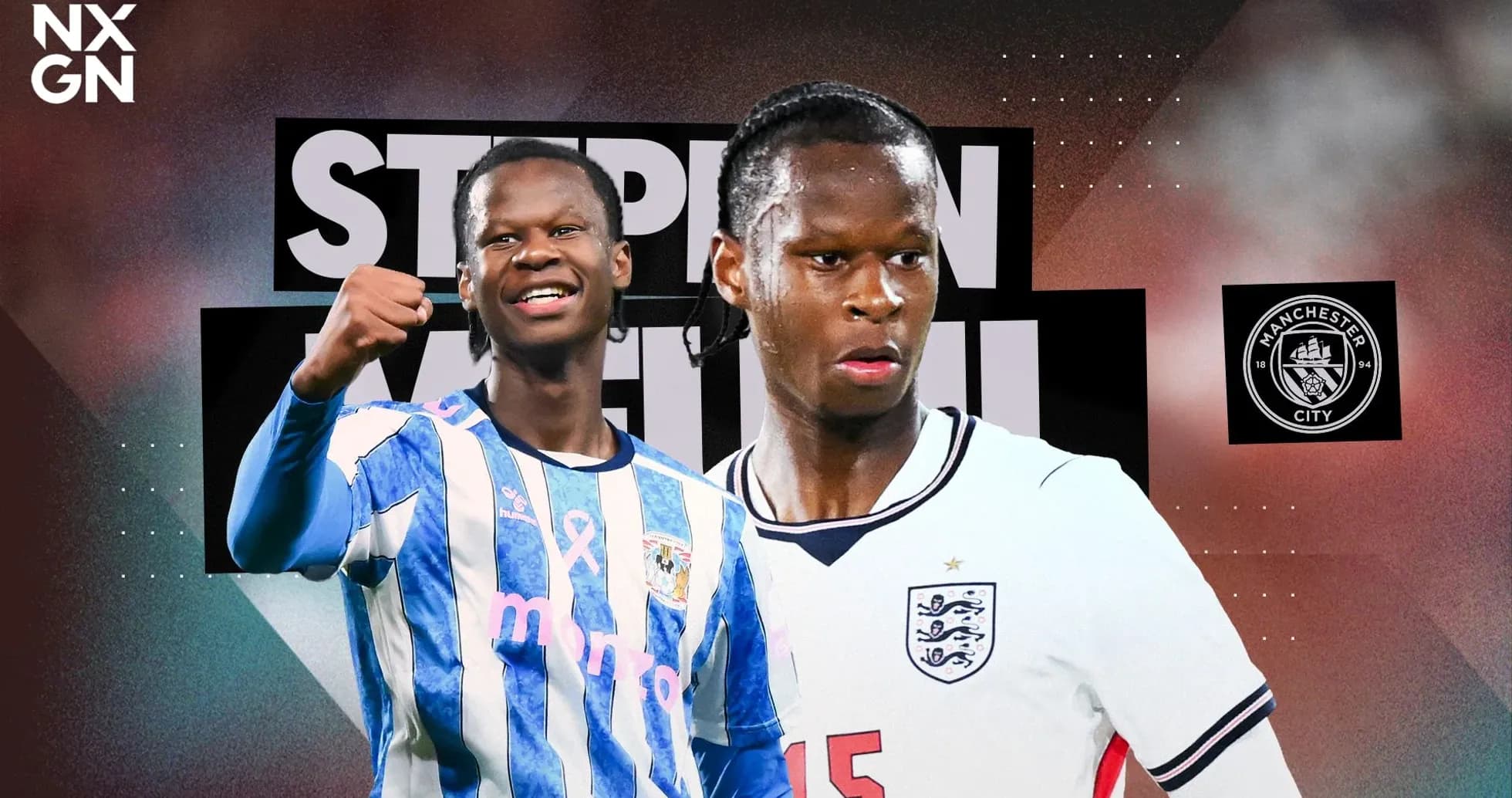
At nine years old, he almost chose Liverpool. Instead, Mfuni walked through the doors at Manchester City and never looked back.
He tore through the age groups, a teenager playing men’s football in everything but name. By 16 he was starring for City’s Under-21s, so assured above his age that Pep Guardiola did what he rarely does with defenders that young – he pulled him into the inner circle.
The reward came on City’s pre-season tour of the United States after their 2023-24 Premier League title. Guardiola put him on the plane, put him on the pitch and, more importantly, put ideas in his head.
"I've been dreaming of being coached by Pep," Mfuni said of that summer. The experience hit him hard. Advice on positioning, on when to step in, on when to drive out with the ball. Training sessions with Erling Haaland. A friendly cameo against Chelsea. For most academy prospects, that would sit in the scrapbook. For him, it felt like a starting gun.
The medals soon followed. FA Youth Cup winner with City in 2024. U21 Premier League champion the next year. While others his age were still bouncing between youth fixtures, he was suddenly on Champions League and Premier League benches, his name printed on teamsheets that used to live on his bedroom wall.
The actual debut arrived in surreal fashion. A 10-1 FA Cup demolition of Exeter earlier this year, Nathan Ake off at half-time, Mfuni on. Low pressure on the scoreboard, high pressure on the moment. He handled it.
Then came the first real bump.
City sent him on loan to Watford weeks after that cup appearance, a straight swap in squad planning terms for Max Alleyne, who was recalled to cover an injury crisis back in Manchester. Alleyne’s glowing review of Vicarage Road helped sell the move.
"[Max] told me about the positive things here – how good and warm the place is and how welcoming the players and staff are," Mfuni said. "I found out about the way they develop players. I’m excited to be involved in it."
Watford’s hierarchy were just as clear. Assistant to the sporting director Valon Behrami spelled out why they moved: an intelligent defender, quick across the ground, comfortable stepping out with the ball, capable of playing centre-back and left-back, and sharp at defending space in behind.
On the pitch, he settled quickly. Straight into the starting XI, straight into the rhythm of the Championship. Then, just as the season threatened to open up for him, it snapped shut. Late in a 3-1 defeat at Stoke in March, an ankle injury forced him off. Loan over. Season over. Back to City, robbed of the run of games that usually defines a first senior breakthrough.
Another door, though, swung open.
This season, Coventry – newly promoted and fighting to belong in the Premier League – have become the next stage of his education. A calf injury to Aurele Amenda and Frank Lampard’s decision to move from a back three to a back four created a gap in the back line. Mfuni stepped into it.
He did not tiptoe in, either. Against Newcastle, he came off the bench and changed the mood of the game, surging forward with the kind of run that would have pleased Guardiola, finishing it off himself in a 4-1 win. A defender by trade, but with a midfielder’s poise and a forward’s conviction when the space opened up.
Lampard rewarded him with a start in the 3-1 victory over Sunderland. It was a different kind of performance – less spectacular, more solid – but just as valuable. Several clearances, important blocks, the sort of night managers remember when they’re picking teams under pressure.
Lampard’s verdict carried weight.
“Well, there are some players I think that are of a certain level and there are some players that are of another level, in my opinion," he said. "He's a young lad and I don't want to give him too much credit because it will maybe go to his head.
"But he's a lovely, confident lad… off the pitch around the training ground [he’s] settled in brilliantly. He's also humble with it, so he's got a really nice way about him, but that's not even talking about his talent.
"Delighted with him, he's going to go a long way in the game."
That rise has not been confined to club football. At 18, he has already climbed to the top of England’s youth ladder. In his first call-up to the Under-21s, he started at left-back in a 4-2 win over Kazakhstan, then shifted into central defence for a defeat to Ireland a few weeks later. Two games, two positions, one clear message: coaches trust his adaptability.
On the ball, he looks like a Guardiola defender. Head up, scanning, waiting for the forward pass rather than the safe one. When he sees a gap, he does not just step into it – he bursts through it. That change in mindset came directly from his time under the City manager.
“He opened my mind, he sees things I didn't see before," Mfuni told the Manchester Evening News after scoring in the FA Youth Cup last year. "Even driving forward, I wasn't doing it much last season. But now I'm doing it and getting goals.
"[I'm always thinking about] the amount of goals you score to win the game, I'm trying to push the team forward from the back to win the game and win another Youth Cup."
His goal against Newcastle was that philosophy in real time: a centre-back turning into an extra attacker, trusting his speed and technique to carry him into the box.
Physically, he has the frame to match the modern demands of the position. Strong in the air, tall enough to command his area, yet with a surprising turn of pace that lets him recover when the line pushes high.
He is not the finished article. Thrown into a Premier League relegation fight, he has had to absorb the mental strain and physical intensity of top-flight football almost on fast-forward. At times he goes to ground too quickly in one-v-one situations, inviting contact and the risk of a foul, or allowing nimble attackers to skip past him.
He knows it. His early exposure to Guardiola’s standards drilled into him the need to be “more aggressive” defensively, to “get that one inch in front of the attackers and use your body shape”, as he put it. Stay on your feet, win the duel, then play.
Watch him and you can see the influences. The comparisons were inevitable. A tall, left-sided defender, brave on the ball, comfortable stepping into midfield – the echoes of City favourite Josko Gvardiol are obvious. Add his height and aerial presence, and the Van Dijk references quickly followed.
"I model myself on Josko, a bit of Van Dijk defensively, but mostly Josko. He can play left-back, centre-back. And a bit of John Stones because he's good on the ball as well," he said.
He is not yet as ferocious in the tackle as Gvardiol, nor as utterly dominant in the air as Van Dijk, but he has already absorbed key parts of their game: the versatility, the bravery in possession, the calmness under pressure.
Two years ago, he caught Guardiola’s eye at 16. Now, he has Lampard’s trust in the middle of a survival scrap. That is a serious trajectory for a defender barely out of school.
Coventry see him as a solution for the present. City still view him as part of their future. Between those two poles lies the season that will define how quickly he gets back to the Etihad.
For now, the task is simple and brutal: help keep Coventry in the Premier League. Do it every week, not just in flashes. If he finds that consistency and keeps climbing at this pace, the question will not be whether he plays for City – it will be how long they can keep hold of him.





