Miami Heat's New Superstar: The Challenge Ahead
The Miami Heat spent an entire summer staring at one name. Giannis Antetokounmpo. They didn’t flirt with the idea; they chased it down. And in a blockbuster deal with the Milwaukee Bucks, they landed the two-time MVP who instantly drags them from play-in purgatory into the championship conversation.
Last season’s 43-39 finish and a quick exit in the SoFi Play-In Tournament feels like a different era already. This is a different team. A different ceiling. And a very different level of expectation.
A New Kind of Monster in Miami
Antetokounmpo arrives with something to prove. He has the trophies, the All-NBA nods, the 2021 title. What he doesn’t have anymore is Milwaukee. Miami offers a fresh stage and a fresh question: can he still carry a franchise to the top?
He won’t have to do it alone.
Bam Adebayo remains the defensive heartbeat of the Heat, and together he and Antetokounmpo form a frontcourt that looks terrifying on paper. Two elite defenders who can switch, protect the rim, and initiate offense. Two bigs who can grab a rebound and go. There may not be a better defensive duo in the league, and if Erik Spoelstra finds the right offensive blend, this could be the most suffocating front line in basketball.
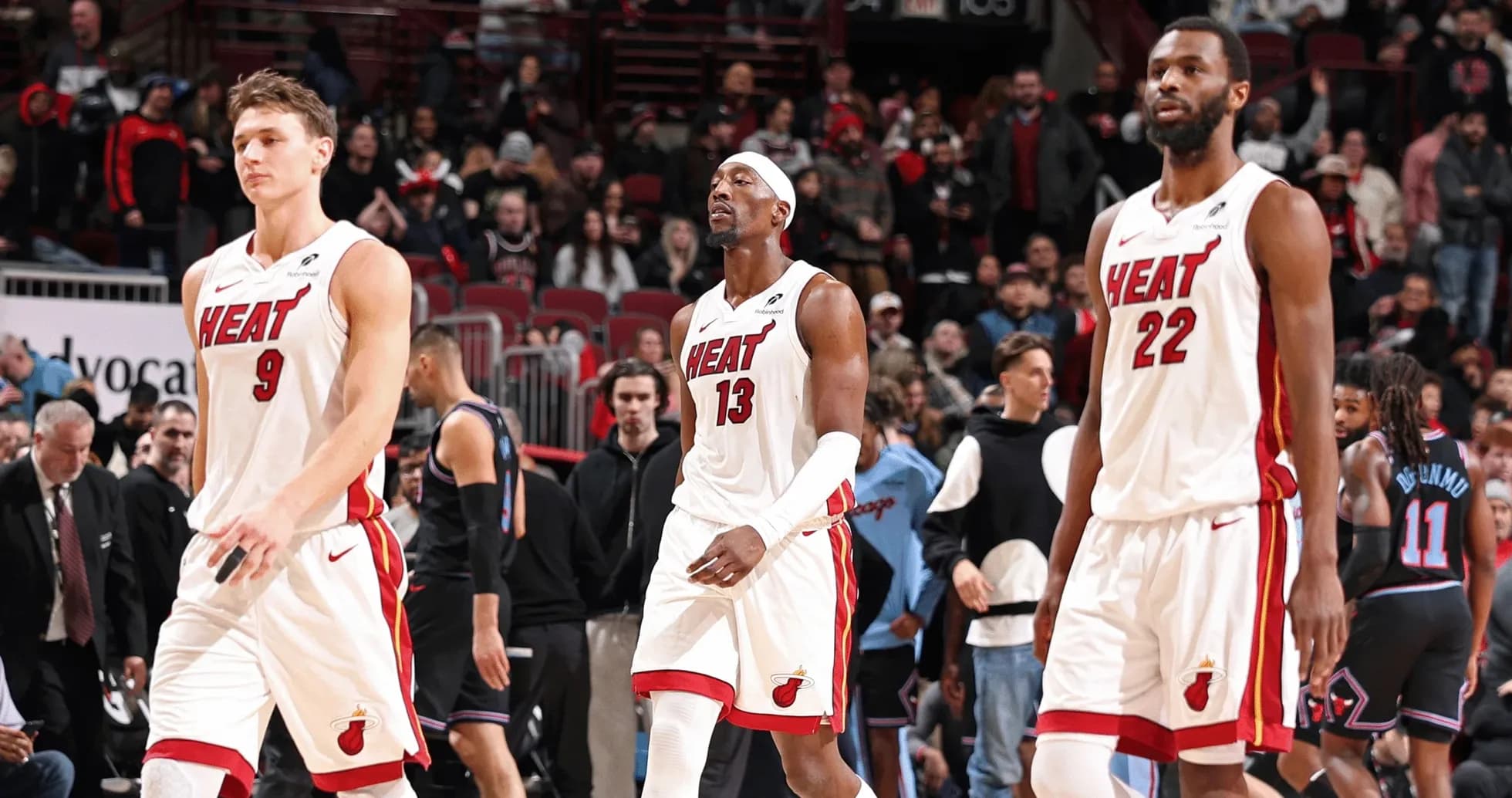
Around them, Miami has leaned hard into experience. Andrew Wiggins, Klay Thompson, Davion Mitchell, Tim Hardaway Jr., Bobby Portis, Nick Richards. This is not a developmental project. Antetokounmpo, Adebayo, Wiggins, Portis, Thompson and Hardaway have each logged at least nine NBA seasons. Between them, there are championships, Finals appearances, All-NBA honors, an MVP and a perennial Sixth Man of the Year threat.
This roster is built for May and June, not for patience.
The Shooting Question, Answered in Numbers
When the trade broke, one concern surfaced almost immediately: how would Miami space the floor around a non-shooting star frontcourt?
The numbers offer a sharp rebuttal.
Hardaway Jr. drilled 224 threes last season at 40.7%. Thompson, in what some framed as a down year, still knocked down 202 triples at 38.3% and now walks into a situation where Antetokounmpo and Adebayo will draw crowds at the rim. Wiggins quietly hit 138 threes while shooting 41.4%. Portis, one of the league’s deadliest stretch bigs, buried 135 threes at a blistering 45.6% and is one of just two players in the last five seasons to finish top five in three-point percentage at least twice.
Those aren’t just shooters. Those are volume, efficiency, and playoff-tested shot-makers.
Spoelstra now has the spacing to unclog the paint for his new superstar while still keeping multiple defenders on the floor. How he arranges those pieces—who starts, who closes, who sacrifices touches—becomes one of the most intriguing coaching puzzles of the season.
Pelle Larsson, the Wild Card
On a roster stacked with decorated veterans, Pelle Larsson is the name that doesn’t yet resonate nationally. That could change.
The third-year guard carved out a meaningful step forward last season, averaging double figures (11.4 points per game) for the first time and shooting 49.6% from the field. He had 26 games with 15 or more points, a sign that he can pop offensively when the opportunity appears.
The catch is the three-point line. Larsson sits at 32.8% from deep for his career, and on this team, that number matters. Miami needs him to punish defenses that tilt toward Antetokounmpo and Adebayo. If he can nudge that percentage upward, he gives Spoelstra another reliable perimeter threat on a veteran-heavy depth chart.
His recent form with Sweden in FIBA World Cup qualifying offers a glimpse of what might be coming. Over his last four qualifying games, he has averaged 26 points, including 31 against Finland and 23 against France in late August. It’s not the NBA, but it is high-level competition and a sign of growing confidence.
If that version of Larsson walks into training camp, Miami’s guard rotation becomes deeper—and far more dangerous—overnight.
Built to Run
The Heat already reinvented themselves once. Last season, 24.9% of their possessions came in transition, the highest rate for any team in the 22 seasons Synergy has tracked play types. They didn’t just dabble in the open floor; they lived there.
Now they’ve added one of the greatest transition players of his generation.
Over the last five years, Antetokounmpo has averaged 1.21 points per possession in transition. The rest of the league sits at 1.13. Give him a head of steam, and it’s over. Pair that with a team already wired to sprint, and Miami’s identity sharpens: defend, rebound, and run until the opponent breaks.
The half-court, though, remains the looming question. Neither Antetokounmpo nor Adebayo is a consistent perimeter shooter. Against playoff defenses that wall off the paint, Spoelstra will need to lean heavily on his shooting core—Thompson, Hardaway, Wiggins, Portis—and creative sets to avoid grinding possessions into mid-range mud.
Still, with that defensive backbone, Miami doesn’t need to win slow, choreographed games. They can turn stops into instant offense and let their new star do what he does best in the open floor.
Spoelstra’s Lab
This is the kind of roster that energizes a coach like Spoelstra. He gets to experiment.
Antetokounmpo’s integration is the first order of business in camp. Where does he operate most? How often does he handle the ball versus screening? How does he and Adebayo share the floor without cramping spacing?
The likely starting framework is clear: Antetokounmpo and Adebayo up front, Wiggins on the wing, Thompson on the perimeter, and Davion Mitchell steering the offense at point guard. From there, Spoelstra can stagger minutes to ensure shooting and playmaking remain balanced.
Behind them sits a bench that blends youth and experience. Nikola Jović, Simone Fontecchio and Nick Richards all push for frontcourt minutes. Jović brings size and skill, Fontecchio offers shooting, Richards adds rim protection and physicality. The back-up point guard spot is unsettled—whether Miami solves it by committee or dips into an open roster spot will shape the second unit’s personality.
The combinations are endless. Spoelstra has never shied away from reinvention. Now he has the talent to push that creativity to the edge.
Dates That Will Define the Season
Some nights carry more weight than others, even in an 82-game slog.
On Oct. 21, the Timberwolves visit Miami for the season opener and Antetokounmpo’s first official game in a Heat jersey. It’s the first real glimpse of the new order.
From Nov. 13 to Dec. 1, Miami runs through a brutal stretch—eight of nine games against 2026 playoff teams. Nestled in that run is a home clash with the defending champion Knicks on Nov. 27, and, almost cruelly, the one non-playoff opponent in that span is Milwaukee. Antetokounmpo’s first meeting with his former team will say plenty about how quickly he and his new teammates have meshed.
Christmas Day brings the Celtics to Miami. Boston made a run at Antetokounmpo and couldn’t find the deal. Now they’ll have to guard him in Heat colors on the league’s biggest regular-season stage.
On Jan. 28, the story returns to Milwaukee. Antetokounmpo walks back into the city where he spent 13 seasons and delivered a title in 2021. The game, broadcast on Prime Video, doubles as a celebration and a reckoning—what he built there, and what he’s trying to build now.
And on April 8, with the regular season winding down, LeBron James and the 76ers arrive in Miami. The Heat had interest in pairing James with Antetokounmpo this offseason. Instead, they’ll have to go through him.
A Contender With Edges to Sharpen
Miami did what so many franchises only dream of: identified the superstar they wanted and actually got him. Around Antetokounmpo, they’ve assembled shooting, length, and veteran savvy. They run more than anyone, defend at a high level, and now boast a transition force unmatched in the league.
The questions are real—half-court spacing, ball-handling depth, rotation battles—but they’re the kind of questions contenders ask, not teams scrambling for relevance.
The Heat wanted the pressure that comes with this kind of roster. Now they have it. The only thing left to find out is whether this version of Antetokounmpo, in this city, with this coach, can turn an ambitious blueprint into a banner.