
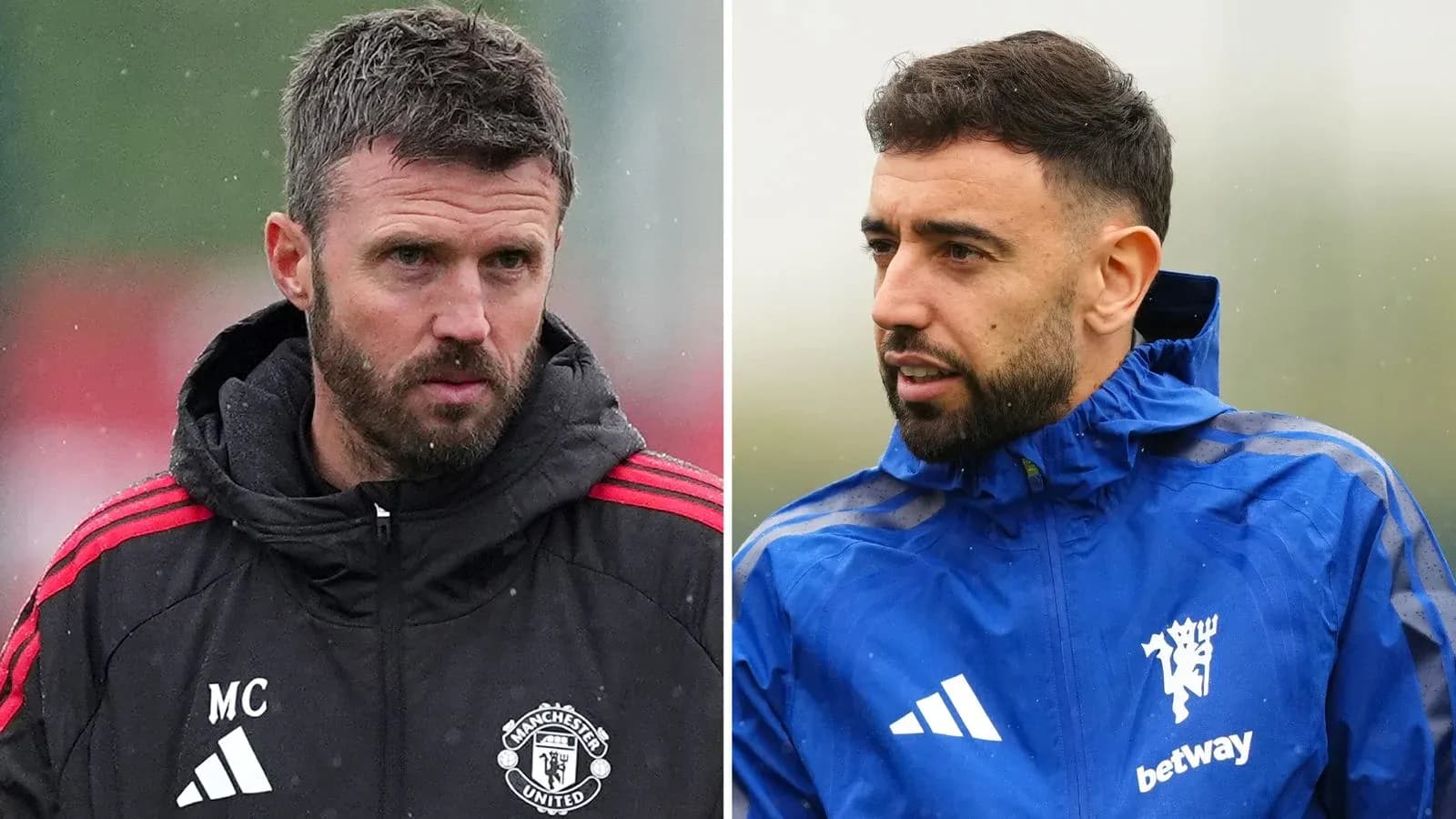
Michael Carrick sat down, took a breath, and went on the front foot.
Before a single question could be asked, the Manchester United head coach delivered a five-minute address that sounded less like a routine press conference and more like a man fighting for the soul of his dressing room – and possibly his job.
“We've lost our way,” he admitted, voice heavy with frustration and resolve. “Respect this football club.”
This is United’s worst run since 2015: seven games without a win, a slide that has dragged the club back into familiar turbulence. The damage has not been confined to the pitch. Captain Bruno Fernandes and defender Lisandro Martinez have both gone public with their frustrations in the last two weeks, fuelling talk of fractures behind the scenes and raising questions about Carrick’s authority.
Carrick, though, refused to accept the idea of a broken dressing room.
“It’s not divided,” he said firmly. “We just need to get back to doing what we do best. And we will.”
Under Fire, But Unflinching
The pressure on the 43-year-old has intensified sharply since Wednesday’s 4-1 Champions League humiliation at Como, a performance Carrick himself labelled “unacceptable”. Fernandes’ post-match criticism of the coaching staff’s tactics, widely condemned by former United players, only added to the sense of a club turning in on itself.
In another era, a captain publicly questioning the game plan might have triggered an instant showdown. Here, Carrick chose his words carefully, but his priorities were crystal clear.
Asked whether Fernandes could be stripped of the armband or dropped, he replied: “The most important thing for me is the team and the dynamics in the squad. It is about the football club.
“Whatever the situation is I will always do what is best for the football club.”
He would not reveal whether he had spoken directly to his captain, insisting those conversations would remain private. He did, though, confirm dialogue with the hierarchy, who are understood to be increasingly uneasy about the team’s form and trajectory.
“It is pretty obvious how we are all feeling,” Carrick said. “The responsibility for me to be in this position is to lead. It is my responsibility what goes on the pitch.
“I will hold that umbrella for me to get wet and everyone else to stay dry. That is the privileged position I am in.”
A Rallying Cry, Not a Rehearsal
Carrick’s opening statement was raw. This was not the clipped, guarded language of a man hiding behind clichés. It was an attempt to drag standards back into line.
“Recently we haven't had a good time, that's pretty obvious,” he began. “We haven't done well enough lately… Wednesday was a bad night, it was a bad night for a lot of reasons and it was a bad night that hurt a lot. It hurt me to see us play that way.”
He spoke directly to the supporters who had travelled in midweek to watch their team unravel in Europe.
“For me to see the supporters have to make the effort and the time and spend the money to come and support us on Wednesday and have the feeling after the game, like we all felt, was a tough moment.”
Then came the core of his argument: identity and values. Words that get thrown around easily at big clubs. Carrick anchored them in the specific demands of Manchester United.
“My responsibility is to get a team on a pitch that represents this football club, represents the supporters and they can be proud of it with the identity that we show. We have gone away from that just recently in certain games, which I'm totally fully aware of and definitely doing something about.”
He referenced the first five months of his tenure, a period he described as “relative success”, where the connection between team and fans felt restored – vigour, intensity, enjoyment, passion. All missing in recent weeks. All non-negotiable if he is to survive.
“We've kind of lost our way a little bit if I'm totally honest and we'll get it back. I'm totally confident we'll get it back.”
Leaning on the Club’s Giants
When Carrick talked about values, he wasn’t speaking in the abstract. He reached back into the club’s history and into his own dressing room memories to frame the standards he expects.
“The foundation of this football club and the values of this football club have been put down and etched for many years,” he said. “It comes down to humility, it comes down to being humble, it comes down to being hard-working and being really proud to work hard… There's a resilience about this football club that's been shown for a long time.”
He name-checked Ryan Giggs, “arguably one of the greatest to play for this football club,” and Wayne Rooney, United’s record goalscorer, pointing out that for both men, the team always came first. He spoke of Sir Alex Ferguson as “the best manager of all time,” a man whose “main priority was Manchester United,” and evoked the legacies of Sir Matt Busby and Sir Bobby Charlton, and the way they rebuilt the club on humility and graft.
“Manchester United is always bigger and always has been, always will be bigger than any single individual. Bigger than me, bigger than any of the players and it always has been.”
The message was aimed at everyone: players, staff, fans, and perhaps those above him in the boardroom. No one is bigger than the club. No one is entitled.
“Entitlement cannot be at this football club, we're not entitled to win,” he stressed. “We've won in the past, we've got an incredible history but that doesn't mean that you're entitled to just win.
“It takes hard work, it takes a lot of sacrifice. You've got to invest yourself in the football club and you've got to do a lot of things that maybe aren't so nice but you've got to do it for each other and you've got to win.”
A Manager on the Edge – and on the Attack
Strip away the emotion and this was a manager making a calculated stand. Carrick knows the numbers. Seven games without a win. Heavy defeat in Europe. Public dissent from his captain. Murmurs from above.
Yet he refused to retreat into self-preservation. He doubled down on his responsibility.
“We're in a moment where it's not gone well so we need to show exactly what it means,” he said. “Respect this football club, what it takes to be here, what it takes to win, what you have to do to win.”
The dressing room, he insists, is not split. The standards, he concedes, have slipped. His answer is not to hide, but to confront.
“I won't let us lose that,” he said of the club’s core values. “It inspires me a lot to live up to that and keep driving that with the players and the group that we've shown for a good period of time and that we're capable of it.”
A Brutal Run-In
If Carrick wanted time and space to reset, the fixture list offers neither.
United face Bournemouth at Old Trafford on Sunday, a game already laced with jeopardy given the mood around the club. Then comes a trip to Chelsea, Roma at home in the Champions League, Aston Villa at Old Trafford, and a visit to Liverpool at Anfield.
Bournemouth (H), Chelsea (A), Roma (H), Aston Villa (H), Liverpool (A). It is a sequence that can define a season – and decide a manager’s fate.
Carrick has chosen his line. He will “hold the umbrella,” he will take the rain, he will protect his players in public while demanding more from them in private.
Now comes the only verdict that matters at Manchester United: what happens when the whistle blows and the stadium lights come up.





