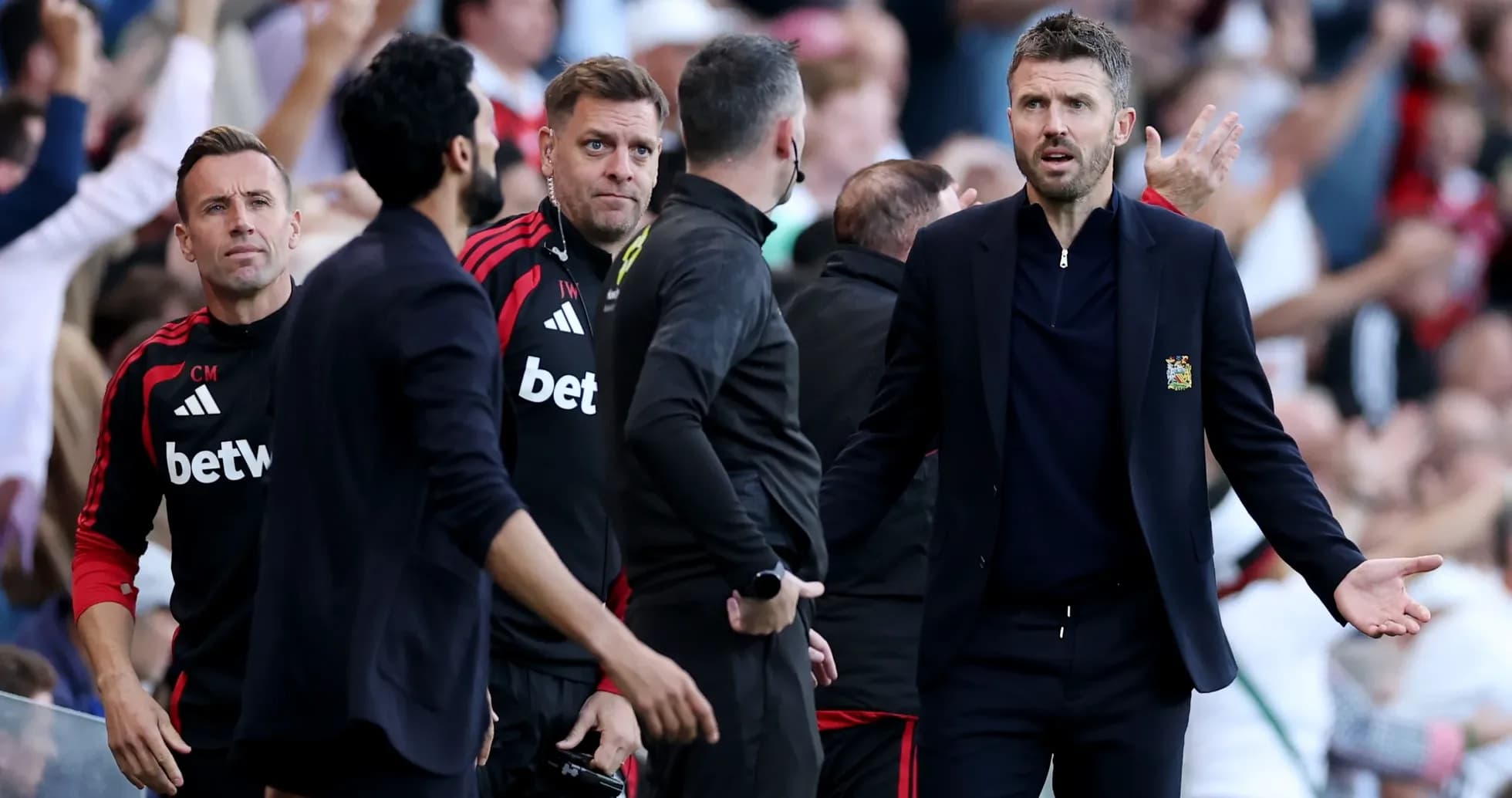
The boos told their own story. Kobbie Mainoo’s number went up in the 90th minute against Fulham and the reaction from Old Trafford was venomous. Thirty days into the new campaign, Manchester United have already dropped as many points as they did in the whole of last season. Michael Carrick’s romantic homecoming has turned into a cold, unforgiving reality check.
Two wins in seven is the headline. The detail is uglier. A series of decisions, selection gambles and tactical missteps have stripped United of their attacking identity and left a once-celebrated former midfielder staring at the exit, as reported by “The Sun”.
A Line-Up Torn Apart
Carrick has not just tweaked his team. He has torn at the fabric of what worked.
The decision to start Ayden Heaven at Hull City bordered on reckless. The 19-year-old had not begun a Premier League match since the opening day on 22 August. He was parachuted in purely because he is left-footed, with Lisandro Martinez unavailable, and asked to deal with the physical, snarling presence of Oli McBurnie. Mazraoui and Dalot watched on.
It was a selection that looked like a solution on a tactics board and a problem in real life.
On the left wing, Carrick had three options. He chose Patrick Dorgu, the least convincing of them, despite a full pre-season to assess his choices. Dorgu lasted 45 minutes. One half, then the hook.
That call triggered a chain reaction. Matheus Cunha, so effective last season cutting in from the left and scoring under Carrick, was shunted into the centre-forward role. His edge dulled. Bryan Mbeumo, who had been thriving and scoring as a central striker, was pushed out to the right. United’s front line, once coherent and dangerous, suddenly looked like a puzzle with the pieces forced into the wrong places.
The confusion did not stop there. Against Ipswich, Everton and Fulham, Carrick clung to the same starting XI: one win, one draw, one defeat. The defence behind them was a ghost from a nightmare. Dalot, Maguire, Martinez and Shaw – the very back four that collapsed 4-0 at Brentford in August 2022, arguably United’s lowest point in the Premier League era – were reunited. In four matches this season, that unit has already conceded five goals. Old scars, new wounds.
Big Moments, Wrong Calls
If the line-ups raised eyebrows, the in-game management has set alarm bells ringing.
United led Everton 1-0 when Marcus Rashford signalled he “felt something”. Carrick’s response was to send on Dorgu. The change rippled through the stadium and the opposition. It looked like a retreat. Everton sensed weakness, introduced Jack Grealish, and he duly dragged them level.
Then came the late chaos. Luke Shaw, who had just created Sesko’s 88th-minute goal, was withdrawn along with Dalot. On came Leny Yoro and Mazraoui. The reshuffle backfired almost instantly. Yoro narrowed the pitch and left Grealish the space he craved. Mazraoui then hesitated at the decisive moment, allowing Ainsley Maitland-Niles to strike the killer equaliser in the 95th minute.
The pattern repeated itself in the derby against City. Phil Foden’s red card in the 23rd minute handed Carrick a rare luxury: time. Twenty-two minutes to plan, to pounce on a numerical advantage. Sesko warmed up. The Stretford End roared for him. The change did not come.
By the time Sesko finally appeared, 19 minutes into the second half, Erling Haaland had already scored what proved to be the winner. The chance to tilt the game had gone.
Worse, the reshaping of the attack blunted United further. Cunha dropped deeper. Bruno Fernandes dropped even deeper into midfield. Carrick moved his most dangerous playmaker away from City’s goal while chasing the game. United created nothing of note until the 95th minute. For a side that once thrived on late drama, it felt like tactical surrender.
Old Trafford, Soft Underbelly
Brighton’s visits to Old Trafford used to be routine home wins. Not any more. They have now won there four seasons running in the league, and yet Carrick treated the cup tie as a sandbox for experimentation.
Eight changes. A 15-year-old on the bench. It felt like a roll of the dice at precisely the wrong time.
Yoro and Heaven were both selected in front of Karl Darlow, making his first appearance in goal. It was an invitation to chaos. The understanding was not there, the composure vanished under pressure, and the trio were at the heart of all three goals conceded. Brighton became the first team to come from 0-2 down and win at Old Trafford since Tottenham did it in 1976. Nearly half a century of history undone in one reckless night.
This is not just about bad luck or a missed chance. It is about judgement.
The Zirkzee Gamble
Up front, the story of Joshua Zirkzee sums up the muddled thinking.
He exploded into life with two goals in Amorim’s first win in December 2024. Since then, the well has almost dried up: just two league goals. Everton tested the waters in the summer and the club were prepared to listen. The message was clear – his future lay elsewhere.
Yet when United needed ideas, Carrick turned back to a striker whose form had deserted him. Zirkzee featured in three consecutive defeats without leaving a mark. No spark, no goals, no sense that this was a player on the cusp of revival.
At a moment that demanded imagination, Carrick reached for a familiar, failing option.
The boos for Mainoo were not just about one substitution. They were a verdict on a month of confusion, on a manager who has drifted away from what made his United side compelling in the first place.
How long can Old Trafford tolerate a project that already feels like it’s slipping out of control?