
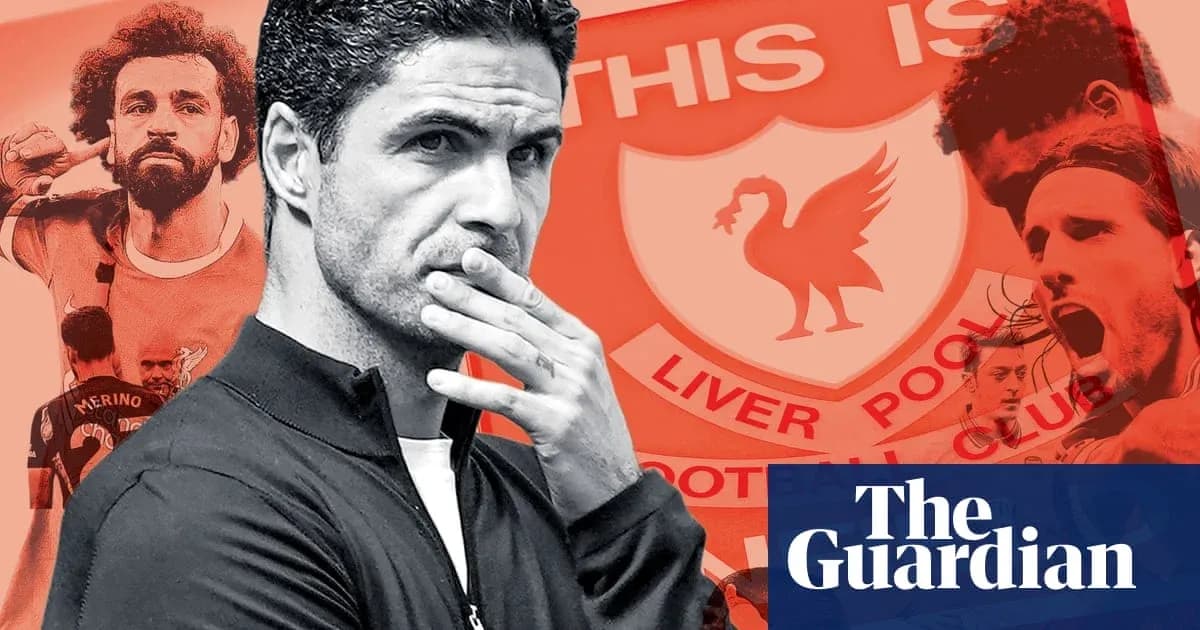
Mikel Arteta has a word for what Anfield can do to a footballer: bajar.
“It’s when a cyclist is going up and looks amazing, then in one kilometre he goes ‘boom’ and he’s struggling again,” he explained in Amazon’s All or Nothing. “The game was going well and then suddenly I could only see red shirts flying around. The game is passing all over me and I cannot react.”
He says he only felt that once in his career. At Anfield. Of course.
A Ground That Haunts – and Defines – Arteta
Given that history, and with Arsenal arriving on Sunday days after being dumped out of the Carabao Cup by Fleetwood, you might expect dread to creep in. Anfield has never really been kind to Arteta, whether in blue or red.
He finally got a win there as a player in September 2012 with Arsenal, having failed five times in the Merseyside derby with Everton. Even that victory came at a cost. A sickening clash with Jordan Henderson left him concussed and spending the night in hospital, an episode he has since called “the biggest fear of my life.”
Six months later he was back, part of the Arsenal side that won again with goals from new signings Lukas Podolski and Santi Cazorla. That was the last time Arsenal left Anfield with three Premier League points. Thirteen league visits without a win since then; it equals the club’s worst run there.
The only respite? A penalty shootout victory in the League Cup in 2020, on Arteta’s second visit as Arsenal manager. A footnote, not an exorcism.
He has tried to change the script. In November 2021 he blasted “You’ll Never Walk Alone” over the training ground speakers to prepare his players for the noise. Liverpool 4 Arsenal 0. The soundtrack stayed; the plan did not.
Last season’s defeat in late August, when Dominik Szoboszlai’s late free-kick ended a run of three draws at Anfield, brought another wave of criticism. Arteta started Mikel Merino as his No 10, kept the handbrake on, and was accused of lacking ambition. Gary Neville went further, claiming Arsenal lacked “the mentality to go and win big matches at big away grounds.”
That will have stung. Not least because there is evidence to back it up. Arsenal have not beaten Manchester City at the Etihad in the league since 2015 under Arsène Wenger. The big away scalp still eludes this project.
From Fleetwood Shock to Anfield Cauldron
All of that swirls around Arteta as he prepares for a reunion with his childhood friend Andoni Iraola, now trying to shape Liverpool in his own image. The context could hardly be more awkward.
Arsenal arrive bruised by a penalty shootout defeat at Fleetwood, a club 84 places below them in the pyramid, in a ground that holds fewer than 6,000 people. The Carabao Cup has been a demanding side quest for two seasons – a semi-final, then a final – and now, abruptly, it’s over. Their exit at Highbury Stadium will have dragged old scars to the surface after May’s Champions League final loss to Paris Saint-Germain, also on penalties.
Arteta’s selection there raised eyebrows. Kai Havertz and Viktor Gyökeres started together up front, a surprise pairing that looked more like a gamble to ease the burden on Martin Ødegaard than a carefully honed plan. Both strikers looked short of rhythm and confidence.
He has problems out wide too. Bukayo Saka is sidelined with a thigh injury. Noni Madueke’s ankle is a concern. The failed appeal against Max Dowman’s red card means the teenager now serves a three‑match ban. For a manager who likes control, this is the opposite.
So he returns to Anfield with a stretched squad, a bruised ego and a narrative he is desperate to rewrite.
Lessons from 1989
If there is a template for how Arsenal can win there, it lies in the club’s own mythology.
Thirty-seven years ago George Graham took his team to Anfield needing a 2-0 win to steal the title from Liverpool on the final night of the 1988‑89 season. The pressure was suffocating. The script said Arsenal had to go for broke.
Graham refused.
“I told my players to keep things tight in the first half – it was imperative we did not concede,” he recalled on the 20th anniversary of that night, when Michael Thomas scored in stoppage time to end Arsenal’s 18-year wait for the title. “The papers were saying we’d have to attack from the off, but I was adamant that was wrong. If Liverpool had scored an early goal it would have been over. But they did very little attacking and played into our hands.”
That performance was built on nerve, organisation and an almost stubborn belief in the plan. It was also framed by tragedy. Before kick-off, Arsenal’s players ran to all four corners of the ground to hand flowers to Liverpool fans, a gesture of solidarity after the Hillsborough disaster a month earlier. The idea came from Ken Friar, the long-serving director who died this month. His imprint is on one of the club’s defining nights.
Arteta, like Graham, won his first league title at 44. The parallels do not stop with the birth certificate.
Graham, a former midfielder who scored almost 80 goals for Arsenal and helped deliver the Double in 1971, built his managerial reputation on defensive rigour. “1-0 to the Arsenal” became a chant, then a label, then a doctrine. Arteta has dragged that line out of the songbook and back onto the scoreboard. Since taking over in December 2019, his Arsenal have won 1-0 in the Premier League 32 times – more than any club except Everton.
He is unapologetic about it.
“Collectively, we acknowledge the importance of defending,” he said last year when asked about comparisons with Graham. “We know that if we excel in that part of the game, the chances and the probabilities to win more matches is going to be very, very high.”
The numbers back him up. Arsenal’s title win last season rested on control, structure and the ability to suffocate games when required. That, more than any swashbuckling attacking flourish, is what gives them a genuine chance at Anfield.
Tight Lines, Set Plays and Thin Margins
So how do you beat Iraola’s Liverpool, a side still finding its rhythm but already dangerous in transition and ruthless when the Kop senses blood?
You don’t turn it into a shootout. You suffocate the chaos.
Arsenal’s 2-0 win over Everton last weekend offered a small but timely reminder of their strengths. They scored their first set-piece goal of the season and looked far more assured defending their own box. Against a Liverpool side that has looked vulnerable from dead balls, that matters.
Set plays, discipline, and a refusal to get drawn into an open game – it is not romantic, but it is realistic. Arteta knows that if Liverpool score early, the old Anfield feeling he calls bajar can sweep through a team in seconds. Legs go heavy. Passes rush. Red shirts fly.
The challenge is to stop the slope from ever appearing.
Arsenal flew back to London after the Fleetwood defeat with the mood flat and the schedule suddenly lighter. The Carabao Cup will not drain them this season. That is one small advantage, even if Arteta, as competitive as they come, will not see it that way.
He will see only Anfield, the noise, the memories, the word that has followed him since that day in 2011. On Sunday, against an old friend in Iraola and an old demon in this stadium, he has a chance to lean fully into his inner George Graham.
Tight lines. Cold heads. One big night.
Is this the moment Arsenal finally turn Anfield from a recurring nightmare into proof they really can win the biggest games in the hardest places?





