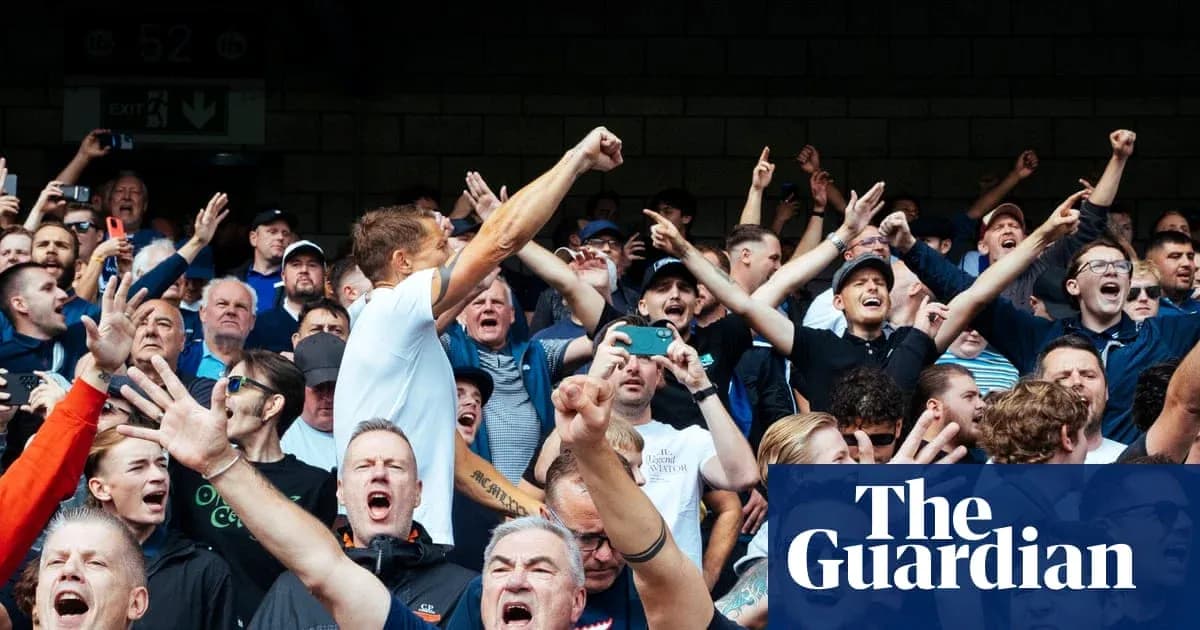
At The Den on Saturday, the noise hit first. A low growl, then a roar, as Millwall and West Ham walked out for their 100th competitive meeting and their first in 14 years. A century-old grudge, finally back on stage.
The Thames still separates them. It also binds them. These are clubs born a short walk and a hard shift apart, forged in the smoke and clang of east London’s docklands in the late 19th century. Back then, Millwall lived on the Isle of Dogs and Thames Ironworks, the works team that would give way to West Ham, stood around Canning Town. Two miles of riverfront, two sets of men chasing the same shifts, the same pay, the same pride.
Millwall were the Dockers in those days. West Ham became the Irons, a nod to the Thames Ironworks and Shipbuilding Company. Dock work was brutal and uncertain. Men queued each morning with no promise of a wage, hoping to be picked while others were turned away. That daily audition for survival hardened a culture: toughness, loyalty, graft. Those values still sit at the heart of how both clubs see themselves and sell themselves to the world.
The clubs drifted physically apart when Millwall moved south of the river to New Cross in 1910, but the stories followed. Some have blurred into folklore. One of the most persistent tales places the origins of the rivalry in the General Strike of 1926, with West Ham dockers supposedly backing the strike and Millwall men refusing to join. It is a neat story, too neat for the historians who have gone back through the records.
David Sullivan and Brian Belton have picked at that myth. Belton argues the strike held firm in the Millwall docks, while only a few men broke ranks around Canning Town. The evidence undermines the legend. It has not killed it. For nearly 100 years that story has been repeated, embroidered and passed on, until it has become part of the match’s mythology whether or not it bears much resemblance to what actually happened.
Their footballing paths first crossed in the 1890s, when Millwall Athletic met Thames Ironworks. Even here, the detail matters. Belton warns against treating Thames Ironworks as simply an early version of West Ham. The company team folded before West Ham were formed in 1900. The neat line from one to the other is appealing, but not entirely accurate. Sullivan and Belton are equally sceptical about the idea of an “ancient” Dockers Derby, arguing that the real heat came later.
That heat arrived in the 1970s. It did not care much for romance. Harry Cripps’s testimonial in 1972, a game meant to honour a player loved on both sides, descended into serious disorder. Four years later a Millwall supporter died after falling from a train; some believed West Ham fans were involved. When the clubs met competitively again in 1978 after a long break, violence flared around the fixture. The rivalry’s reputation hardened.
All this unfolded as the world that had created both clubs was collapsing. London’s docks were closing. Traditional industries were shedding tens of thousands of jobs. Whole communities were left facing unemployment and decline. It would be simplistic to draw a straight line from shuttered dockyards to football hooliganism, but they grew side by side. As the old workplaces and unions faded, football terraces became one of the last places where territory, masculinity, belonging and local pride could be loudly asserted.
Through the 1980s, 90s and into the early 2000s, the Millwall–West Ham rivalry became shorthand for football trouble. Flashpoints were rare but unforgettable. The most notorious came at Upton Park in 2009, a League Cup tie scarred by fighting outside the ground, a stabbing and pitch invasions that dominated the headlines. Their two Championship meetings in 2011-12 were far calmer, and then the fixture vanished again from the calendar until this season.
Cinema helped cement the image. Films such as ID and Green Street turned both clubs into global bywords for football violence, exporting a stylised version of east London tribalism. The Dockers Derby became bigger in the imagination than in reality. So when the fixture returned, there was the usual social media chest-beating, the usual warnings, but also a broad expectation that the day would pass with more noise than real trouble. That is largely how it played out.
Suspicion of journalists runs deep on both sides. Photographers are watched closely. People from both fanbases advised caution. A few insults flew during the day, sharp enough to remind you where you were, but they came from a minority. Far more striking was the sense of community – families walking together, old friends meeting on corners, supporters happy to talk about their clubs, their streets, their pasts.
This was a game the authorities treated with respect. ITV took it live. Kick-off was dragged forward to 12.30pm to cut down drinking time. Around 400 police officers were deployed. West Ham were given only 1,774 tickets in a crowd of about 20,000, and most of their fans chose not to wear colours. They were funnelled through London Bridge to South Bermondsey, then escorted in a tight line to the away end.
On the pitch, West Ham arrived top of the table and fresh from a 6-0 demolition of Wrexham. Millwall, patched up and missing players, were supposed to suffer. They refused. The Lions controlled much of the first half, snapping into challenges, pressing high, feeding off the noise. By half-time they were 2-0 up and The Den was bouncing, old songs spilling out from the stands with a familiar edge.
The league leaders finally woke up. West Ham worked their way back into the contest after the break, moving the ball quicker, pinning Millwall deeper. The pressure told. They pulled one back, then, with 10 minutes left, forced an equaliser. Each goal detonated around the stadium, a shockwave of limbs and sound. Only after the second West Ham goal did the mood feel as if it might spill over, stewards tensing, extra police called in to ring the pitch.
The drama was not finished. In the 89th minute Kyrell Lisbie broke clear, the game stretching, space opening. One stride, two, and suddenly he was through on goal. Mohamadou Kanté dragged him down. The red card was instant, the sense of what might have been just as quick. Millwall were left with a free-kick and a man advantage, West Ham with relief and anger in equal measure. The chance of a famous late winner slipped away. It ended 2-2, a scoreline that left both sides able to argue they had thrown it away and rescued it at the same time.
Outside, there were a few brief scuffles between Millwall fans and police, quickly smothered. Within minutes the scene had shifted. Children waited patiently by the players’ entrance with programmes and pens. Groups of supporters stood in small circles, replaying Lisbie’s run, Kanté’s challenge, the swings of momentum.
To anyone not raised in this rivalry, the similarities between Millwall and West Ham can feel greater than the differences. Many fans have family on the other side. Both clubs trade heavily on working-class London values: toughness, loyalty, authenticity. They speak a similar language, shaped by the same streets and the same lost industries. Yet when they meet, the animosity is real among sections of both supports. That tension, that need to draw a hard line between “us” and “them”, gives the fixture its crackle.
In truth, they are fighting over more than three points. They are competing to represent a place, a culture, an identity – to claim that they, not the neighbours across the water, are the truest voice of that old dockland world.
Millwall and West Ham have now faced each other across three different centuries. The docks that named the derby have all but vanished. The clubs have moved further apart. Competitive meetings have become rare events rather than regular battles. Yet the argument over what each club stands for, and which one carries the more authentic story of that vanished industrial London, still burns every time the teams walk out and the noise rises at either end of the pitch.