
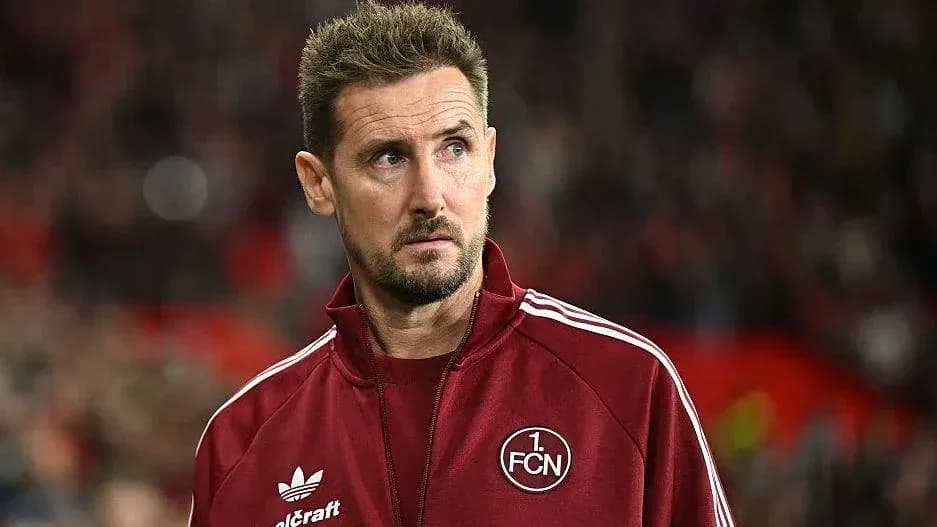
Miroslav Klose has never been confused about what wins football matches.
Goals. Real goals. From real strikers.
Germany’s record marksman, once the World Cup’s all‑time leading scorer and still only behind Kylian Mbappe and Lionel Messi, built a career on ruthless simplicity. More than 300 goals from Kaiserslautern to Werder Bremen, Bayern Munich and Lazio – and, by his own estimate, all but two of them from inside the penalty area.
He has not changed his mind now that he stands on the touchline.
“At the moment, thankfully, we’ve moved away a little from the idea of the false nine or a second striker circling around the main striker, with everyone coming towards the ball,” says the FC Nuremberg coach. For Klose, the game still starts – and ends – in the box.
“You need someone who is there to score goals. You need someone in the box because that’s where you’re closest to the goal. That’s why I’m a big believer in practising the final ball, whether it’s a cross, a shot or something else.”
The obsession is not romantic. It is rehearsed.
“That’s crucial. How do you create that final ball? When you develop automatisms and players get to know each other better, that’s when you see harmony on the pitch.
“It can make things look effortless, but it involves a huge amount of work. A lot of work in training and attention to detail, making sure the players communicate with each other and understand their team-mates’ strengths and weaknesses.”
From penalty-box predator to detail-obsessed coach
Klose’s fixation on detail was forged long before he stepped into management. As a player, he dissected everything: opponents’ movements, defensive lines, the smallest quirks in a goalkeeper’s stance.
He wanted to know how they reacted to specific shots. Did they spread themselves? Were their hands high, or did they dip? Where was the gap, the fraction of a second, the half-metre that would turn a half-chance into another tick on his scoring record?
“When goals are scored, the whole team deserves credit,” says the 48-year-old, whose reputation as a selfless runner matched his finishing instinct. “But you still need someone who has that ability in their feet or in their head to put the ball in the net.”
That belief powered him all the way to Rio de Janeiro in 2014. At 36, he finally lifted the World Cup with Germany, breaking Ronaldo’s tournament scoring record during that surreal 7-1 demolition of hosts Brazil in the semi-final.
It was the payoff for a career of near-misses and relentless graft – a path that may offer a degree of comfort to Harry Kane and England as they continue to chase their own major-tournament breakthrough.
A late bloomer who kept climbing
Nothing about Klose’s rise was pre-ordained. Born in communist Poland, he moved to West Germany at the age of eight when his father Josef – a former Auxerre player – relocated the family.
There was no gilded academy pathway. Klose played in the lower leagues while training as a carpenter, only later earning a move to Kaiserslautern. Like Kane, he did not truly establish himself in top-flight football until his early 20s. Yet within two years of his Bundesliga debut, he was starting a World Cup final against Brazil.
He kept scoring and kept learning until he was 38, when he finally retired from playing. That longevity, and the way he adapted his game, underpins the admiration he holds for Kane today.
“You could always see his quality, and he’s worked incredibly hard to get where he is,” Klose says of the Ballon d’Or winner.
“He’s also a great role model for me, particularly because he has stayed in Germany. I often tell my players that they should look at someone like him as an example.
“Young players can’t yet have the instinct and experience he has developed, but that’s where it starts – thinking about what you can and can’t do as a footballer. You have to keep learning. That’s the crucial thing for me.
“If you understand that you train to become better, then in five years’ time you’ll naturally be a different player. But if you think everything will happen automatically just because 10 people around you tell you that you’re a fantastic player, I don’t think you’ll continue to develop.”
Building the youngest side in the league
Klose’s belief in growth and repetition feeds directly into his work at Nuremberg. He has already shown a knack for shaping young talent, having previously coached Bayern Munich’s under-17s and served briefly as Hansi Flick’s assistant.
Nuremberg, historically one of Germany’s most decorated clubs, handed him the reins in 2024. He responded with 10th- and eighth-placed finishes. This season, his side sit second in the 2. Bundesliga, behind Hertha BSC, and share the title of the division’s most prolific attack. Promotion back to the top flight for the first time since 2019 is no longer a distant dream.
Crucially, they are doing it with kids. According to Transfermarkt, Nuremberg boast the youngest squad in the league, with an average age of 23.3 years.
“You need that balance and a certain core of experienced players,” Klose says. “But we’re very brave in that respect. Over the three years I’ve been here, we’ve made progress in how we assess young players and in the conversations we have about them.
“How do we rate them? How far along are they? What do they need to work on to take the next step? Is it perhaps more about their physical development? Because from a footballing perspective, we’re already producing some really good players.”
The work started the moment he arrived.
“When I first came, I spoke to the youth coaches about the club’s DNA and its coaching philosophy, and what they focus on,” he explains. “There was already a lot of common ground. We suggested trying certain things because we wanted to do a little more in particular areas, and they were open to that.
“That’s important. We benefit from this because our young players are getting opportunities in the first team, and everyone is paying attention to their development.
“But that journey starts with the youth coaches. I know how important it is to take those steps. We’re benefiting from that now because we have access to so many young talents.
“As a coaching team, we’re brave enough to give them opportunities when we see that they can compete at this level. That’s the first step.”
Zoma, Kornwachs and the next wave
The numbers tell the story. Of the 11 players who have logged the most minutes for Nuremberg this season, seven are 22 or under. Among them is top scorer Mohamed Ali Zoma, already capped by Italy and quickly becoming the kind of penalty-box presence his coach demands.
There is more on the way. Seventeen-year-old midfielder Marc Kornwachs has also surged into the spotlight, another teenager trusted in pressure situations.
“Of course, everyone gets a lot of praise, as is currently the case with Marc Kornwachs,” Klose says. “But his journey isn’t over yet. Now it’s about helping him become more consistent and establishing himself, while continuing to develop his game and take further steps forward.
“These players are so talented that we have absolutely no hesitation in giving them opportunities, regardless of the scoreline.”
It is a bold stance, but it fits the man. As a player, Klose won fair play awards in both Germany and Italy. As a coach, the humility remains, even as the stakes rise.
“I’m very comfortable with the steps I’ve taken, even though it involves a huge amount of work,” he says of his managerial path, which began with the German national team set-up before Bayern and a first job in charge at Rheindorf Altach in Austria.
“You learn something every day.
“I’ve said that I’m already a much better manager than I was three years ago. That’s perfectly normal, and you have to embrace it. I’ve always been willing and eager to learn, and I’ve always been a hard worker. That isn’t going to change.”
The shape of a Klose team
So what does a Miroslav Klose side actually look like?
“Personally, as a player, I always liked having the ball for long periods, and that hasn’t changed,” he says. “When you have the ball, you have a certain level of dominance. I know you also have to be very adaptable in terms of possession, and that’s something we are. We constantly show the players different ways of playing out of situations.
“It’s great to see how they develop and to be able to support individual players along the way. That’s exactly the approach I like to take as a manager.”
The principles are clear: possession with purpose, detail in the final ball, a ruthless finisher in the box, and a conveyor belt of young players trusted to grow under pressure.
Klose once lived off the tiniest margins inside the penalty area. Now he is trying to turn those same margins into promotion – and perhaps, in time, into something even bigger.





