
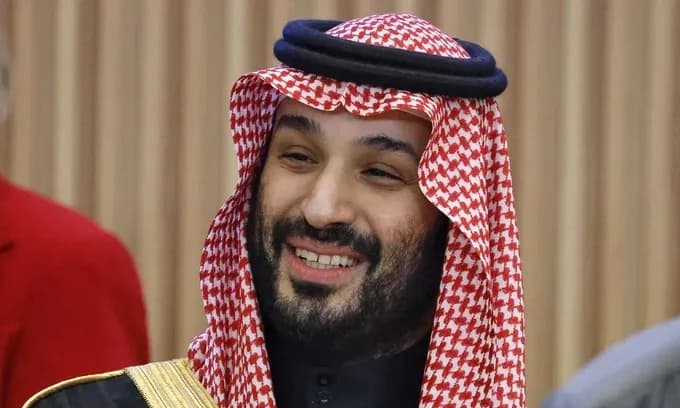
The most powerful man in Saudi football does not just collect players. He collects worlds.
In 2015, Crown Prince Mohammed bin Salman stepped onto a 134-metre superyacht in the Mediterranean. Within roughly 12 hours, the Russian owner had a new buyer and the Serene had a new flag. Price: €429 million, around US$550.7 million. Two helipads, an underwater viewing room, cinema, multiple pools, a private nightclub – less a boat, more a floating kingdom.
That same year, another record fell. Outside Paris, near Versailles, the Château Louis XIV – a modern palace wrapped in 17th-century French grandeur – changed hands for more than $300 million. It has all the trappings of old royalty, but wired for the age of the iPhone: climate control, lighting and ornate fountains all run from a screen, plus an underwater aquarium tucked beneath the moat. The world’s most expensive private residence, sold to a man reshaping what power looks like in the Gulf.
Two years later, the art world felt the same financial shock the transfer market would soon recognise. At auction in 2017, Leonardo da Vinci’s Salvator Mundi went for a staggering $450.3 million. The buyer was listed as anonymous. Multiple reports have since linked the Crown Prince to the record-breaking purchase. Another cultural trophy, another signal.
These are not just indulgences. They are symbols of a project.
With an estimated personal fortune of around $25 billion, according to House of Saud, Mohammed bin Salman sits at the heart of a financial machine now driving some of the biggest shifts in global sport. As chairman of Saudi Arabia’s Public Investment Fund (PIF), he has turned sovereign wealth into a strategic weapon, using football and entertainment to push the country’s Vision 2030 plan – a bid to diversify the economy and rewrite the nation’s image.
The numbers in football tell the story more clearly than any speech.
In 2023, PIF took majority control of four of the Saudi Pro League’s historic powerhouses: Al Nassr, Al Hilal, Al Ittihad and Al Ahli. That injection of state-backed capital lit the fuse. It gave Al Nassr the financial muscle to sign Cristiano Ronaldo, a move that did not just bring a superstar to Riyadh – it opened the floodgates. Big-name players who once viewed the Saudi league as a distant outpost suddenly saw it as a lucrative, ambitious stage.
The ripple effect has been relentless. Salaries soared. Transfer fees spiked. European clubs realised they were no longer the only apex predators in the market. A league that barely registered on the global radar now appears nightly on highlight reels and social media feeds.
And the reach extends beyond the Gulf.
In 2021, PIF completed the takeover of Newcastle United, dragging the club from years of drift into a new era of expectation. St James’ Park, once a symbol of frustration, turned into a lightning rod for debate about state ownership, sportswashing and the future of the Premier League. For Newcastle fans, it meant dreams of competing with England’s elite again. For the rest of football, it was a stark reminder: Saudi money was not just buying players – it was buying institutions.
The man behind this football empire moves in circles that reflect his ambition. His network stretches from the White House to Silicon Valley to Hollywood. He has been linked publicly with figures such as former U.S. President Donald Trump, tech billionaires Mark Zuckerberg and Elon Musk, and actors like Johnny Depp, Morgan Freeman and Lindsay Lohan. Boardrooms, film sets, private screenings on superyachts – they all fold into the same orbit.
He has never pretended to be an ascetic.
“As far as my private expenses, I'm a rich person and not a poor person. I'm not Gandhi or Mandela,” he told CBS in a previous interview, when pressed on his lifestyle. “I'm a member of the ruling family that existed for hundreds of years before the founding of Saudi Arabia.”
It was a rare moment of blunt self-definition from a leader more often discussed than heard in the West.
Yet even for a man insulated by palaces, yachts and priceless art, the region’s realities still cut through the glass.
According to The Wall Street Journal, a recent wave of drone and missile attacks by Houthi forces has changed the Crown Prince’s daily routine. Targets have reportedly included airports and oil infrastructure in Riyadh, as well as commercial maritime routes in the Red Sea. The response has been to pull decision-making deeper inside the fortress: operations shifted to heavily fortified palaces, some equipped with secure underground bomb shelters.
It is a stark contrast. Above ground, the image is Serene, Versailles-style châteaux and da Vinci masterpieces. On the surface of the football world, it is Ronaldo in Riyadh and a rejuvenated Newcastle challenging the old order. Below, there are bunkers, security briefings and the constant hum of regional tension.
This is the paradox at the heart of modern football’s new power broker: a game built on noise and spectacle, increasingly shaped by a man who signs deals from behind blast-proof doors.





