Giuseppe Farina’s Alfa Romeo cuts through the late-summer light in 1950, the final race of Formula 1’s very first season. Home soil. Home colours. Home glory. By the end of the Italian Grand Prix, Farina had not only won the race, he had sealed the inaugural world championship – the only driver ever to clinch the title in his own country. Monza, from the very beginning, knew how to frame a coronation.
Three years later, the grid reads like a roll call of legends. Farina again, this time in Ferrari red, closest to the camera. Juan Manuel Fangio in a Maserati. Alberto Ascari in another Ferrari, parked on the far side. Between them, they would carve up the first eight world titles. Fangio wins that 1953 race, but Ascari walks away with the championship. At Monza, even victory can feel like a subplot.
By 1956, the circuit’s notorious banking dominates the skyline, concrete curves tilting cars toward the heavens. Fangio, Stirling Moss and Peter Collins slice along the steep arc, the sort of place where bravery and madness blur. Moss, in a Maserati, takes the win. Behind him, Ferrari orchestrate a very different kind of drama. Collins hands his car to Fangio, sacrificing his own chance so the Argentine can bank the points he needs. Second place is shared, the title all but secured. Fangio’s fourth crown is born from speed, strategy and a teammate’s quiet surrender.
Monza does not only make champions. It breaks hearts.
In 1961, Ferrari’s Wolfgang von Trips arrives on the brink of the world championship. A German star in a scarlet car, he sits on the threshold of history. Two laps into the race, it all ends. Contact with Jim Clark’s Lotus sends von Trips’ car into an embankment packed with spectators. He dies, along with 14 fans. The photograph from before the start shows a composed driver, unaware that this will be his final race. The title goes elsewhere; the scars at Monza never quite heal.
Six years on, a quieter moment in the pits. Graham Hill, the moustachioed Englishman, adjusts his helmet and visor before the 1967 race. Around him, his family clusters in the cramped garage – wife Bette, their children. At the front, a six-year-old boy: Damon Hill, years away from his own championship in 1996. The picture freezes a rare softness at a brutal circuit, a reminder that behind the visors are husbands, fathers, sons.
The track layout of that era turns races into high-speed chess at 180mph. No chicanes, just long straights and sweeping bends that turn the slipstream into a weapon. In 1969, Jackie Stewart’s Matra hits the line first, but only just. Jochen Rindt’s Lotus, Jean-Pierre Beltoise in another Matra and Bruce McLaren in his own car flash across almost alongside him. Four cars, less than two tenths of a second apart. Monza doesn’t deal in gentle margins.
A year later, the atmosphere darkens again. Nina Rindt sits in the pits in 1970, timing laps for her husband Jochen during practice. It looks like a simple domestic scene, stopwatch in hand, eyes on the track. Shortly after, Rindt’s Lotus suffers what is almost certainly a suspension failure on the approach to Parabolica. He is killed. Weeks later, the points he had already amassed prove enough. He becomes Formula 1’s only posthumous world champion. Even triumph can feel hollow here.
The finishes stay wild. The cost stays high.
In 1971, Peter Gethin’s BRM wins one of the most frantic races the sport has seen. He beats Ronnie Peterson’s Lotus, Francois Cevert’s Tyrrell, Mike Hailwood’s Surtees and Howden Ganley’s BRM. Five cars, six tenths of a second. A photo finish stretched across half the main straight. For some, it’s a career-defining day. For Monza, it’s just another chapter in its obsession with speed.
Two years later, the circuit plays host to a different kind of race. In 1973, drivers and team personnel line up for a run around the track, a charity-style dash organised by team boss Frank Williams. At the front, bare-chested and striding out, is James Hunt. The cameras love him. The stopwatch loves someone else. Williams himself comes through to win and pockets the £750 prize. Even off the track, Monza finds a way to turn competition into theatre.
The theatre takes on a harsher edge in 1976. Niki Lauda arrives at Monza barely six weeks after his near-fatal crash at the Nürburgring. His face carries the scars, raw and unmistakable. The Austrian Ferrari driver hauls himself back into the cockpit, still in significant pain, because the title fight with James Hunt demands it. He finishes fourth that day, stretching his championship lead. Months later, Hunt wins the title by a single point. Lauda’s comeback at Monza remains one of the sport’s most defiant acts.
The start of the 1978 race brings another nightmare. Behind the leaders, cars collide in a multi-car accident. Ronnie Peterson’s Lotus is wrecked, the Swede trapped with serious leg injuries. Fellow drivers pull him from the car. The damage doesn’t look fatal. It should have been survivable. Delays in treatment prove catastrophic; Peterson dies the following morning from an embolism. On the same day as the crash, his team-mate Mario Andretti secures the world title. Later, Andretti sums up the day with a brutal truth: “Unfortunately, motor racing is also this.”
Even when Monza delivers joy, it rarely does so without a twist.
In 1988, McLaren look untouchable. They win every race – except one. The Italian Grand Prix stands apart. Ayrton Senna, in full command, comes up to lap Jean-Louis Schlesser, standing in for Nigel Mansell at Williams. Contact. Senna spins out with two laps to go. Out of nowhere, Ferrari inherit a one-two. Gerhard Berger leads Michele Alboreto home. The tifosi erupt, a sea of red under the late-summer sky. The celebration carries a different weight: Enzo Ferrari has died only weeks earlier. The team’s first win since his passing feels less like a result and more like a farewell salute.
The same chicane bites Senna again in 1993. This time the Williams in his path belongs to Damon Hill. At the start, they collide. Both continue, but the damage is not terminal for Hill. He regroups, resets and drives through to win the race. On a circuit that remembers his childhood presence in the pits, he now owns the podium.
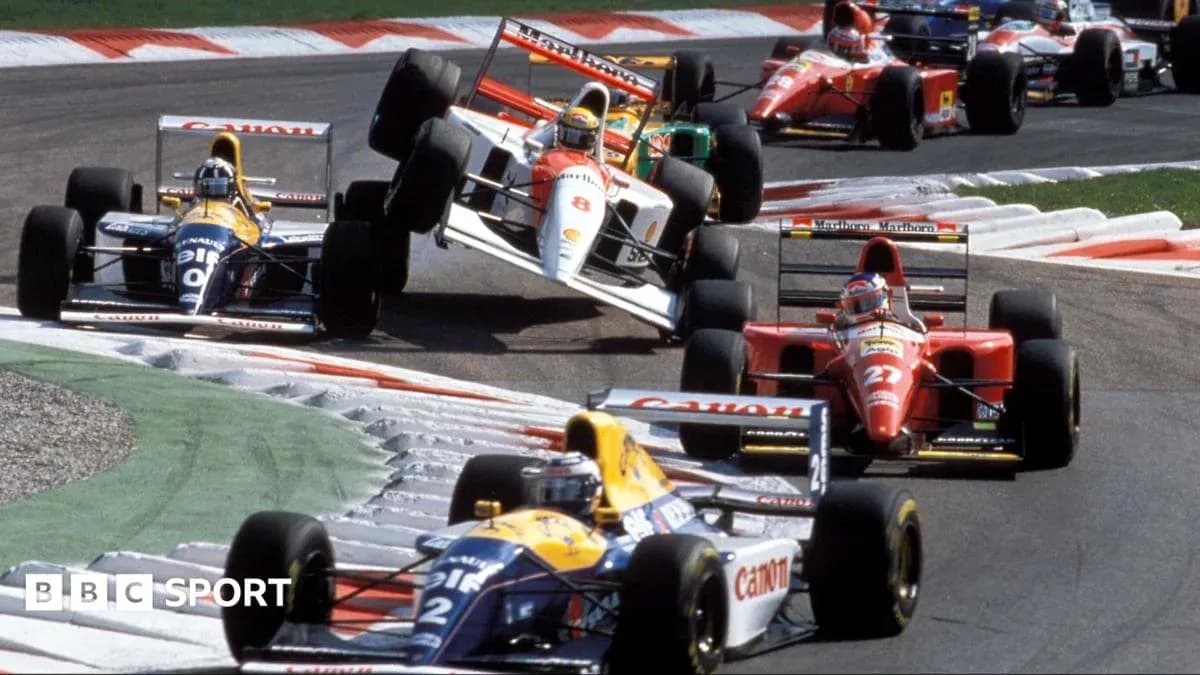
Monza’s chaos doesn’t always come at the front. That same year, Christian Fittipaldi’s Minardi performs one of the most surreal finishes in F1 history. On the run to the line, he collides with team-mate Pierluigi Martini. The Minardi flips, somersaults, and lands upside down, skidding across the track. Miraculously, both drivers walk away unhurt. Fittipaldi’s car, carried by its own momentum, still crosses the finish line. He is classified eighth, one spot behind Martini. Only at Monza could a driver complete the race while looking at the world the wrong way up.
In 1999, the circuit toys with a champion’s nerves. Mika Hakkinen, leading comfortably for McLaren, spins off. He knows instantly what it could mean. In the gravel, he breaks down in tears, convinced he has thrown away the title. The image of a distraught world champion-in-waiting becomes one of the defining pictures of that season. He recovers in time, regroups, and ultimately beats Ferrari’s Eddie Irvine to the championship. Monza had tried to break him. It failed.
A year later, the track becomes a cathedral for Ferrari’s faithful. In 2000, Michael Schumacher wins, and the tifosi flood the start-finish straight in a red tide. This victory becomes a key step on the way to his first of five consecutive drivers’ titles with Ferrari. Monza, so often cruel, grants the Scuderia a pure, unfiltered celebration.
Not that the place ever fully tames its opening lap fury. The first chicane, reprofiled over the years, still acts like a funnel for aggression. In 2011, the start turns into a scramble of cars pointing in every conceivable direction. Wheels lock, noses point at the grass, and drivers fight for inches. It’s untidy, frantic, utterly Monza.
Even in the modern era, with safety standards transformed, the circuit still finds ways to sit at the centre of the sport’s biggest storylines.
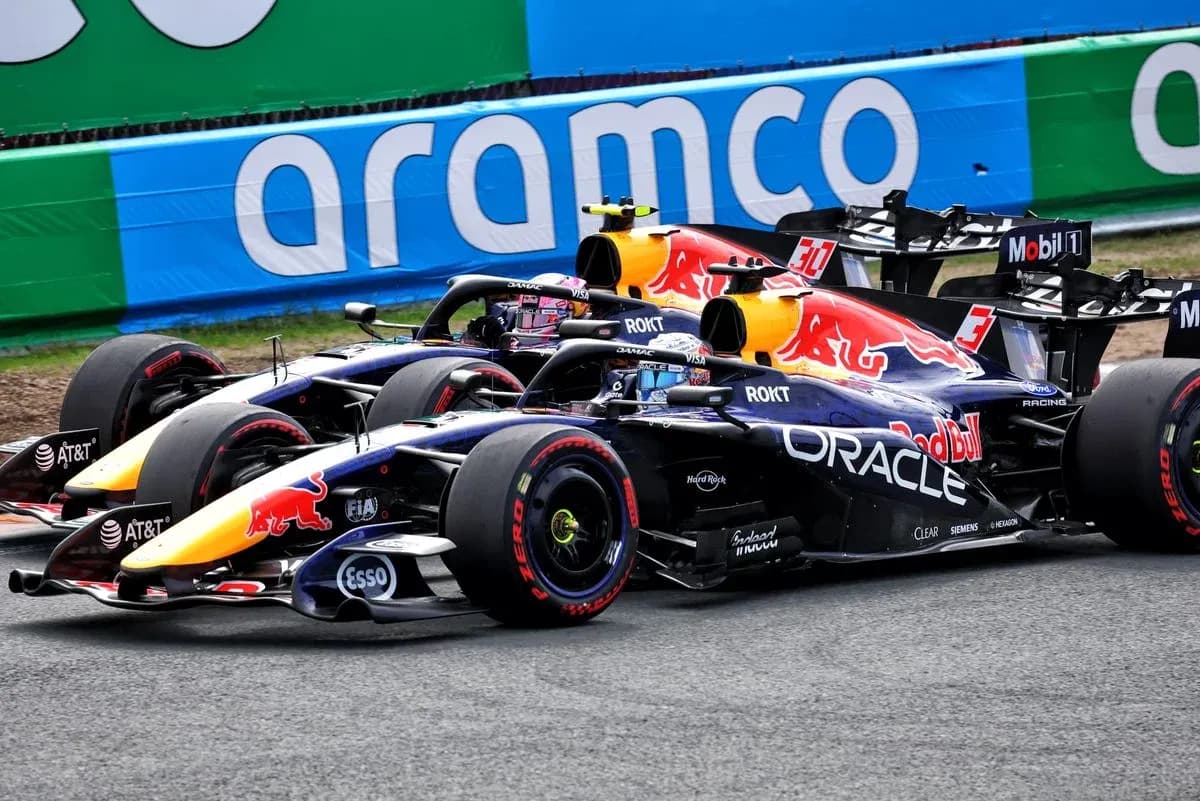
The 2021 season, already crackling with tension between Max Verstappen and Lewis Hamilton, brings another flashpoint. At the first chicane, the two title rivals collide as they battle for position. Verstappen’s Red Bull is launched up and over Hamilton’s Mercedes. The rear of the Red Bull lands on the Mercedes’ cockpit. The halo, once debated, now proves its worth beyond argument. It likely saves Hamilton from serious injury. The image of the Red Bull perched on top of the Mercedes becomes one of the defining pictures of their ferocious title duel.
From Farina’s first crown in 1950 to Verstappen and Hamilton’s clash in 2021, Monza has never been just another race. It is a place where titles are won, legends are made, and the sport’s most thrilling and harrowing moments collide at 200mph. The Temple of Speed keeps its history close – and it never stops writing new chapters.