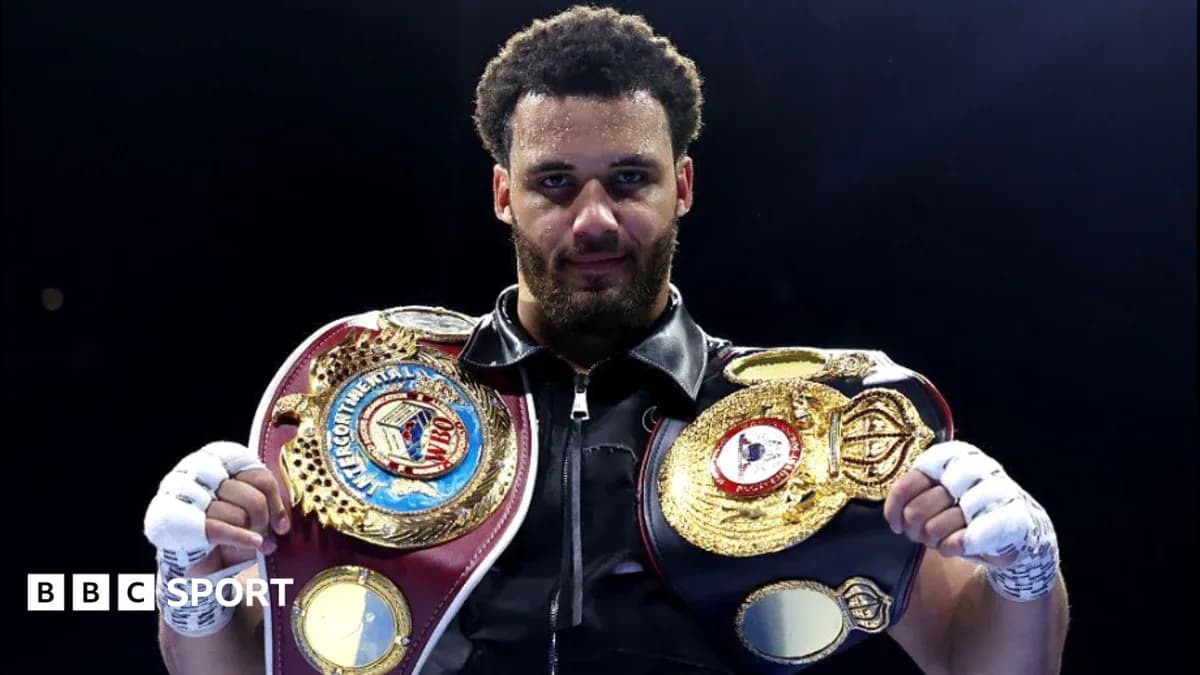
Moses Itauma scrolls through his phone and bursts out laughing.
On the screen, former Nigerian president Olusegun Obasanjo stands in traditional dress, hands on hips, staring straight through the camera. The caption reads: “This is how an African dad looks at you when you pursue a career that goes against his wishes and you turn out to be successful.”
“That is pretty much my dad,” Itauma tells BBC Sport.
From that look to this stage, the journey has been anything but straightforward.
From Kent kid to history’s doorstep
Itauma was born in Slovakia to a Nigerian father and Slovak mother, then moved to Kent as a young boy. At home, ambition was clear and conventional. Doctor. Lawyer. Respectable professions, not a life in a brutal, unforgiving sport.
Boxing was supposed to be his older brother’s path, not his. Then the family realised the younger son wasn’t just good – he was gifted.
“Don’t worry about school. Just focus on your boxing,” his mother eventually told him.
That sentence changed everything.
Now, at 21, Itauma walks into a very different kind of examination. On Saturday he faces Filip Hrgovic for the vacant IBF heavyweight title, with the chance to become the second-youngest world heavyweight champion in history.
“There’s a lot of expectations on my shoulders to carry the flag of British boxing. I just have to live up to it,” he says.
Win, and he doesn’t just pick up a belt. He steps into a space that will soon be vacant.
Tyson Fury and Anthony Joshua are edging towards the twilight of their careers. British heavyweight boxing will need a new standard-bearer. A new name on the marquee. Promoters, broadcasters, and fans are already looking in Itauma’s direction.
The reluctant star
Fury has turned himself into a one-man industry – Netflix cameras, microphones, and headlines never far away. Joshua, though more guarded, still leans into the spotlight when required.
Itauma is different. Closer in temperament to Joshua than Fury, but even more resistant to the circus.
“What irritates me most is when people think you’re public property,” he says.
“What people don’t know about me is that I don’t actually want to be in the limelight. The way my career is going, I just have no choice.”
Fight weeks often expose a fighter’s true character. Where others roar, posture and posture some more, Itauma tends to shrink the noise. When Hrgovic cut across him at Thursday’s news conference, there was no spike in temperature, no attempt to win the soundbite war. He simply turned to host Adam Smith and asked for the next question.
Cold. Controlled. Almost disinterested in the theatre.
Yet the parallels with Joshua keep coming.
Joshua fought for the same IBF title in his 16th professional bout, with 34 rounds behind him. Itauma reaches his first world-title shot in his 15th fight, with 31 rounds boxed. Joshua arrived with an Olympic gold medal and a glittering amateur résumé. Itauma doesn’t have that pedigree, but if he beats Hrgovic, the comparison becomes unavoidable – and in one key metric, he overtakes Joshua as the fastest British heavyweight to win a world title.
“Pressure is a privilege”
Inside his camp, there is no sense that any of this is too much, too soon.
Ben Davison, who has worked with both Fury and Joshua, now steers Itauma’s corner. He has seen how the biggest nights can twist a fighter’s mind. He does not sound worried.
“Pressure is a privilege,” Davison says.
“Moses has already had that pressure for such a long time and I just think it’s water off a duck’s back.”
Most blue-chip heavyweights are eased through the ranks, matched carefully, allowed to learn their craft against modest resistance. The idea is to season them slowly, to make sure the first real test doesn’t arrive before they’re ready.
Itauma has skipped that queue.
Francis Warren, son of Queensberry boss Frank, first spotted him as a teenager, trading leather with grown professionals in sparring. Even before that, former British heavyweight champion Jeamie ‘TKV’ Tshikeva had seen the warning signs for the rest of the division.
“Moses was a big 11 or 12-year-old, around 75 to 80kg, and sparred an adult of the same weight,” TKV recalls. “He really showed up, put hands on this grown man, and I was shocked.
“The guy he sparred was around 25. Imagine going home and telling your wife you got beat up by a kid.”
The stories kept coming. Then the knockouts followed.
Fast track or shortcut?
In the professional ranks, Itauma has ripped through opponents with a ruthless efficiency that makes matchmakers both excited and nervous. Destructive stoppages over Dillian Whyte and Jermaine Franklin did not come against champions, but they were names, men who had shared rings with the elite. The manner of those wins hardened the belief that Itauma was not just promising – he was inevitable.
When Oleksandr Usyk vacated the IBF title and Frank Sanchez agreed to step aside, the landscape shifted. Suddenly, Itauma-Hrgovic wasn’t a step on the ladder; it was the top rung. The fight was elevated to a world-title contest.
The fast track began to look, to some, like a shortcut.
Hrgovic has not been shy in saying so. Even before the belt entered the equation, the Croatian insisted Itauma had been handed “everything on a plate”. On social media, plenty agreed. Many argued a final eliminator, a more traditional rite of passage, would have been the fairer route.
Itauma has no interest in that debate.
“It’s a lose-lose situation for me because if I win, I’ve done what people expect, and if I lose, it’s just like, I wasn’t as good as what I thought,” he says.
“I don’t find happiness in trying to please other people’s expectations.”
He sounds detached from the noise, but the questions remain. Not about his power – that’s obvious – but about the unknowns.
The questions only rounds can answer
What happens when the man in front of him doesn’t fold? When the right hand lands clean and the opponent is still there in round eight, still dangerous, still throwing back?
That is where hype usually goes to die or becomes something more.
TKV has shared rounds with Joshua, Daniel Dubois and Fabio Wardley. He has also seen Itauma in the quiet, unforgiving spaces where cameras rarely go.
“Moses works hard even though he hasn’t had to face adversity in his fights or training,” he says. “I’ve never seen him slack. He’s fast, sharp, a good learner and I rarely see him get hit.
“I believe he can do the rounds, too. He has the potential to dominate the division for years.”
Inside Team Itauma, there is no doubt he belongs at this level. The arguments about timing, merit and whether he has “earned” this shot will mean nothing when the bell rings.
On Saturday night, the prodigy has 12 rounds – if he needs them – to find out whether he is just the next British hope, or the man who will define the heavyweight era that comes after Fury and Joshua.