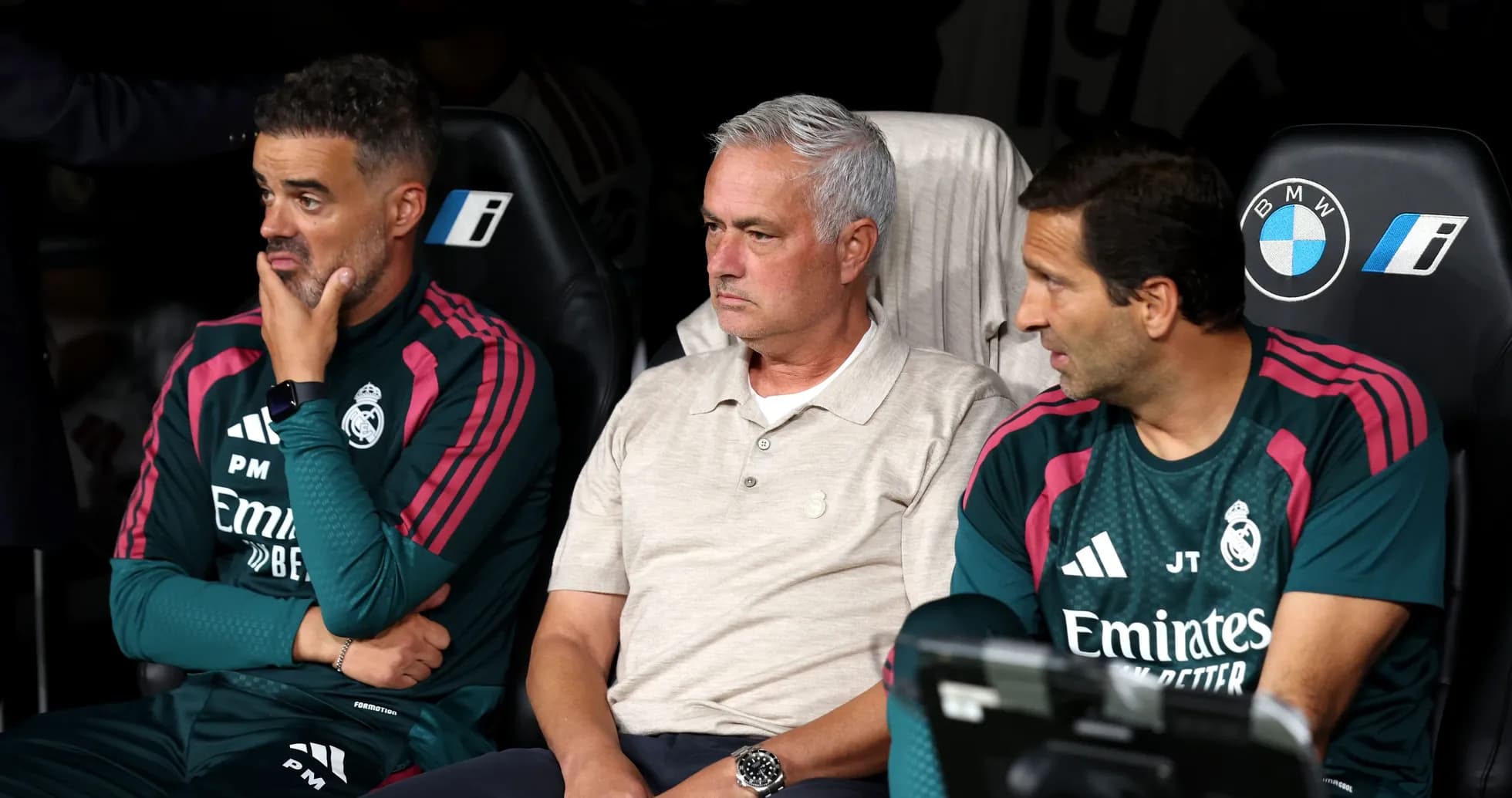
José Mourinho has never hidden where he builds his teams. At the Santiago Bernabéu against Real Sociedad, he started pouring the concrete for a new Real Madrid back line.
The warning shot came on 35 minutes. Sergio Gomez let fly, the ball flashing close enough to Thibaut Courtois’s goal to snap Mourinho out of what had been a relatively calm opening. Courtois had already denied Mikel Oyarzabal in the tenth minute; this second scare was enough.
Mourinho reacted instantly. Five players were sent to warm up with fitness coach Antonio Pintus: Cucurella, Camavinga, Brahim Diaz, Trent Alexander-Arnold and Asensio. It looked like a shake of the dice. In reality, it was routine.
“I always do that in the 35th minute. I like everyone to be inside during the break, because there are instructions for everyone,” the Portuguese coach explained.
Halftime arrived with the game level at 1-1, but the real shift came in the tunnel. When the teams emerged, the Bernabéu saw the first glimpse of what Mourinho clearly believes will be his defensive blueprint.
A new back four takes shape
Cucurella replaced Álvaro Carreras at the interval, stepping onto the Bernabéu pitch for his Real Madrid debut. The change was not about experimentation; it was about control.
“The change of Carreras was because of the yellow card,” Mourinho said, referring to the booking the full-back picked up in the tenth minute for a challenge on Kubo.
From there, the structure snapped into focus. Dumfries moved into the right-back role, Cucurella took the left, and Konaté slotted in as the right-sided centre-back alongside Huijsen on the left. Three of the four had arrived in the summer, Huijsen the exception, signed last season.
This, barring injury or rotation, is the line Mourinho and his staff have settled on. Only Rüdiger looks likely to break the hierarchy, potentially rotating with Konaté or Huijsen until Éder Militão returns. Otherwise, the path is clear: these four will carry Madrid through the season’s defining stretch.
Dumfries has already shifted the internal pecking order. Accustomed to operating as a wing-back in a five, he has surged past Trent Alexander-Arnold to become Mourinho’s first-choice right-back. On the opposite flank, Cucurella offers the aggression and energy to mirror him.
With both full-backs pushing high, Madrid’s defensive line steps forward, compressing the pitch. That gives the side the platform Mourinho craves: defend on the front foot, attack quickly, and press high without dragging the midfield back toward their own box. The forwards and midfielders can hunt in advanced areas because the back four is willing to live closer to the halfway line.
Numbers that back the eye test
The Opta data underlines how assertive this new unit already looks.
- Dumfries ranked fifth on the pitch for passes in the final third with 15. Only Güler (25) and Mbappé (22) finished significantly ahead, with Valverde level on 15 and Bernardo on 17. For a right-back, it is a telling sign of where he is operating: not pinned to his own half, but repeatedly stepping into attacking zones.
- Konaté led the tackle count with two successful challenges, level with Cucurella. It was not a game of desperate last-ditch defending, but when Madrid needed a duel won, the new centre-back pairing answered.
- Huijsen, meanwhile, quietly dictated the build-up. He completed 69 of his 72 passes, a 95.8% success rate that made him the most accurate passer on the pitch. For a young central defender learning the demands of the Bernabéu, those numbers speak of calm rather than nerves.
- Carreras, despite his early withdrawal, had also contributed strongly before the break, recovering four balls – the same number as Huijsen. In total, Madrid’s back line recovered 15 balls, with seven of those coming inside Real Sociedad’s half. That is Mourinho football with a modern twist: pressure applied high, not just a low block in front of Courtois.
Defensively, Real Madrid allowed only three shots on target against Courtois, matching the figure they conceded versus Espanyol. On paper, that is control. For Mourinho, it is still one step below his old standard.
During the 2010-2011 season, his teams kept 30 clean sheets in 59 matches: 16 in 38 La Liga games, 8 in 12 UEFA Champions League fixtures, and 6 in 9 Copa del Rey ties. More than half the matches ended with the opposition blanked. That is the benchmark he knows, and the one this new line will be judged against.
Three shots on goal might feel like a quiet night for most coaches. For Mourinho, it is a reminder that the work has only just begun.
A unit built for the run ahead
The real test for this back four will not be a single night against Real Sociedad, but the coming run that will stretch their understanding and resilience.
Malaga and Betis are next, followed by the Champions League opener. Then come Rayo and Elche, fixtures that can either consolidate a defensive identity or expose cracks. Looming beyond all of that sits the derby against Atletico at the Metropolitano, the kind of occasion where a defensive line either announces itself or unravels.
By then, Dumfries, Konaté, Huijsen and Cucurella will have had weeks of shared minutes, shared mistakes, and shared corrections under Mourinho’s unforgiving eye.
He has made his choice. Now the season will reveal whether this back four can restore the clean-sheet brutality that once defined his greatest teams – and whether Real Madrid’s new foundations are as solid as he believes.