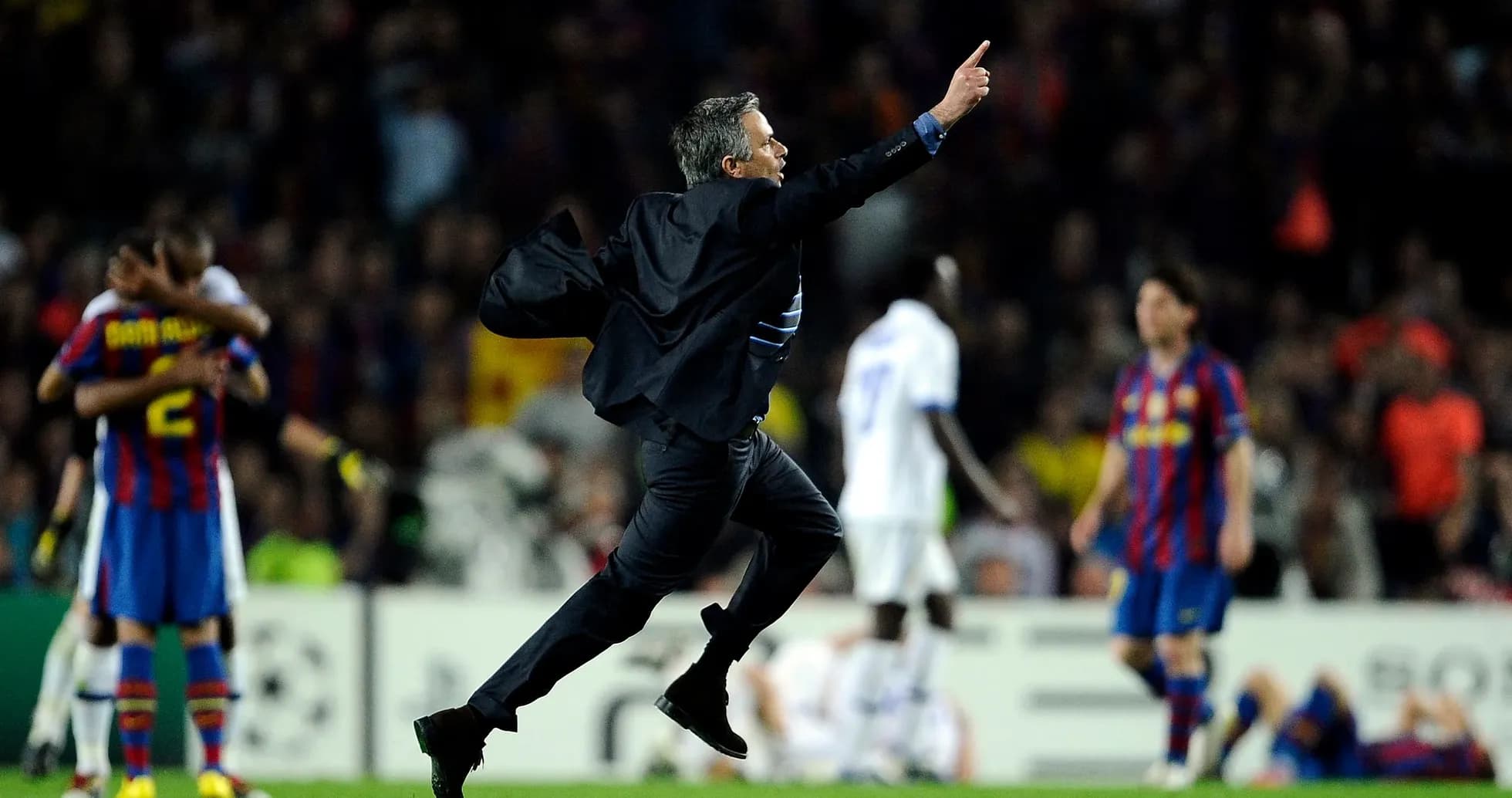
On 28 April 2010, the Camp Nou staged a defeat José Mourinho would later cherish more than many victories. Inter Milan lost 1-0 to Barcelona that night, yet walked off the pitch with a place in the Champions League final – and a place in history.
Mourinho would call it "the most beautiful defeat of his life" and a "historic miracle". It felt exactly like that.
The Night of the Sprinklers
Inter arrived in Catalonia with a 3-1 lead from the first leg against the defending champions, a Barcelona side widely expected to sweep them aside. Pep Guardiola had Lionel Messi at his peak, the Camp Nou at full volume and, after 28 minutes, a man advantage when Thiago Motta was sent off.
Sixty minutes with 10 men. Against that Barcelona. In that stadium.
Most teams would have crumbled. Mourinho’s plan tightened.
He built his entire approach around one idea: stop Messi, and you stop Barcelona. Inter dropped deep, closed passing lanes, and suffocated the Argentine’s influence. Barcelona had the ball, the territory, the shots. They did not have the breakthrough they needed.
Gerard Piqué finally scored to make it 1-0 on the night. The stadium roared, sensing the comeback. Inter held. Tackle after tackle, block after block, minute after minute. The final whistle sounded with Barcelona one goal short and Mourinho’s Inter still standing.
The Portuguese coach exploded.
Index finger raised, he sprinted onto the Camp Nou pitch, celebrating wildly with his players, punching the air in front of a furious home crowd. The image travelled the world: Mourinho, soaked in noise and hostility, revelling in the chaos he had created.
Some in Catalonia took it as provocation. The response became part of the folklore. The sprinklers came on, soaking Inter’s celebrations and, in theory, hurrying them off the pitch. The water only added to the theatre. Mourinho and his players danced in it.
A few weeks later, they finished the job. Inter beat Louis van Gaal’s Bayern Munich 2-0 in the final, sealing the treble and confirming that night in Barcelona as the defining chapter of their European run, the miracle that made everything else possible.
From Milan to Madrid
That triumph closed one era and opened another. In 2010, fresh from conquering Europe with Inter, Mourinho left Milan for Real Madrid. His first spell in the Spanish capital ran until 2013, a turbulent and compelling three-year battle with Guardiola’s Barcelona.
He won trophies, stirred emotions, divided opinion. One thing he did not win with Real Madrid in that stint was the Champions League.
Now, at 63, he is back at the Bernabéu for a second spell, returning to a club that measures itself by European Cups. The demand is simple and ruthless: win the Champions League with Los Blancos, or the story feels incomplete.
A Reunion on Europe’s Biggest Stage
This Tuesday, the past and present collide. Mourinho’s current club, Real Madrid, face his former club, Inter, on the opening matchday of the new Champions League league phase.
It is not just another group-stage fixture. It is a reunion loaded with memory.
Inter arrive as the club with whom Mourinho wrote one of the great away-leg epics of modern European football. Real Madrid stand as the institution where he has unfinished business in this competition.
The man at the centre of it all once turned an “almost impossible” mission in Barcelona into a miracle. Now he chases a different kind of completion: delivering Europe’s biggest prize to a club that has built its identity around lifting that trophy.
The question is no longer whether Mourinho can engineer a miracle. It is whether, in Madrid this time, he can finally turn it into destiny.