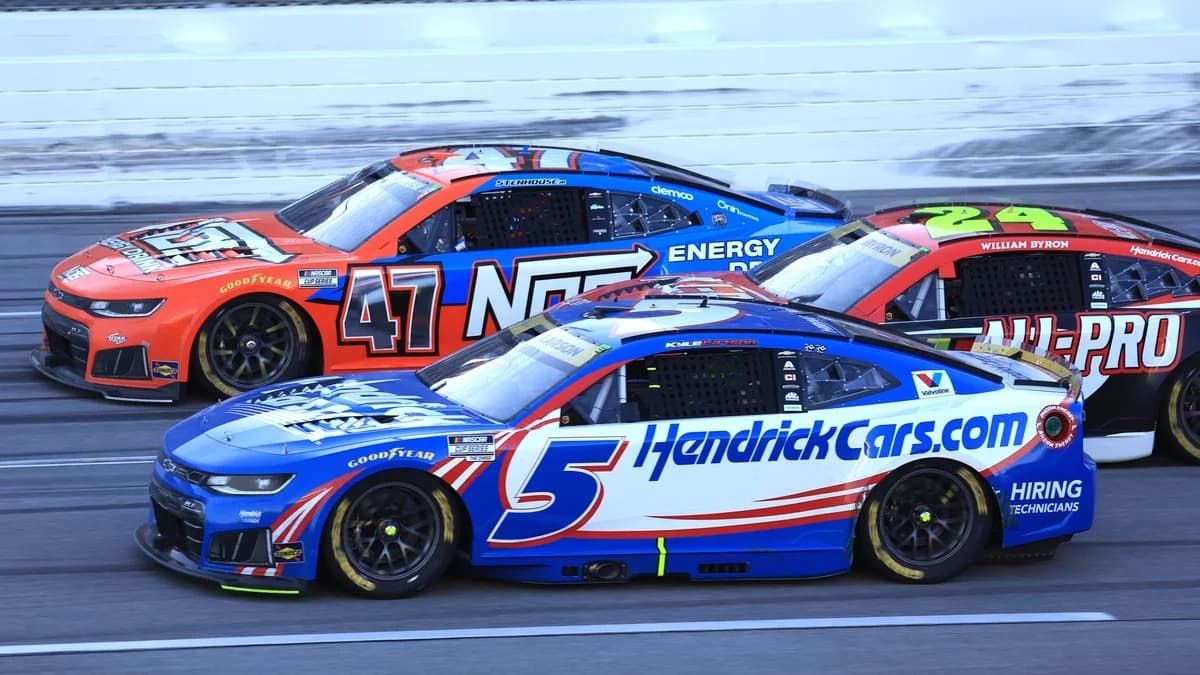
NASCAR Warns Most Drivers at Talladega Over Minimum Speed Concerns
During the first stage of Sunday’s Cup Series race at Talladega, NASCAR warned nearly all drivers about failing to meet the minimum speed requirement. Race officials threatened to black flag those who did not increase their pace.
Most cars, except for the three from RFK Racing, were running slowly around the 2.66-mile superspeedway in an effort to conserve fuel. This caused race control to receive automatic alerts about cars running below the set speed limit.
Mike Forde, NASCAR's vice president of racing communications, explained on the Hauler Talk podcast that they used instant messaging to alert all teams on pit road about the issue. The message warned, "There are X amount of cars that have not reached minimum speed. If you guys don’t pick it up, then we’re going to have to step in." Soon after, the drivers increased their speed, avoiding any black flags.
At Talladega, the minimum speed is defined as within 12.5 percent of the pole position lap time. Forde noted that while the timing of a black flag is at NASCAR’s discretion, drivers typically get a lap or two to comply.
"We’re not trying to remove cars from the race," Forde said. "Sponsors invest heavily in this sport, and fans want to see the cars on track even if their driver isn’t competing for the win. We want to keep them out there for the fans."
Kyle Larson’s Double Yellow Line Pass Confirmed Legal
Race control took time to review Kyle Larson’s final lap pass on Todd Gilliland, which involved crossing near the double yellow line. NASCAR concluded that Larson’s tires never fully went below the yellow line, so no penalty was issued.
"There was a little bit of time," Forde said. "The tire has to go completely below the yellow line. If even half an inch remains on it, no penalty is called. We felt it was pretty clear."
NASCAR follows a flowchart approach for decisions on passes involving the yellow line: the tire must be below the line, the driver must gain position, and the move cannot be forced by another car. All three conditions must be met for a penalty.
In Larson’s case, his tires stayed on the line, so the pass was legal. Forde dismissed speculation that the timing of the call was influenced by Larson having already passed the competitor.
Denny Hamlin reacted on social media, criticizing the officiating and communication as "horrible."
Questions About Chevrolet Teams’ Strategy
There was fan speculation that Chevrolet teams, especially Ricky Stenhouse Jr. and William Byron, deliberately slowed to help Larson, aiming to secure stage points and the overall win. NASCAR addressed this concern during the race.
Forde stated that veteran official Scott Miller, monitoring remotely in Concord, North Carolina, found no reason to suspect wrongdoing. No teams raised issues with NASCAR either, and since all teams access the same SMT data, any suspicious behavior would likely have been noticed.
Some teams asked about Larson’s tires and the double yellow line rule but did not question any slow-driving tactics to benefit Larson and Hendrick Motorsports.
Additional Notes
- Minimum speed warning: Issued to most drivers except RFK Racing's three cars.
- Minimum speed threshold: Within 12.5% of pole time at Talladega.
- Kyle Larson’s pass: Tires stayed on the yellow line; no penalty given.
- Denny Hamlin’s comment: Called officiating and communication "horrible."
- Chevrolet strategy rumors: Disproved by NASCAR officials and teams’ data reviews.