NBA Draft Season: Top Guards to Target
The NBA calendar has flipped to draft season, and this year, the sharp money is moving to the backcourt. Guards sit right at the fault line between price and production, and managers willing to ignore last spring’s noise will find the board loaded with value.
This is where leagues are won.
Garland’s New Stage in Los Angeles
Darius Garland arrives in Los Angeles with the ball in his hands and a franchise in transition behind him. James Harden and Ivica Zubac were moved at last season’s deadline, and Kawhi Leonard is expected to follow them out the door. That leaves Garland as the primary engine of a Clippers offense entering a new era.
The numbers already paint him as an elite fantasy guard. Over the last five seasons, he has delivered 20.1 points, 2.8 rebounds, 7.3 assists, 1.2 steals and 2.6 3-pointers in 33 minutes a night, shooting 46 percent from the field, 39 percent from deep and 87 percent at the line. In 9-cat formats, that is premium production. Now layer on the likelihood of the highest usage rate of his career.
The sample with Leonard off the floor last season shows what that might look like over a full campaign: 27.5 points, 2.2 rebounds, 8.5 assists and 1.2 steals per 75 possessions on a 34 percent usage rate. That is a true lead-guard workload. In High Score formats, where assists are worth two points, that kind of playmaking becomes a weekly cheat code.
Dejounte Murray’s Comeback Window in New Orleans
Dejounte Murray’s last two years were defined by recovery. Forty-five games played across two seasons, an Achilles tear that threatened his prime and a long, frustrating climb back. Down the stretch, he finally looked like himself again. That is the detail that matters.
Since the 2021-22 season, Murray has averaged 20.7 points, 6.2 rebounds, 7.1 assists, 1.7 steals and 1.9 3-pointers. Those are Top-25 fantasy numbers, and he has not yet turned 30. Modern medicine has changed the arc of Achilles injuries, and his final 13 games last season backed that up: 17 points, 5.6 rebounds, 6.6 assists and 1.7 steals in around 28 minutes a night. Essentially his five-year baseline, in six fewer minutes.
New Orleans gives him a clear lane. Sharing the floor with Jeremiah Fears, Jordan Poole and scorers like Zion Williamson and Trey Murphy III, Murray slots back into a featured role without having to force offense. He can defend, rebound, create and pick his spots. In High Score, those 1.7 steals per game alone are worth more than five points a night. That is a category swing on defense before his scoring even lands.
VanVleet’s Discount in Houston
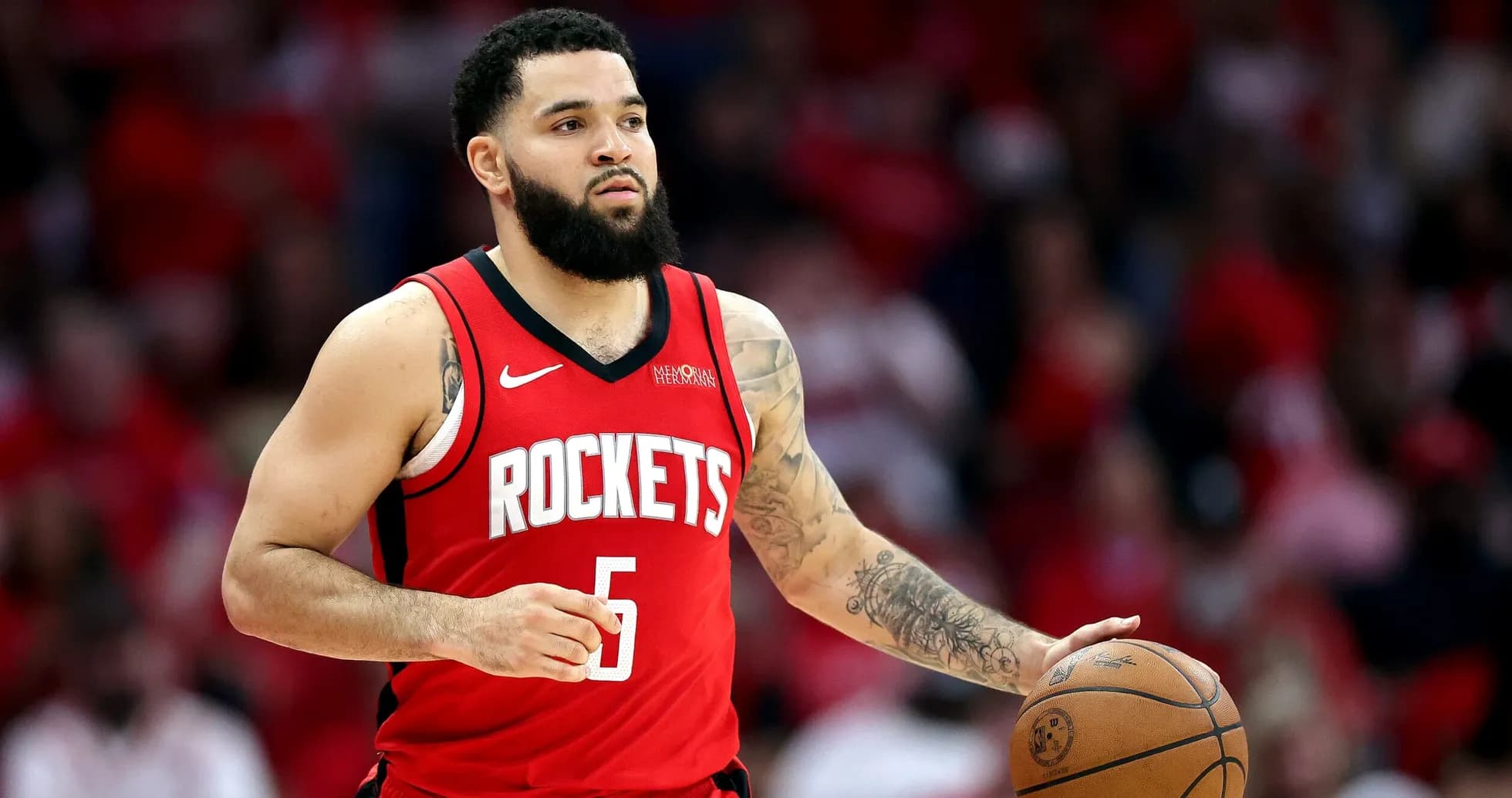
Fred VanVleet has lived in the Top-50 fantasy range for most of his career. This year, drafts are treating him like a late-round flier. That disconnect is where savvy managers pounce.
Houston still has a 35-minute starting point guard job waiting for him. The 32-year-old tore his ACL in September 2025 and has reportedly looked fully healthy. His six-year line is remarkably stable: 18.1 points, 4.0 rebounds, 6.8 assists, 1.7 steals, 0.6 blocks and 3.1 3-pointers per game. That is a proven multi-category profile.
Even if you only buy the Houston version, the price is still wrong. Across two seasons with the Rockets, VanVleet has averaged 15.9 points, 3.8 rebounds, 6.9 assists, 1.5 steals and 0.6 blocks on solid efficiency. Houston’s postseason run exposed how much they missed his ball-handling and leadership. The role is safe, the minutes are there, and the cost is a fraction of his track record.
Fox Mispriced in San Antonio
De’Aaron Fox is paying for San Antonio’s spring storyline more than his own performance. Dylan Harper and Stephon Castle exploded in the playoffs, while Fox tried to navigate a significant ankle sprain. That is a tough stage for a guard whose game leans on burst and first-step speed. He turns 29 just before Christmas. This is not a late-prime fade.
Even in what qualifies as a down year, Fox still put up 18.6 points, 3.8 rebounds, 6.2 assists and 1.2 steals. For a player sitting around pick 85, that is already useful production. His six-year baseline tells a different story: 24.3 points, 4.2 rebounds, 6.2 assists and 1.5 steals. That is the version managers are effectively getting at a deep discount.
Durability adds another layer. Fox has played at least 72 games in three of the last four seasons. In a High Score format, where one explosive outing can swing a week, his ceiling games carry real weight. When he hits, he does not just help. He buries opponents.
Quickley’s Garland-Like Upside in Toronto
Immanuel Quickley’s profile mirrors Darius Garland’s more than his draft slot suggests. The roughly 40-pick gap between them traces back to Toronto’s deeper rotation, not any glaring flaw in Quickley’s game. With a player like Scottie Barnes on the floor, that depth can actually work in his favor. Barnes draws attention, moves the ball and elevates his guards.
Quickley has already shown what he can do with a starting role. Across two full seasons with the Raptors, he has averaged 16.6 points, 3.9 rebounds, 5.9 assists, 1.1 steals and 2.6 3-pointers. He has done it efficiently, too, shooting nearly 44 percent from the field, 38 percent from 3-point range and 84 percent at the line.
The most intriguing part is the workload. He produced those numbers in just 30.6 minutes a night. With only Jamal Shead and Ja’Kobe Walter behind him, 30 minutes looks like his floor this season. His availability helps, too: at least 64 games played in five of six NBA seasons. That kind of steady presence, with room for a bump in volume, is the definition of a mid-round guard who can outperform his draft slot.
Pippen Jr. and the Memphis Opening
Memphis has a vacancy at point guard after moving on from Ja Morant, and Scotty Pippen Jr. is very much in that conversation. Every time the Grizzlies have handed him the keys, he has produced.
Over three seasons in Memphis, Pippen Jr. has averaged 10.6 points, 3.2 rebounds, 4.5 assists, 1.4 steals and 1.2 3-pointers in 22 minutes a game. When he stepped in as a starter two seasons ago to cover for Morant, he raised that to 14.2 points, 4.5 rebounds and 5.7 assists across 21 games. Last season, he appeared in just 10 games but finished the year in the starting lineup.
The pattern is clear: when the role grows, so does his stat line. Given his past production, his fit on the roster and a 155 ADP, he stands out as one of the best value plays on the draft board. If he wins the job outright, that price will look comically low by November.
Ellis on the Edge in Brooklyn
Keon Ellis sits outside the Top 200 in most drafts, a name you scroll past quickly. He should not be ignored. Brooklyn offers his cleanest path yet to real minutes, with a wide-open guard rotation and a clear need for defense.
Ellis has never needed heavy usage to matter in fantasy. Across his career, in just under 20 minutes per game, he has averaged 1.2 steals and 0.6 blocks. Stretch that toward a 30-minute role, and his defensive counting stats alone justify a roster spot.
In formats like High Score, where steals and blocks are worth three points each, his impact spikes. Managers who stash him now, before the minutes catch up to the opportunity, may find they have quietly secured one of the most profitable late-season guards on the board.
The draft room will chase big names and last year’s headlines. The managers who stay calm at guard, read the roles correctly and trust the numbers behind Garland, Murray, VanVleet, Fox, Quickley, Pippen Jr. and Ellis will walk away with the real edge.