The new season is still some way off, but in boardrooms, design studios, and kit rooms across Europe and beyond, the work has already moved on. Contracts change, eras end, identities are sharpened. You can see all of it in the shirts.
Parma’s neon statement
At Parma Calcio, the third kit has arrived as the final piece of the 2026-27 puzzle, and it does not whisper. It glows.
Puma has dressed the Serie A club in a black base slashed with neon pink. The contrast is brutal, deliberate, the kind of palette you notice instantly under floodlights or in a packed Curva. A refined single-button collar carries a vibrant trim that spills onto the sleeve cuffs, tying the whole frame together. Under the arms, dynamic panel inserts break up the darkness and give the shirt a sharper, more athletic outline.
Every logo on the front shouts in the same high-voltage pink. Turn the shirt around and the message becomes literal: a graffiti-style “Writing Our Future” graphic sprawls across the upper back. It is not subtle. It is not meant to be. For a club still rebuilding its place among Italy’s elite, the kit reads like a manifesto worn on the spine.
With the home and away already out, this third strip completes Parma’s 26-27 set with a jolt of modern edge, a clear step away from nostalgia and into something more defiant.
Melbourne Victory changes hands – and identity
On the other side of the world, Melbourne Victory has chosen this moment to redraw its technical identity.
The A-League club has announced a new multi-year deal with Australian activewear brand Elite Eleven, ending its spell with Italian supplier Macron. The Melbourne-based label will take over as Victory’s official Technical Kit and Apparel Partner for the next four seasons, starting in 26-27.
The ink on the contract barely dried before the club moved into launch mode. Under the banner “Melbourne Born. Melbourne Worn.”, Victory unveiled its 26-27 training and lifestyle collection, leaning heavily into local pride and homegrown style. The range is on sale immediately, giving supporters a first feel of the new partnership months before a competitive ball is kicked.
The main event is still to come. Victory’s 26-27 home and away kits are locked in for an early October reveal, a key moment for both club and brand as they try to show that this is more than just a logo swap.
Sedan’s gothic edge with Kappa
In France, CS Sedan Ardennes has completed its first full kit cycle with Kappa, and the third shirt is the boldest of the trio.
After a retro green home and an off-white away that nodded to the club’s heritage, the new third kit steps firmly into lifestyle territory. The jersey is predominantly black, but the eye goes straight to the chest: a striking gothic “ARDENNES” wordmark stretches across the front, turning the shirt into a walking banner for the region.
The crest sits on the left in a clean monochrome white badge, facing off against white Kappa Omini logos on the right chest and shoulders. Around the sleeves, discreet red and green trim adds a final detail, a quiet salute to Sedan’s traditional colors without disturbing the modern, almost streetwear feel of the design.
Black shorts and socks finish the 2026-27 third strip, giving the club a full blackout option that feels as suited to the stands and the city as it does to the pitch.
Germany and Adidas: a farewell in black and gold
Some kits are about a season. This one is about history.
Adidas CEO Björn Gulden has confirmed that the German national team will wear a special farewell shirt for their UEFA Nations League fixtures in late 2026, a final on-pitch chapter in a partnership that began in 1954 and shaped the visual identity of German football for seven decades.
From the first World Cup win in Bern to the modern era, Adidas and the DFB have been inseparable. All four of Germany’s men’s World Cup titles, multiple European Championships, countless iconic moments – the three stripes were always there. That will end when Nike takes over as official kit supplier at the start of 2027.
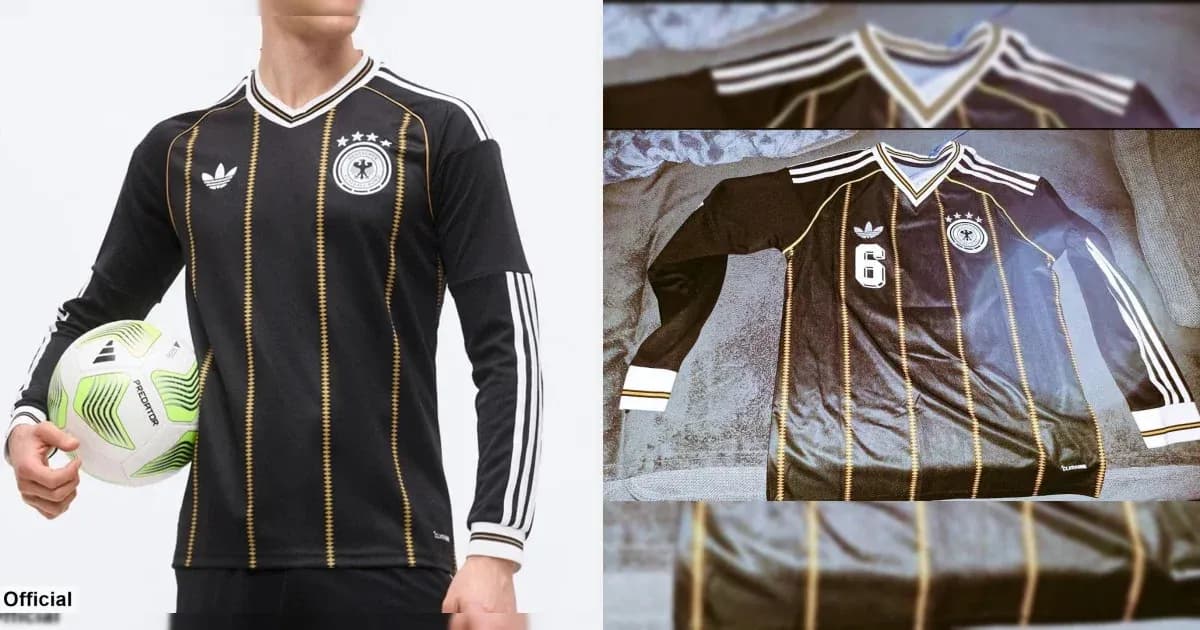
The farewell jersey, seen in leaked images, leans into that legacy. A predominantly black base is cut by vertical gold diamond pinstripes running down the front, a refined, almost regal pattern. On the chest, the classic DFB crest sits alongside the Adidas Trefoil, a deliberate throwback to earlier eras. A retro-inspired V-neck and cuff detailing complete the look, turning the shirt into a curated tribute rather than a simple one-off.
When Die Mannschaft step out in it for the last time, it will not just be a new kit. It will be the closing scene of one of football’s most enduring commercial and cultural alliances.
Barça’s Sant Jordi cross
While Germany prepares to say goodbye to a giant, Barcelona is busy weaving another layer into its own mythology.
New renders of the Nike FC Barcelona 2026-27 fourth shirt, created by memorabilia1899, show summer signing Anthony Gordon and Pedri in a design built around Sant Jordi, the patron saint of Catalonia. The imagery is unmistakable.
The jersey uses a light beige base as a canvas for a bold maroon cross dominating the front, a clear nod to the traditional cross of Saint George that has long been part of Catalan and club iconography. Dark navy accents frame the story: collar, sleeve cuffs, Nike Swoosh, and Spotify sponsor logo all carry the same deep tone.
Navy shorts and socks complete the set, anchoring the dramatic front graphic with a more restrained lower half. This is not a primary kit; it is a statement piece, the kind of fourth shirt designed to ignite debate and emotion in equal measure.
The club is expected to officially release the 26-27 fourth kit in January 2027, alongside a matching apparel collection. By then, the Sant Jordi cross will not just be an image in a render. It will be another symbol for a fanbase that has never been shy about wearing its identity on its chest.
From Parma’s neon ambition to Germany’s black-and-gold goodbye, from Melbourne’s local pivot to Sedan’s gothic pride and Barça’s saintly cross, the message is clear: the next wave of kits is not just about performance fabric. It is about who clubs and nations believe they are – and who they want to become.