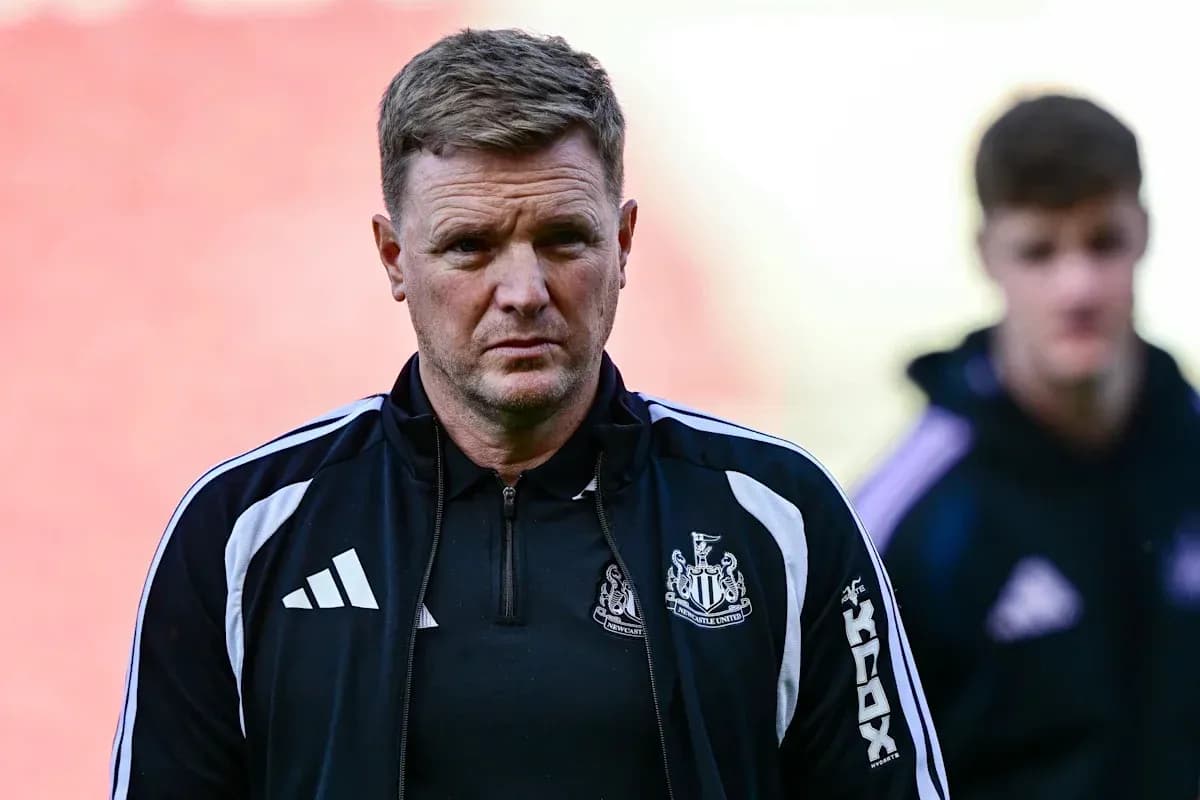
Newcastle United braced itself for a summer of upheaval. Big sales, big buys, a reshaped dressing room. What it did not expect was the fault line that ran straight through the middle of those plans: Eddie Howe walking away.
His departure, early in pre-season and right in the heart of the transfer window, ripped through Newcastle’s preparations. Training plans, tactical work, recruitment meetings — all of it suddenly had a new layer of uncertainty. Yet inside the club, those in charge insist it never descended into panic.
Ross Wilson, the sporting director tasked with steering Newcastle through this storm, has lifted the lid on what was really happening behind the scenes. The club, he says, had been quietly preparing for this kind of moment from the day he arrived.
Two windows at once
While the outside world focused on potential signings and Financial Fair Play calculations, Wilson and his team were running a second, secret operation.
According to The Athletic’s Chris Waugh, Wilson told Newcastle’s scouting staff that the process felt “almost like running two transfer windows” at the same time. One window was visible: players in, players out. The other stayed hidden: the search for Howe’s successor.
For two weeks, that managerial hunt ran in total secrecy alongside the club’s recruitment work. Shortlists were refined. Profiles were checked against the squad. Conversations were held under the radar. All roads, in the end, led to Matthias Jaissle.
The speed of that appointment surprised many. Inside the club, it was the point of all that quiet work.
“No, it never felt chaotic inside at all,” Wilson said. He made a point of underlining Howe’s legacy. “Big respect to Eddie for the job he did for us over a long period of time. Bringing that trophy here means we would all describe him as a club legend.”
Disruption in the middle of a rebuild
The timing still hurt. Howe left in the middle of a summer in which Newcastle were attempting a major rebuild, one that ultimately saw around £300 million invested in eight new signings.
Pre-season is when a manager imprints his ideas, when new arrivals are knitted into the system, when fitness and shape are set for the campaign ahead. To lose the head coach then, and after he had already committed to another season at the end of the previous campaign, created what Wilson himself described as a huge disruption.
Newcastle had not expected to make a coaching change at that exact point. The club’s schedule did not include “replace the manager in July” as a key milestone. Yet the possibility of a change had never been ignored.
“Eddie would tell you, since I came to the club, I’ve been planning in the background for a managerial change,” Wilson said. “Part of our responsibility as leaders of the club is to be prepared.”
That preparation became Newcastle’s safety net. While the outside narrative focused on shock and timing, the internal process shifted into execution mode.
Jaissle and the joined-up plan
Because the groundwork had been done, Newcastle could move quickly for Jaissle. The club had already mapped out what it wanted from the next coach: style, personality, development track record, ability to work within the existing structure.
The recruitment department had also been working to a broader blueprint, not just a manager-specific wish list. That meant many of the transfer targets identified for Howe also fit Jaissle’s preferences. The club did not have to rip up its plans or abandon deals already in motion.
“Clearly the timing was not (what) we had planned for,” Wilson admitted. “But we had a plan in place, which is why we could execute it as quickly as we did.”
Newcastle still endured a turbulent summer. Losing a popular, trophy-winning manager always leaves a mark, especially one hailed internally as a “club legend.” Yet Wilson’s account reveals a club trying to operate like an elite institution: emotionally attached to its people, but structurally ready for change.
The question now is simple and ruthless, the kind football always asks: will that careful succession planning turn a moment of disruption into a launchpad, or will this summer be remembered as the point where momentum slipped away?