
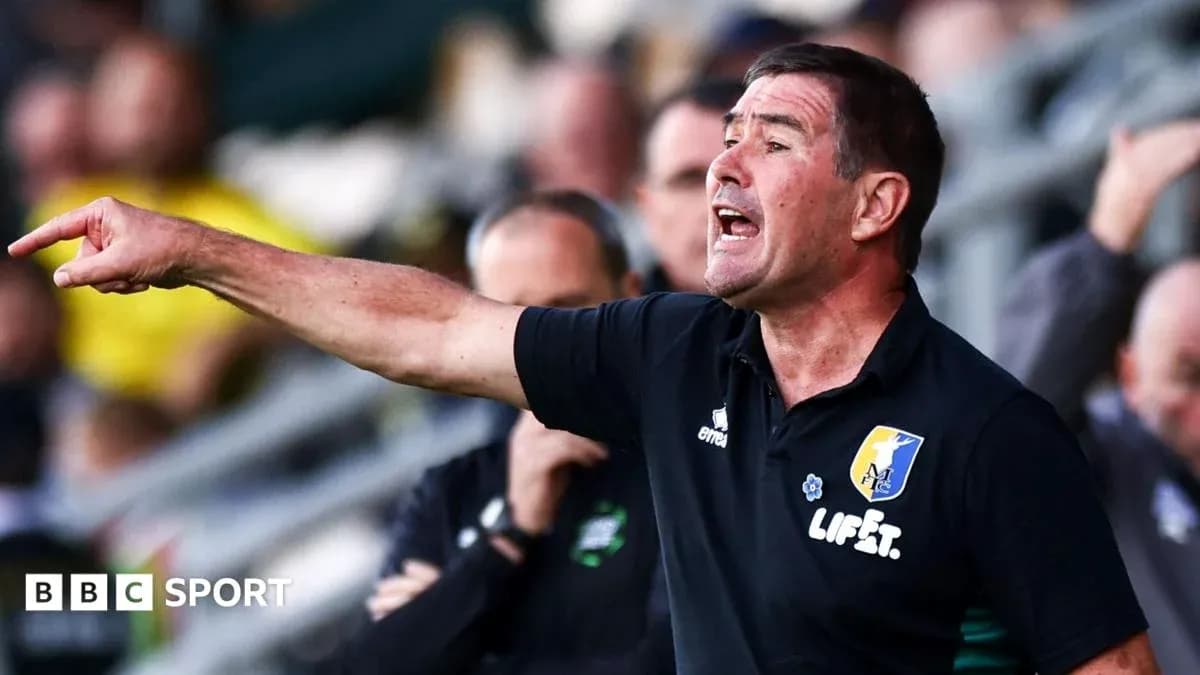
Nigel Clough never sounds like a man interested in milestones.
He shrugs at numbers, bats away talk of records, and insists he is “just trying to get through the week”. Yet this weekend at Mansfield Town, he steps into a category of his own.
The 60-year-old becomes the longest-serving manager in the club’s history in terms of active years and league games in charge, overtaking Ian Greaves – the man who last took the Stags this high up the ladder in the late 1980s. At Burton Albion, that status has long been his. Now, across two modest East Midlands clubs, he owns a pair of longevity records in a profession that chews through managers in months.
Clough calls it “an indictment of football”. It says plenty about him as well.
Outlasting a ruthless era
The League Managers’ Association numbers are stark: on average, bosses in England’s top four divisions now last less than a year. While the carousel spins ever faster, Clough has quietly put down roots.
He has been in the Mansfield dugout for six years and a week, taking charge of 329 games in all competitions. Only Mikel Arteta at Arsenal has been in his current job longer among managers in the Premier League and EFL. Across the top four divisions since he left non-league Burton for Derby County in 2009, nobody has overseen more matches than Clough’s 893.
His reaction? A wry shake of the head and a glance back to an era he knows will not return.
“When you look back 20 or 30 years,” he says, “my dad was at Forest for 18 years, Alex Ferguson was at Manchester United for so long and then there was Arsene Wenger at Arsenal. That was at the top level, but even lower down there was a lot of managers who stayed a lot of years.
“I just think it’s sad the way football is going at the moment. The first bad period that people have, a month, two months or something like that, and the manager is the one that goes.”
He has lived the other side of that impatience. He has also benefited from a club refusing to panic.
From relegation fight to Wembley and promotion
Clough’s most precarious spell at Mansfield came in his first full season, 2021-22. The Stags sank into the League Two relegation places and went 12 games without a win. In the modern game, that kind of run usually ends one way.
Asked whether he felt his job was under threat, he doesn’t dress it up. “Of course.”
The board held their nerve. The dressing room did the rest.
What followed was a surge that summed up Clough’s stubborn belief in the arc of a season. Mansfield rattled off a club-record 11 consecutive home wins, roared into the play-offs and reached Wembley. They fell short of promotion under the arch, but the trajectory had changed.
“You’ve got to go through that period and you’ve got to get through it,” Clough says. “As you get a little bit older, you know more that it’s going to change.
“You get a result out of adversity as much as anything. If you’re winning, it doesn’t keep going, and if you’re losing it’s the same thing if you’ve got a reasonable team and you’re doing the right things.”
Two years on from that relegation scrap, Mansfield finished third and went up automatically, ending a 21-year exile from the third tier. He kept them there at the first attempt, achieving something no Stags manager had managed for 35 years.
Last season’s 10th-place finish in League One matched the high-water mark Greaves set in 1987. That is the company Clough now keeps in club folklore.
A manager players want to play for
The numbers tell one story. The dressing room tells another.
“He is really good football man to have around. We should be proud that he is Mansfield Town manager,” says Stags fan Dean Foulkes. “Look at what he has achieved, promotion, and we now have players coming to Mansfield Town because they want to play for Nigel Clough.”
That line is not flattery. It is recruitment policy.
Veteran striker David McGoldrick chose Mansfield in the summer. So did former Leeds United forward Tyler Roberts and ex-Preston striker Michael Smith. Highly rated Tottenham midfielder George Abbott arrived on loan. All have options; all bought into the manager.
Defender Ryan Sweeney admits Clough was “the main reason” he returned last summer. Stephen McLaughlin, who has played under a string of bosses at Nottingham Forest, Southend and elsewhere, says Clough “manages differently to any other manager” he has known.
“He doesn’t treat you as a number, he treats you as a person and you want to run through brick walls for him,” McLaughlin explains. “You are not on the grass too long in training because he trusts you to get your work in and to be ready for Saturday.
“He doesn’t give too much tactical information to people because the message is ‘just do your job and work hard’.”
Jordan Bowery knows that message comes with trust. Signed as a forward, he has been rebuilt as a defender and utility man, now regarded as “Mr Versatile”.
“He is incredibly loyal and trusts me in those positions,” Bowery says. “A lot of managers wouldn’t do that, but he’s had my back and I appreciate that.
“He can get onto you, but that is like most managers. He expects and demands the best out of every single one of you each day.
“He has obviously been around the game a long time, played at the highest level – he knows the game and he knows the players.”
Shaped by a unique football upbringing
Clough’s authority does not rest only on his surname, but it is impossible to separate the manager he is from the childhood he had.
He scored 131 goals for Nottingham Forest – more than anyone else at the club in the past 113 years – and thrived under his father Brian, who dragged Forest to the First Division title in 1978 and then back-to-back European Cups. Before that, Brian Clough had already turned Derby County into champions of England.
Nigel grew up inside that world.
“When you’re brought up in the household that we were brought up in and the environment we were brought up in, then we have a certain insight into what it takes to have a chance of being successful and what you expect of the team and everything,” he says.
“And the empathy, I don’t think you should ever forget that if you’ve been a player as well, how that feels when you have a rough time and so on.”
That empathy runs through his career path. After hanging up his boots, he spent a decade in non-league with Burton Albion, hauling the Brewers up the pyramid and learning the hard economics of the lower tiers. When Derby called in 2009, he jumped several divisions at once into the Championship. Spells at Sheffield United and a second stint at Burton followed.
At each stop, he left a footprint. At Burton, he is a legend for turning a non-league club into a Championship side. At Sheffield United, he took a League One team to an FA Cup semi-final in 2014. At Derby, the job carried a weight only a Clough could fully understand.
The quiet secret: character and money
Ask him for the secret to staying power and he doesn’t talk about formations or pressing triggers. He talks about people and money.
“We don’t like wasting the owners’ money,” he says. “Whether it was at Burton when we were in the Dr Martens South or whether it’s here at Mansfield Town, we try and look after it as best we can. And we have a responsibility to do that.”
The transfer market, for Clough, starts with character.
“We do as much in-depth research as we can on players. Character is the main feature of what we look at. We can see all the stuff on the videos of what they can do, then we watch them live and everything, but you have to delve really into the character and get a lot of references from players, coaches, managers.
“We take that very seriously. Each season we set out to just try and get a few better players in the squad.
“It’s keeping the ball rolling, keeping the owners happy, keeping the supporters happy.”
A throwback who still belongs
As Manchester United part ways with managers inside a year and Crystal Palace make a change after 16 games, Clough’s six-year stretch at Mansfield feels like a relic from another age.
Yet it is not nostalgia that keeps him in work. It is results, relationships, and a way of working that convinces players to sign, owners to trust and supporters to believe that the story is still unfolding.
He might dismiss the idea that his longevity is any kind of achievement. The record books, and the clubs he has reshaped, suggest otherwise.
The question now is not how long Nigel Clough has been at Mansfield Town. It is how far this unlikely, quietly built project can still go.





