
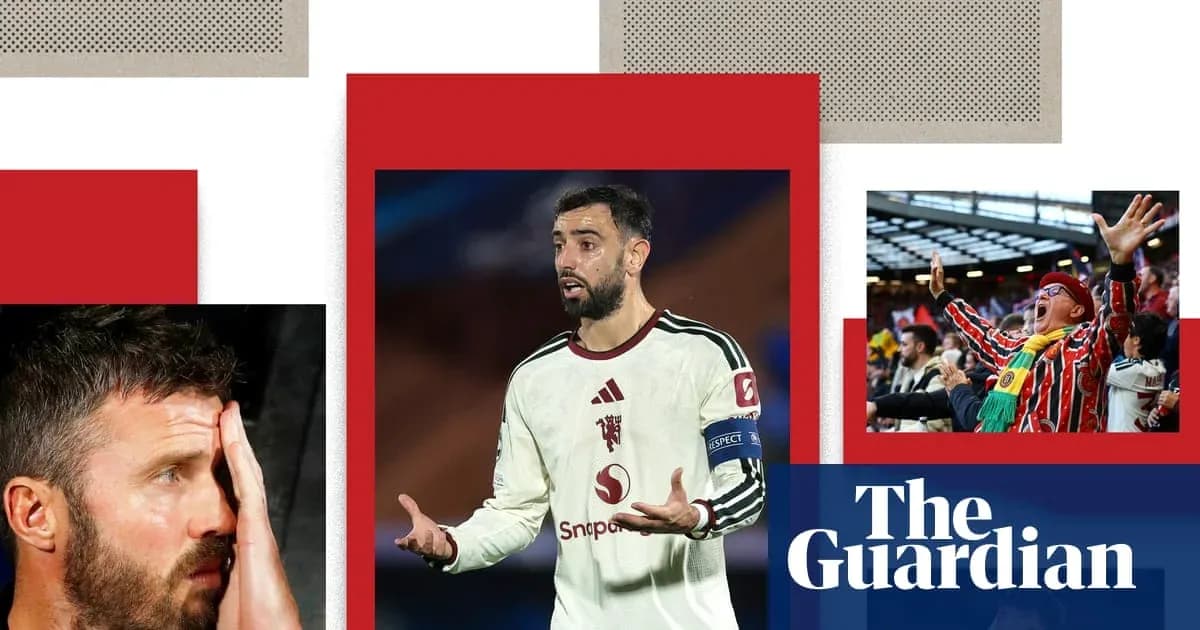
Bournemouth’s visit to Old Trafford on Sunday is not just another early‑afternoon kick-off. It feels like a stress test of Michael Carrick’s authority and a club drifting towards a hard reset.
At the centre of it all: Bruno Fernandes, the captain who may not be captain much longer, and Lisandro Martínez, his ally in dissent. Both are out of contract in the summer, both have club options for an extra year, and both, judging by recent behaviour, look like men edging towards the exit.
Carrick was asked on Friday if he might strip Fernandes of the armband or even drop him. He pointedly refused to rule it out. That alone tells its own story.
A captain in open revolt
The 4-1 collapse at Como still hangs in the air. Not just the scoreline, not just the sight of United folding in the rain against Cesc Fàbregas’s side, but what came after.
Fernandes walked through the mixed zone and lit the fuse.
“It’s a decision from the staff to not press man-to-man and sometimes leave space behind and try to get the ball, wait for them, but sometimes when you give space to these teams they get confidence,” he said.
Those words still jar days later. This was not a vague gripe or a throwaway line. It was a direct questioning of Carrick’s tactical plan, delivered by the captain, in public, after a humiliation.
That is a challenge to the head coach’s authority. Pure and simple.
Now comes the response. Does Carrick stare down his captain and reassert control? Or does he try to ride out the storm and risk looking powerless in his own dressing room?
If he acts – by taking the armband, by dropping Fernandes, by drawing a hard line – he may, ironically, be doing a favour for whoever follows him. A squad that has grown comfortable testing the limits would be reminded that the manager’s word still matters.
Cashing in on the mutineers
Behind the immediate drama lies a colder calculation. United have two high-profile, high‑value players who may already be mentally halfway out of the door.
The club hold an extra-year option on both Fernandes and Martínez, yet their current deals run out in the close season and their intent looks clear enough: they do not seem committed to a long-term future at Old Trafford.
So the question becomes brutal but simple. Do United cling to them in the hope of a late revival, or do they cash in now and trigger a new era?
Numbers are already being kicked around. Around £40m for Fernandes. Perhaps £25m for Martínez. Fees that, in January, could be pushed straight back into a rebuild Carrick insists is necessary.
Selling two of the dressing room’s loudest voices mid-season would be a seismic move. It might also be the moment United finally stop pretending this group can be patched up and instead accept that the next team, the next cycle, has to start now.
Fans in the rain, patience on the line
Seven hundred United supporters went to Lombardy and watched their side disintegrate in a downpour. They stayed, they sang, they suffered.
They will be there again on Sunday. They always are. Desperate to cheer, desperate to believe, desperate for a team that looks like it understands what this club is supposed to be.
Carrick often speaks about the fans as the lifeblood of United. He is right. The question is whether his players feel that as deeply as he does.
Performances like Como suggest a disconnect. A manager can talk about the badge, the history, the obligation; unless the squad lives it, it is noise.
Carrick needs to lay it down as a non‑negotiable: the supporters are not a backdrop, they are the core. If the players do not grasp that, Old Trafford will keep turning up to watch a team that looks emotionally miles away.
Where did the joy go?
This is not what United are supposed to look like. Not at this ground, not in this shirt.
Sir Matt Busby’s holy trinity of Best, Law, Charlton. Sir Alex Ferguson’s flying wingers and the roar that greeted every wave of attack. “Attack, attack, attack” was not just a chant. It was an identity.
Right now, that identity feels buried.
Carrick admitted on Friday that something has been “lost”. He knows what it looked like when it was there. On 17 January 2026, in his first game of this second tenure, he sent out a side that went after Manchester City from the first whistle. They suffocated Pep Guardiola’s team, refused to let them breathe, and ran out 2-0 winners. Old Trafford walked away buzzing.
That was the template last season: a side with bounce, aggression, and enough edge to finish third. The mood has flipped. The smile has gone. A sense of doom has seeped back in, the same suffocating gloom Carrick had cleared away after Ruben Amorim’s final days.
He has to drag this team back towards that cavalier edge. Not nostalgia, but a modern version of it: front-foot, fearless, unapologetically ambitious.
A possession plan without the legs
Part of United’s current malaise stems from Carrick’s attempt to shift the team towards a more possession-heavy style. On paper, it made sense. On grass, the flaws have been exposed.
Youri Tielemans was signed to help control games, to knit passes, to set a rhythm. The issue is his legs. He does not have the range to dominate as a central midfielder in this system, so Carrick has nudged him into a No 10 role.
Kobbie Mainoo, the one young midfielder who can genuinely run an engine room, is injured. That removes the natural fulcrum.
Then there is Fernandes again. His relentless roaming, the constant search for space and influence, leaves gaps where a passing outlet should be. The very man who should be the key receiver in the structure often vacates the space he is supposed to occupy.
The result is a possession plan full of holes. Players turn, look up, and see no obvious short option. Control evaporates. United lose the ball, lose territory, lose their nerve.
Time for the kids
If the senior core is stuck in a rut, there is an obvious antidote staring Carrick in the face.
Fernandes, Luke Shaw, Harry Maguire, Diogo Dalot, Marcus Rashford, Amad Diallo, Martínez: all long-serving, all underperforming. The mood around them feels stale, heavy, predictable.
So why not lean harder into youth?
“Play the kids” can sound like a cliché, a reflex shout when things go wrong. Yet it endures because there is truth in it. Young players run, they risk, they smile. They do not carry the same scars. They can light up the darkest weeks.
Shea Lacey, a sharp, nippy wide player. Harry Amass, a left-back with promise. The Fletcher twins, Jack, a bright, inventive No 10, and Tyler, a holding midfielder with bite. All 19. Between them, just 22 senior appearances.
None of them could realistically do worse than the senior names ahead of them right now. They might inject urgency, energy, even a bit of joyful chaos. They might also jolt the established players who have grown too comfortable in their roles.
Carrick has always spoken about pathways. Sunday would be a good day to prove the door is genuinely open.
A blunt attack, and the threat below
The numbers in front of goal are stark.
In seven of their 11 matches this season, United have scored once or not at all. That is not a blip; it is a pattern. Ten goals in seven league games. Five in three Champions League outings, four of those against Sabah, a side they should overpower without breaking stride.
At Como, the same story unfolded again. No clear pattern of play. No sustained control. A chronic shortage of chances.
This is how teams sleepwalk into trouble. Keep failing to score, keep failing to create, and the table stops flattering. A relegation fight stops being a distant, absurd notion and starts creeping into view.
Carrick has forwards who thrive on spontaneity and aggression. Matheus Cunha wants space to drive into, defenders to unbalance. Bryan Mbeumo needs early service, quick combinations, the licence to take risks in the final third.
A looser, more off‑the‑cuff attacking style, built on an aggressive mindset rather than rigid control, would suit them. It would also drag opponents back onto their heels, the way United did when they beat City, Arsenal, Chelsea and Liverpool last season.
That version of United scared teams. This one does not.
So Sunday is not just about three points against Bournemouth. It is about a manager deciding who leads his team, who still belongs in his dressing room, and what kind of football this club wants to stand for.
Does Carrick cling to the old guard and the safety of compromise, or does he rip up the script and start writing the next United side in real time, under the Old Trafford glare?





