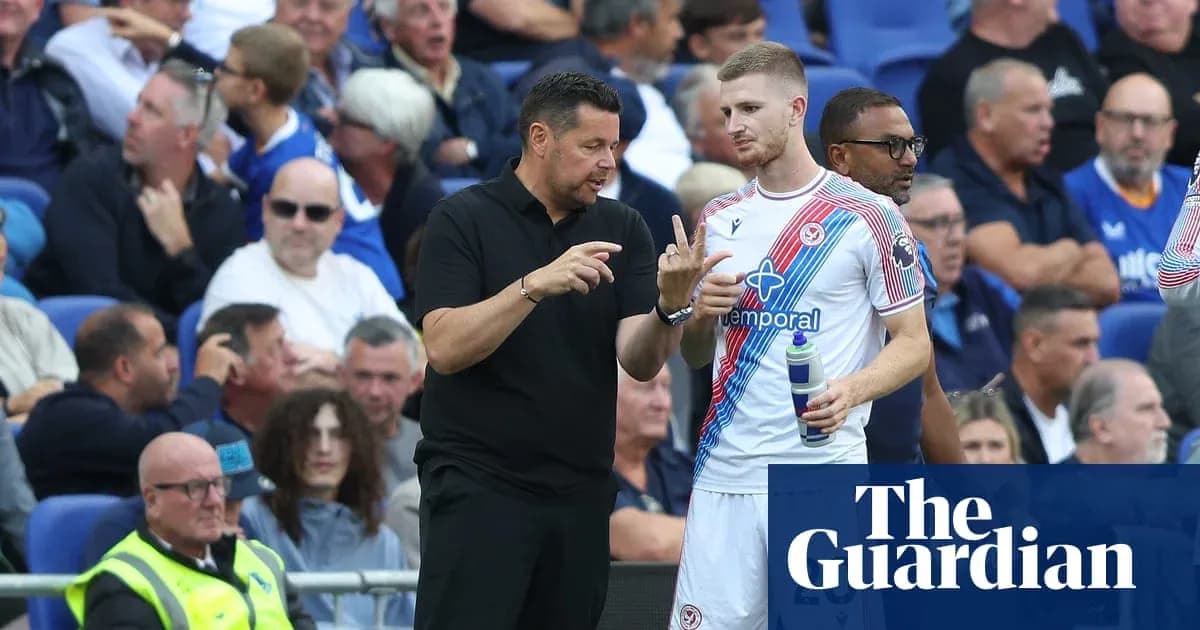
Pierre Sage walked into Selhurst Park with his eyes open. He had to. You do not replace Oliver Glasner – the architect of the most successful era in Crystal Palace’s history – without first studying the chaos you’re inheriting.
Two defeats to start the season, against Everton and Manchester City, have already cooled the glow of his summer arrival. Key figures from that Conference League-winning run have spent the past few months with one foot out of the door. The mood could easily have soured. It hasn’t. Not publicly, at least.
A manager who knew what he was signing up for
Palace’s reputation for late, frantic business is no secret. Ten signings on deadline day across the previous three summers told Sage everything he needed to know about life in south London. He came anyway.
“I knew that and I had to deal and adapt to that,” he said this week, the words calm rather than combative. The club missed out on Malick Fofana to Sunderland in one of the window’s more dramatic finales, yet still pushed four new signings through the door. Ismaïla Sarr and Jean-Philippe Mateta, both courted by bigger, richer clubs – Liverpool and Aston Villa among them – stayed put.
For a new manager, that could have been the flashpoint. Instead, Sage framed it as alignment. The squad, he insisted, matches the profile he asked for. The message: this is my group now. No excuses.
The Lacroix problem
Behind the scenes, the picture has been more complicated. Palace sold Maxence Lacroix to Chelsea in July, ripping out the defensive organiser at the heart of last season’s success. Replacing that kind of leadership is never straightforward; Palace found out just how difficult it can be.
Sage’s first choice was clear: Ismaëlo Ganiou. The 21-year-old was a cornerstone of the Lens side that followed his coach to glory in France, winning the Coupe de France and finishing second in Ligue 1 under him. Palace pushed. Lens pushed back harder. Ganiou signed a new deal in early August and the door slammed shut.
Other targets came and went. Joel Ordóñez of Club Brugge was ruled out, his broken foot too big a risk. Approaches for Chrislain Matsima at Augsburg and Raphaël Le Guen at Brest stalled and died. Time drained away.
Axel Disasi eventually arrived, along with teenage defender Honest Ahanor on loan. Both help. Neither is Lacroix. Inside the club, the question lingers: who leads that back line now?
Missed chances and a manager who keeps his cool
The theme of near-misses stretched into midfield. Mamadou Sangaré chose Brentford over Palace. Sage then turned to another familiar face, Malick Fofana at Lyon, and personally drove the pursuit. Phone calls on deadline day, persuasion, pressure, the full charm offensive. It still ended the same way – with the player elsewhere.
Sage refused to turn that frustration into a public feud with his employers. “We fight a lot and sometimes you cannot give more than this,” he said. “At the end, the player chooses.” The club pivoted to Dario Osorio from Midtjylland, a Chile forward arriving on an initial loan with an obligation to buy for £26m. Talented, quick, predominantly right-sided. A solution, but not the one he had spent the summer chasing.
Up front, Palace look stocked. Dwight McNeil is in, Evann Guessand too – though the latter has been left out of the Europa League squad. Sarr remains, his move to Liverpool never materialising. Ben Chilwell’s return and the late addition of Quinten Timber give Sage more options in midfield. The board also stood firm when bids came in for Adam Wharton, with Manchester City and Chelsea among the admirers. On that front, the manager sounded satisfied. The core of his team, at least, remains intact.
A club counting the pennies
Scratch the surface, though, and the financial story jars with Palace’s recent on-field ambition. After breaking their transfer record twice in January on Jørgen Strand Larsen and Brennan Johnson – the latter eventually swapped for McNeil in a deal with Everton – this summer went the other way.
Palace ended the window with almost £40m in profit, the second-lowest net spend in the division behind Aston Villa. Over the past five seasons, their total outlay of around £90m has been dwarfed by Hull and Coventry, both operating from the Championship. For a club with European football and a London postcode, that is a striking statistic.
Sage chose not to rail against it. His reference point was not another coach or another club, but his parents’ brasserie in Belley, in eastern France. Some days the restaurant was full, some days it was not. You made do. You adapted. You worked.
“We are not a bank,” he said. “We do with what we have.” It was a line that landed with more weight than any tactical briefing.
Fulham, injuries and a delicate mood
The immediate challenge is less abstract. Palace travel to Fulham on Saturday without Sarr and Mateta. Mateta’s hamstring problem killed off any hope of a late move and will keep him out for another three weeks. Sarr’s groin injury should clear in time for the Ipswich match next weekend, but his situation is more delicate.
Liverpool’s interest unsettled him. His agent’s public criticism of how the player was treated only added to the noise. Sage’s view is that Sarr “needs time” – time to recover, time to reset, time to remember he is still central to what Palace want to be.
So the new manager walks into Craven Cottage with a patched-up attack, a reshaped defence and a squad built on compromise as much as design. The Glasner era has gone. The Conference League euphoria has faded. The transfer window has closed.
Now the question is simple, and brutally so: with all the improvisation, all the missed targets and all the careful diplomacy, has Pierre Sage actually been given enough to keep Palace moving forward?