
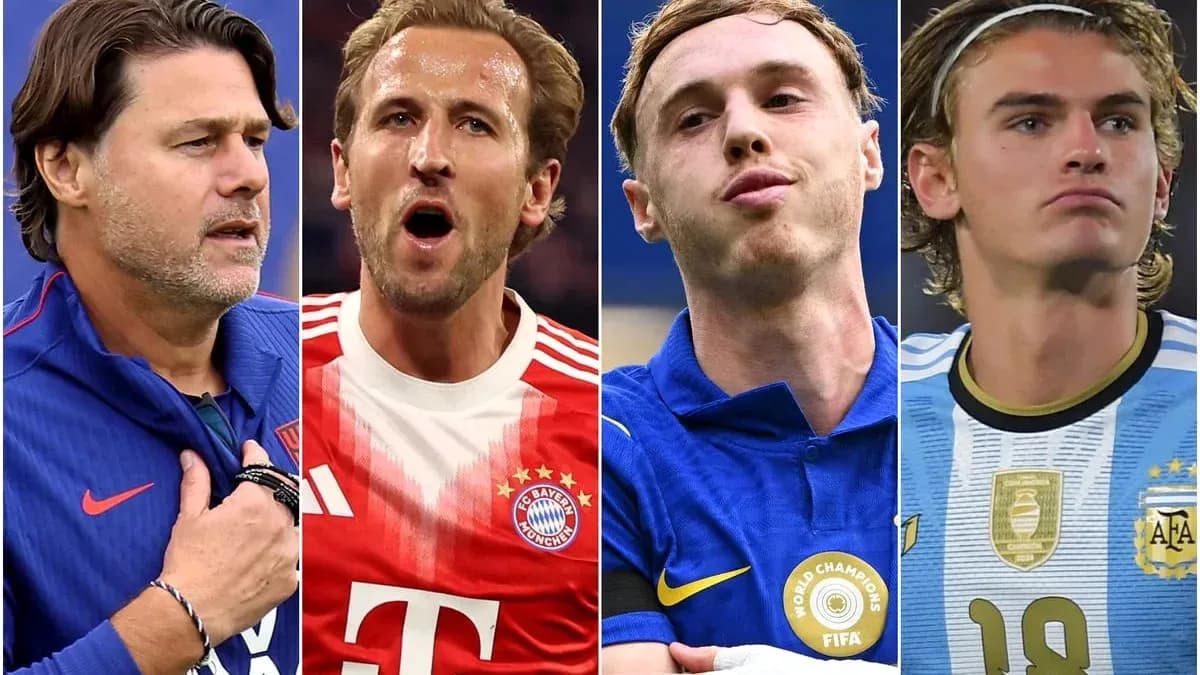
Mauricio Pochettino is edging closer to the Manchester United job, with club powerbrokers gathering in Monaco to thrash out Michael Carrick’s future and, by extension, the direction of a team marooned in the relegation zone after their worst league start in 40 years.
United need more than a new voice in the dressing room. They need a reset. Pochettino, if appointed, will walk into Old Trafford with the expectation of serious backing in January and beyond, tasked with dragging the club away from crisis and back towards something resembling its old stature.
And that raises the key question: what would a Pochettino-built United actually look like?
Building from the back
Pochettino has never been a manager who rips up every root for the sake of it. So Senne Lammens, despite a few recent mishaps that have seen the ball end up in his own net, would likely keep his place. He is a recent recruit, a capable goalkeeper, and this is not an area in total collapse. If it isn’t completely broken, Pochettino tends not to waste time fixing it.
The full-back positions are a different story. They have become a glaring weakness.
Luke Shaw’s body keeps betraying him, injuries undermining both his rhythm and his reliability. On the other flank, Diogo Dalot is now in his ninth season at Old Trafford and still hasn’t truly convinced as a long-term solution. For a coach who places such importance on the energy and intelligence of his wide defenders, that simply won’t do.
At Tottenham, Pochettino built some of the Premier League’s most dynamic full-backs, moulding young, athletic players into relentless runners who could dominate both sides of the ball. It’s easy to see him pushing for a similar profile at United, which brings Lewis Hall and Archie Gray into focus.
Whether Hall, tied down on a new contract, or Spurs’ Gray could actually be prised away is another battle entirely. But the lure of working under Pochettino, with his track record of elevating young talent, would carry real weight. Both Hall and Gray already look assured at Premier League level, comfortable going forward and defending their flank. Gray, on top of that, carries the early signs of leadership that managers cherish.
An Argentina core and a high ceiling
At centre-back, an Argentina thread runs through the thinking. Pochettino’s connection to his homeland and his fondness for aggressive, front-foot defenders makes Lisandro Martinez an obvious pillar for United’s medium-term plans. The defender’s bite, passing range and willingness to defend high up the pitch fit neatly into Pochettino’s blueprint.
Alongside him, the temptation to work with another high-upside youngster would be hard to resist. Leny Yoro, still only 20, fits that description perfectly. Raw, but with the kind of potential Pochettino has always relished, he would give United a pairing that could grow together under demanding, detailed coaching.
A midfield to bridge eras
In central midfield, Pochettino’s ideal scenario blends experience with youthful exuberance.
Youri Tielemans would be asked to anchor that unit, dictating tempo and offering the kind of calm, technically secure presence that allows a team to breathe. Next to him, Kobbie Mainoo would be the apprentice, learning in real time alongside a seasoned operator, encouraged to express himself but also to understand the tactical discipline Pochettino demands.
Ahead of them, the attacking midfield and wide roles hint at both nostalgia and ambition.
A reunion with Cole Palmer would be a tantalising prospect. The forward played his best football at Chelsea under Pochettino, blossoming into a decisive, inventive presence in the final third. At United, he would be deployed from the right, driving inside, linking play and offering goals.
That shift opens up the central No10 role for a new face. In this imagined XI, Bruno Fernandes’s successor in that slot is Como’s Nico Paz. Already a full Argentina international, Paz has the profile Pochettino loves: a creative No10 with promise, hunger and plenty of room to grow. Under a coach who specialises in challenging young attackers to hit the next level, he would be pushed hard.
Rashford, a new spearhead, and the Kane question
On the left, Marcus Rashford remains the obvious choice. For all his fluctuations in form, his pace, direct running and eye for goal make him a natural fit cutting in from the flank in a Pochettino side that thrives on vertical bursts and quick transitions.
Through the middle, the hunt for a striker becomes trickier. Pochettino would, of course, scan the market. Benjamin Sesko would get a long, hard look, but genuine top-level centre-forwards are scarce and expensive.
The answer, in this scenario, is Bryan Mbeumo.
The Cameroonian has spent this season leading the line out of position, yet has still emerged as just about the only shining light in what has been a miserable spell under Carrick. His work rate, movement and willingness to carry responsibility would make him a compelling option to spearhead United’s attack. He may not be the superstar name supporters dream of, but he looks like a Pochettino player: selfless, adaptable, and effective.
Of course, in an ideal world, Pochettino would simply pick up the phone and reunite with Harry Kane. The pair’s partnership at Tottenham came agonisingly close to silverware and defined an era of exhilarating football. But that dream has drifted out of reach. Kane has just signed a new three-year contract with Bayern Munich, becoming Europe’s highest-paid player by base salary. That door is shut.
So, for now, Mbeumo leads the line. Around him, a team reshaped in Pochettino’s image: younger, hungrier, more aggressive, and built to grow rather than simply survive.
If United do pull the trigger in Monaco and hand him the keys, the question won’t be whether he has a plan. It will be how quickly this imagined XI can turn from a theoretical blueprint into a team capable of dragging a fallen giant back up the table.





