
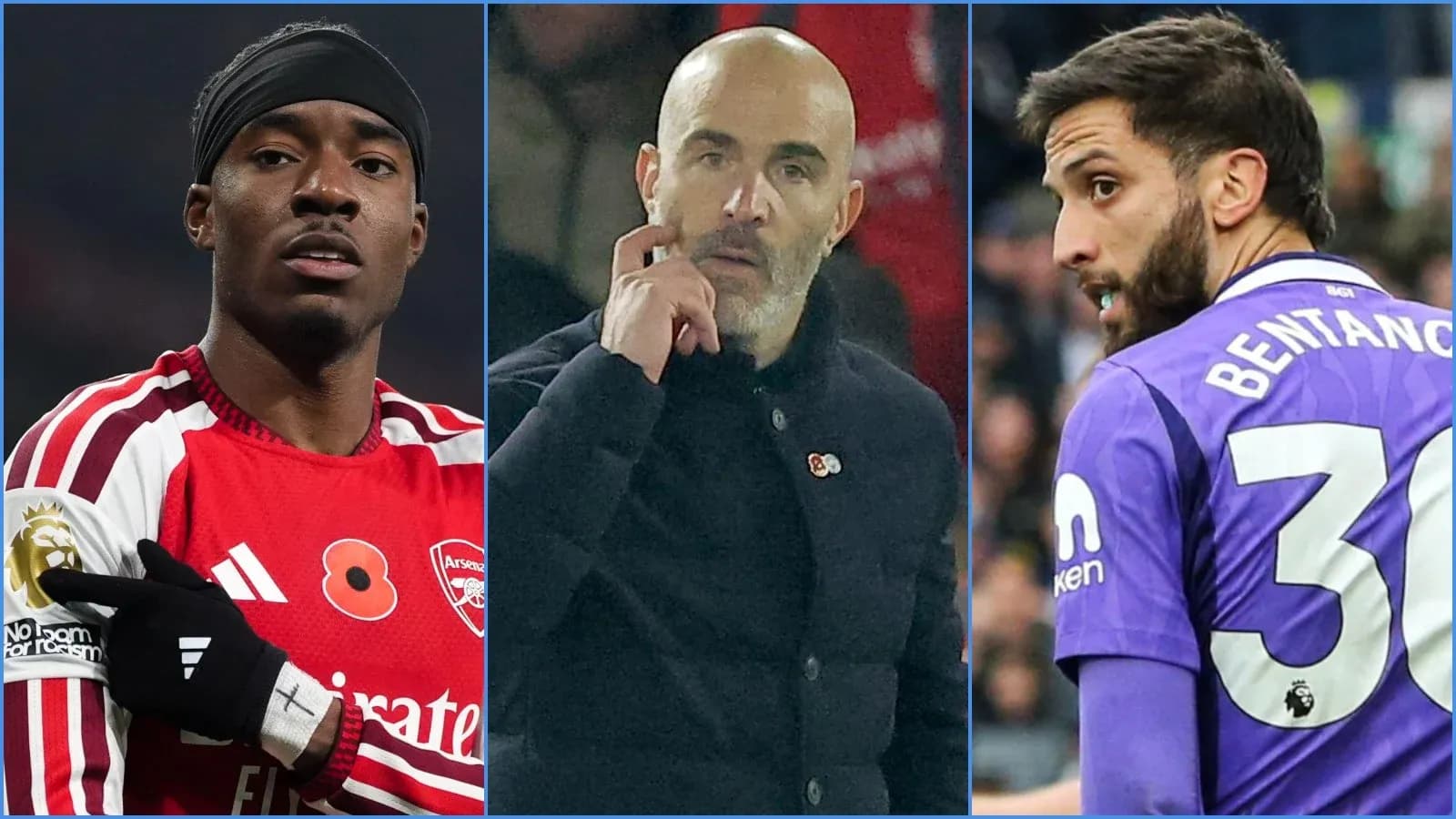
Noni Madueke, David Moyes and Rodrigo Muniz walk into the international break as winners. Unai Emery, both Manchester clubs and a Spurs midfielder trudge out of it with a familiar sense of dread.
The Premier League never does half-measures. Even on pause, it finds a way to bare its teeth.
Forest and Brighton: Different paths, same direction
Nottingham Forest are not just surviving. They’re striding. A team once boxed in by relegation maths now looks like it has worked out the equation at the other end of the table. The title talk will sound outrageous to some, but Forest’s trajectory has that unmistakable upward pull: organised, aggressive, increasingly ruthless.
Then there’s Brighton, who don’t so much win games as suffocate them. Their last 10 Premier League victories have all been to nil, racked up through 25 unanswered goals. Once Brighton score first, the contest feels less like a match and more like a slow, inevitable submission.
Pascal Gross quietly conducts, Diego Gomez lets fly from distance as if the 25-yard line is his personal penalty spot, and Luka Vuskovic dominates as long as the game is in front of him. Give him a set-piece in the opposition box and he suddenly looks like a roaming No 9. The result is brutal: the second-best team in the country, scoring first and then positionally outplaying you into oblivion.
Madueke: From snub to standard-bearer
Noni Madueke has turned an England snub into rocket fuel.
Mikel Arteta called him “the best player in training in the last 10 days” before restoring him to the Arsenal XI when the domestic season resumed in October. A few weeks later, heading into another international break without a call from England, the manager was talking about “a different Noni”.
On the pitch, the numbers back that up. Across a punishing spell of nine games in 28 days, no Arsenal player has been more influential. In the league alone, Madueke has effectively delivered four extra points: the only goal against Nottingham Forest, and the shot that forced the decisive breakthrough against Hull.
Hull felt the full force of it. Madueke led the match for shots (four) and duels won (eight). He had at least five more touches in the opposition area than any other player. He completed six dribbles – as many as everyone else on the pitch combined.
No one in the division is creating more chances per 90 minutes. It’s a small sample, but the profile is clear: this is the elite, game-breaking wide forward Arsenal did not sign in the summer. The only blemish is his tendency to overcomplicate a move, as shown by that maddening late miss at the end of a gorgeous team sequence. Even that, though, hints at upside. There is still so much more to come.
His response to being overlooked by England was to fly to Portugal on his own initiative, train, sharpen, and come back transformed – from undesirable to undeniable. Now he heads into another break with more time to work, more fuel from rejection, and more defenders who will wish he’d just stayed home.
Moyes and the centre-forward factory
Say what you like about David Moyes. Plenty have, for the best part of 25 years. But few managers in the Premier League era have understood, profiled and unleashed a centre-forward quite like him.
Thierno Barry is the latest entry on a list that reads like a quiz question and a punchline at the same time. Marko Arnautovic, Michail Antonio and Jarrod Bowen were all retooled or repurposed into devastating line-leaders at West Ham. Before that, Nikica Jelavic and Beto each hit 16 league goals under Moyes despite often looking as if they were still learning which bit of the ball to kick.
Barry is now just two shy of that mark in Moyes’ personal Premier League scoring charts. His brace against Coventry moved him past James Beattie and into the airspace of Jermain Defoe and Duncan Ferguson, both on 15.
Moyes almost certainly believes Everton would have won the title in his first spell if he’d had Barry up front. The way Barry is playing, you’d struggle to argue with him.
Muniz: A goal, a loss, and a dedication
For Rodrigo Muniz, the wait for another Premier League goal stretched back to the opening day of last season. The drought ended against Newcastle, but the story behind it cut far deeper than a barren run in front of goal.
“Last season was really difficult for me because, now I can say it, but I had the surgery,” he revealed after the draw. “My wife was pregnant last season and, unfortunately, we lost the baby, but God is good all the time and now she’s pregnant again. The goal was for my baby, and I hope this season will be different than last season.”
It was a raw, human moment in a sport that often hides those away. The finish mattered. The context mattered more. Fulham will hope the goal unlocks his season. Neutrals will hope no bigger club comes along to twist the story into something uglier.
Ahoka and Sunderland’s quiet coup
Jules Ahoka arrived at Sunderland in August for £8.6m with barely a footprint in senior football. Two professional games. Ninety-eight minutes. Ninety of those at centre-half.
Fast-forward to this week and he has started five times, scored in the Europa League and, against Chelsea, was thrown into the deep end almost immediately. On came Ahoka in the fourth minute for the club captain, staring at a £173m midfield in blue.
He didn’t blink. He dominated.
By full-time, Ahoka was man of the match and had racked up more defensive contributions than anyone else on the pitch – 14 across tackles, interceptions, recoveries, clearances and headed clearances. Sunderland kept a clean sheet, their manager got a vital win, and an 8.6m gamble suddenly looked like a masterstroke.
While some clubs have turned squad-building into a bloated, mismanaged science, others keep quietly finding gems. The contrast with Manchester United’s sprawling, incoherent midfield rebuild is hard to ignore.
Liverpool and Bournemouth: Away days and succession plans
Liverpool sit 18th in the home table. That’s the jarring part. Top of the away table and the only side still unbeaten on the road? That’s the twist. For years the worry has been what happens to them away from Anfield. Now the suspicion is that Anfield itself, with all its weight and expectation, might be holding this version back.
Bournemouth, meanwhile, are running a different kind of experiment. In this calendar year alone they have set a club record for their longest unbeaten run and matched their best sequence of consecutive wins. Two different managers, same upward curve. That’s what proper succession planning looks like.
Evanilson has become the patron saint of chaos, forcing mistake after mistake from opposition defences. Bournemouth have scored at least twice as many goals from opposition errors as any other team. The only regret is timing: they ran into Manchester City before Marco Rose had joined the dots, and they won’t get another crack at them until April.
Lammens and the Goalkeepers’ Union
Senne Lammens had a moment that will not be replayed in any Goalkeepers’ Union training videos. That’s the thing with high-profile errors between the posts: everyone sees them, and no one forgets. He’ll know exactly how far short he fell. The only question is how quickly he turns the embarrassment into edge.
Palace, Emery and the Old Trafford curse
Crystal Palace can dress it up however they like, but everyone knows how this story ends. Roy Hodgson’s name hangs over the club like a recurring dream. Or a recurring mistake. They can delay the inevitable, but they can’t pretend they’re not thinking about it.
Unai Emery, by contrast, walks away from Old Trafford as both winner and loser. Winner, because Manchester United will now surely leave him alone and therefore not ruin him. Loser, because the numbers are absurd.
Ten trips to Old Trafford. Four different clubs. Five different United managers. Emery has led nine times in those games – 0-1 on four occasions, 1-2 twice, 0-2 twice and 2-4 once. He has never won there.
Villa and Emery are better together than apart. But Old Trafford remains his personal house of horrors.
City: From slick machine to awkward transition
The inflatable bananas in the away end used to symbolise a kind of giddy defiance. Now they feel like a costume for a party that ended early.
Manchester City look like strangers to themselves. A squad built for one manager is adjusting to another, and it shows. The new-manager bounce has flattened, the siege mentality has cooled, and a club in transition on the pitch is locked in stasis off it.
Playing badly is one thing. Playing badly while found guilty of systemic cheating is another. The joy has drained away. The grind remains.
United: Living off stoppage time
For two minutes and 46 seconds, Manchester United were bottom of the Premier League. In November. During their tenth game.
Stoppage time has saved them from outright humiliation in each of their last two matches – a comeback win and a scarcely believable 4-4 draw. Fergie Time, the old superstition, has become a broken clock that occasionally strikes the right hour.
Strip away the drama and the picture is bleak. This is almost certain to be their longest continuous spell in the top-flight relegation zone since at least October 1986, when it became obvious Ron Atkinson could not continue.
That moment has long since arrived with Michael Carrick, yet the club clings to late goals as evidence of a corner turned rather than a warning flare. The maze that trapped far more decorated managers now has a new occupant.
Fun.
Bentancur and the Spurs hex
Rodrigo Bentancur’s season has become a case study in how one player’s presence can somehow, inexplicably, coincide with everything going wrong.
The caveat is important: the mess starts with Roberto De Zerbi. His tactical missteps sit at the root of Spurs’ issues. But Bentancur’s numbers are still staggering.
Spurs have not scored a single goal with him on the pitch in the league this season. They have conceded eight. The timeline is almost comical.
He started against Aston Villa and was taken off in the 84th minute with Spurs 3-0 down. They scored twice after he left. He was sent off at 1-0 down against Manchester United and inadvertently lit the fuse for a comeback. The suspension that followed kept him out of three straight wins in which Spurs conceded just once. He then returned with a bright cameo against Leeds at 0-0, only to end up assisting the winning goal for the opposition.
Curse, coincidence or cruel variance, the pattern is brutal. With Bentancur on the pitch, Spurs are consistently worse.
Leeds, Brentford and the price of edge
Leeds will savour their win over Spurs. They earned it, fought for it, deserved it. But ask any long-suffering supporter and they’ll tell you the joy is tempered by one ongoing frustration: Tarik Muharemovic.
He looks ungainly, awkward, supposedly unsuited to the Premier League’s physicality. The jokes write themselves. Yet he leads the division in both clearances and headed clearances, by a distance. Leeds will grumble, roll their eyes and, if they’re honest, keep picking him.
Brentford’s problems lie at the other end of the emotional spectrum. Two red cards for violent conduct in three games is not edge, it’s self-harm. Igor Thiago earns more sympathy than Yehor Yarmoliuk, but both incidents exposed a naivety Brentford should have outgrown by now.
They have already matched their total of three red cards from their first Premier League season. If they keep ignoring the lessons of the last few weeks, that number will rise, and so will the cost.
Hull, Newcastle and the missing goals
Hull’s return to the top flight has not brought the thrashings many predicted. When they were last in the Premier League, only four of their 22 defeats were by a single goal. This time, all three of their losses have been 1-0 or 2-1.
The winless run is now nine games. Sergej Jakirovic will take no comfort from that. But the narrow margins speak of organisation, energy, and a refusal to fold. They may yet go down, but they will not go quietly.
Next up after the break? Brighton. Of course.
Newcastle’s problem is the opposite. They are not short of goals in total – 255 Premier League strikes spread across the squad – but the distribution is alarming.
Only two current players have ever reached double figures in a single top-flight season: Harvey Barnes for a relegated Leicester side in 2022/23, and Yoane Wissa across two campaigns at Brentford that ended up costing Newcastle dearly in the market.
Joelinton, third in this squad’s all-time Premier League scoring list, has 24 goals across six seasons. Jacob Murphy, the hero against Fulham, has 23 in his ninth. Fifth on the list is Fabian Schar, a centre-half.
In Newcastle’s last 36 league games, only Will Osula (seven) has outscored Anthony Gordon and Bruno Guimaraes (six each). Neither is a natural finisher in the classic sense. A big chunk of goals was sold in the summer and never properly replaced, despite a spend north of £250m.
The numbers don’t lie. They just sit there, quietly accusing.
Colwill, Ipswich and fragile reputations
Levi Colwill’s afternoon against Brian Brobbey will live long in the memory for all the wrong reasons. In 20 years’ time, he will almost certainly be on a podcast somewhere, telling an AI-generated Jake Humphrey that Brobbey was his toughest opponent. The tape from this game will back him up.
Injury and absence had burnished Colwill’s reputation last season, helped along by Enzo Maresca’s vocal frustration at losing him. Now he is back on the pitch, the reality is more complicated. Performances like this don’t kill a career, but they do stain it just enough to remind everyone that potential is not a shield.
Ipswich have their own defensive stain to scrub away. Twenty-nine Premier League games without a clean sheet is not a blip, it’s a trend. The last team they shut out in the top flight had Christopher Nkunku up front and Joao Felix in support. That feels like another era.
The league pauses now, but the questions don’t. Who uses this break to reset, and who comes back to find the same problems waiting in the same places, only louder?





