
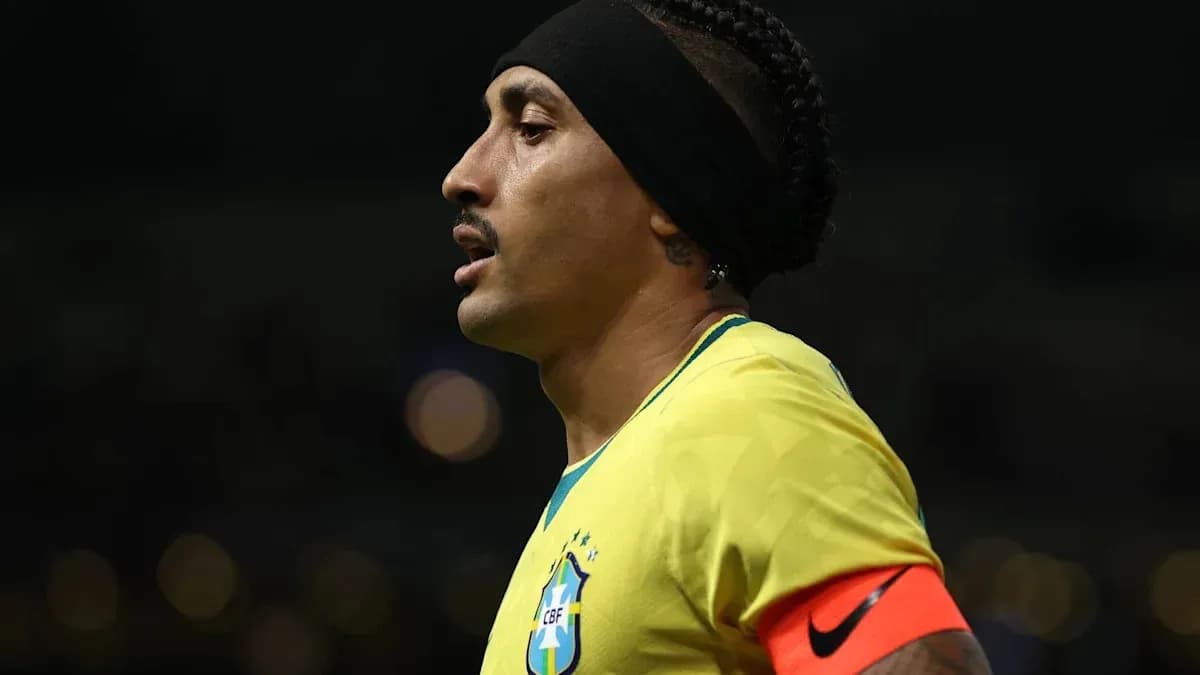
Raphinha’s night in Singapore was supposed to be about rhythm and reassurance. It ended with a walk down the tunnel, a straight red card, and fresh questions for both Brazil and Barcelona.
On a sticky November evening, Brazil were beaten 3-2 by Japan, undone by a stoppage-time winner and a storm of protest that saw the Barcelona captain and head coach Carlo Ancelotti both sent off.
The flashpoint arrived deep into added time. Tatsuhiro Sakamoto had just driven Japan’s winner past a scrambling Brazilian defence when the protests erupted. Brazil’s players and staff surrounded the officials, convinced Joao Gomes had been fouled in the build-up.
Raphinha, already under a microscope before a ball was kicked, went too far. The referee reached straight for red. Moments later, Ancelotti followed him down the tunnel, dismissed for his part in the angry scenes.
For Raphinha, it capped a brutal international break.
Fitness doubts, contract noise, and a risky start
The stakes for him were high before kick-off. Only recently back from a muscle problem, he had stood at his contract renewal ceremony and admitted what everyone could see: he was not yet fully fit.
Those remarks, and his follow-up explanation that he had spoken with Ancelotti about managing his physical condition, set off a storm back home. Some took it as a plea to ration his minutes for Brazil. Raphinha insisted otherwise in Singapore, facing the media to stress he wanted to play whenever his body allowed, that he was trying to avoid another spell on the sidelines, not pick and choose fixtures.
Barcelona watched all of this with unease. Repeated muscular issues during international windows have made them wary, and yet here he was, leading the line for Brazil.
Ancelotti didn’t park him on the wing or ease him in. He trusted him at the heart of the attack, starting Raphinha as Brazil’s number nine. It was a bold call, given the context and the calendar.
Raphinha responded with industry if not a decisive moment. Across 71 minutes he managed 39 touches, two shots on target and created one clear chance, working between the lines and trying to knit Brazil’s forward play together before making way for Endrick.
The real damage to his night came long after he had been substituted.
Japan strike early, Brazil chase late
Before the chaos, there was a game that swung sharply against Brazil in the opening stages.
Japan flew out of the blocks. Takefusa Kubo struck first, then Keito Nakamura added a second, and by the 19th minute Brazil’s defence had been cut open twice and looked rattled. Every Japanese surge seemed to expose another gap, another hesitation.
Brazil needed a spark and, as so often, Vinicius Jr. found it. He halved the deficit, then dragged his team level in the 75th minute with his second of the night, turning what had threatened to become a humbling defeat into a contest again.
At 2-2, the momentum felt Brazilian. Japan, though, refused to fold. They stayed compact, picked their moments, and when stoppage time arrived, they struck with precision.
Sakamoto’s late goal flipped the mood in an instant. Brazil’s bench erupted, not in celebration but fury, fixated on the challenge on Joao Gomes in the build-up. The arguments boiled over, and the referee’s response was ruthless: red for Raphinha, red for Ancelotti.
A bruising break and an uncertain next step
For Brazil, the 3-2 defeat will sting. For Raphinha, the repercussions run deeper.
He leaves Singapore with more than just minutes in his legs. He now carries an unwanted disciplinary mark at a time when his fitness, his workload and his role for the national team are all under intense scrutiny.
His dismissal forces Brazil to weigh up his availability for their next friendly, also in Singapore on November 17. For a player trying to prove he can be trusted physically and emotionally on this stage, the timing could hardly be worse.
Barcelona, watching from afar, will not have enjoyed the sight of their captain in the middle of another storm.





