
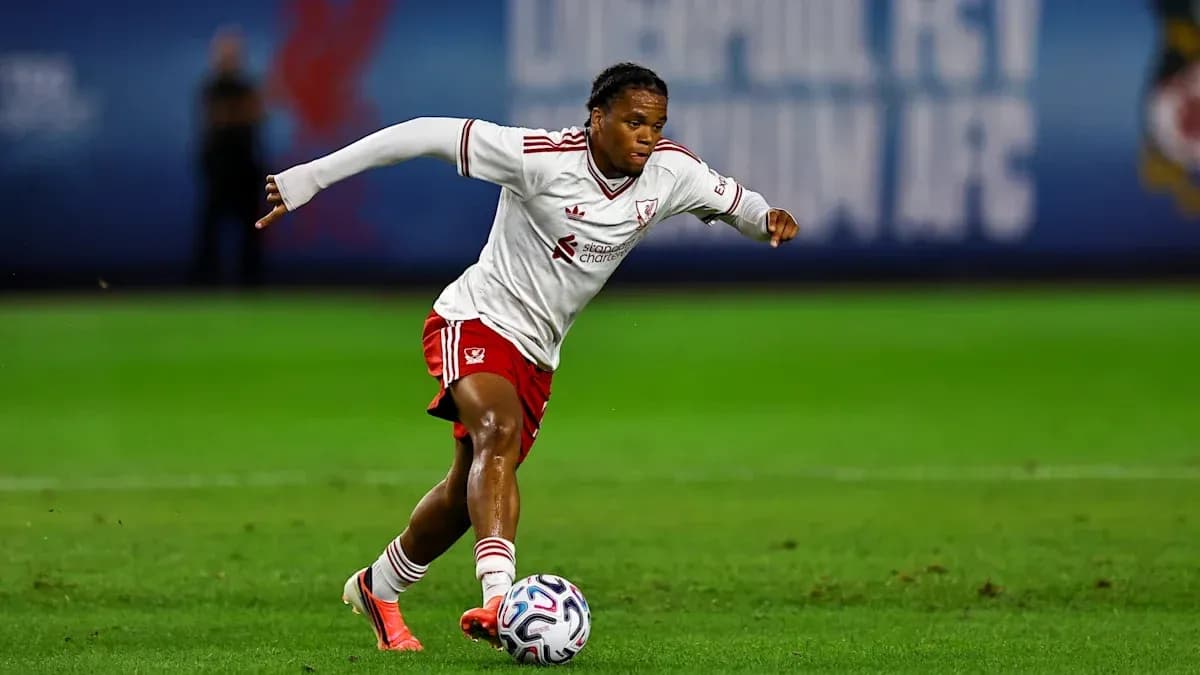
Rio Ngumoha is 18 years old and already carries a label that usually belongs to club folklore, not to a teenager still finding his way. Liverpool’s youngest-ever goalscorer. Forty-four senior appearances behind him. The novelty has gone. The scrutiny has not.
He understands the difference now. Talent gets you noticed. Trust gets you picked.
The goal that changed everything
His life shifted in a single August moment against Newcastle United in 2025. One strike, one clean connection, and a career moved from promise to proof.
"That goal, it's still in my mind, to be fair," he said in an interview with the club’s media. "I remember my mum, she still to this day can't stop watching it. But I know that memory will always be in my head and I'll never forget that day."
That is the emotional snapshot: a teenager, a family, a replayed clip on repeat in a living room. The football reality is harsher. He scored, people noticed, and expectation followed. The glow of a first goal fades quickly at a club that measures itself in trophies and standards, not sentiment.
Ngumoha is no longer the kid everyone points to as “one for the future”. He is part of Andoni Iraola’s present, living inside the grind of first-team football, where every appearance is a test of whether you can be trusted again.
A winger who plays with no fear – and within limits
Ask Ngumoha what he is and he does not reach for buzzwords or brand slogans.
"I'll just say I'm just like a free player, try to play with as much freedom as I can within the structure, of course, and be fearless and don't really think too much," he explained. "Just if I see a one-v-one then obviously try to take it on. But if not, I can use my teammates. I just say I play freely with no fear. I'll say just fearless."
That is Liverpool’s blueprint for wide players stripped back to its essentials. Attack with purpose. Win your duel if it is there. Release the ball if it is not. No extra touches, no unnecessary flourishes.
Plenty of young wingers fall in love with the decoration. Ngumoha talks like someone who has already been told, bluntly, that the only currency that counts is end product and impact.
One phrase jumps out: “within the structure”. Iraola does not give creative licence for free. Freedom on the ball has to be repaid off it. Pressing, tracking, recovering. Ngumoha knows the deal.
Learning the other wing
Like many left-footed attackers who grow up hugging the touchline on their natural side, he has had to move. This season, he has found himself more often on the right, facing the game differently, receiving the ball on the opposite angle, and he has not tried to pretend it all came naturally.
"I think it's difficult. Like you said, I'm more used to playing on the left and this season I'm playing more on the right," he admitted. "I think the first couple of games I've been struggling. But the gaffer and all the coaching staff and all the players, they helped me a lot. Then when I went away with England as well, that really helped, I learnt a lot from all the wingers. Now I'm enjoying playing on the right as well because it's another toolset to be [able to] play on the left and the right. It's important in world football to be unpredictable and stuff. I'm enjoying myself right now."
No drama. No excuses. He struggled, he listened, he adapted. That is how careers move forward.
Modern wide forwards are expected to slide along the frontline, solve different problems, and survive different game states. If you can only do one job, someone will eventually design a plan to take that job away.
Ngumoha is already looking at it through that lens.
"Obviously I haven't mastered anything yet, of course. I'm still learning," he said. "I think definitely knowing that the manager can say, 'We can play Rio left today' or 'We could play Rio on the right' or whether I'm on the bench and 'We can bring Rio on on the left and the right', I just think that's a really big toolset to have. I think for every young player, especially coming through academies, you can't just have one position. You definitely have to have a lot more now. You have to be a lot more versatile. It's good."
That is not a buzzword. It is survival in elite football.
The unseen work: earning trust off the ball
The more intriguing part of his development is not the dribbling or the finishing. It is what he keeps bringing up: movement, tracking back, game management. Young attackers usually want to talk about nutmegs and goals. Ngumoha keeps steering the conversation towards the ugly work.
His relationship with Iraola and the staff sits at the heart of that shift.
"I think it's definitely grown," he said. "Because I think sometimes when you're young, managers might think that you're a bit shy and stuff. But once you start speaking and once I start speaking to them, they really understand you, which is nice. I think me and the gaffer and all the other coaching staff, Tommy [Elphick], Coops [Shaun Cooper], Pablo [de la Torre], they have a great relationship with everyone and me as well. It's just enjoyable to work with them every day. They help me a lot and they've been helping me a lot. So, it's good."
The conversations have a clear purpose.
"Like I say, with the gaffer and all the other coaches, they've really been helping me off the ball and on the ball," he added. "So it might be like my movement or tracking back and we'll just have these little meetings and they just go into more detail and stuff. Like I say, I'm always eager to learn. Because even though I'm young, I want to be starting as many games as I can. For example, if we're losing or we're winning 2-0 or 2-1 and the game's tight, I just want their trust, 'Rio can also help us score a goal but also stop a goal as well.' So, I think that's important now in football to gain the manager's trust. Slowly and slowly I'm improving, which is nice."
That is the crux of it. He does not want to be the wildcard thrown on at 0-0 when a game needs a jolt. He wants to be the winger a manager leans on at 2-1 with ten minutes left.
He went even further: "I think definitely off the ball, whether it's a full-back making runs in behind and I stop him. I think that's the one big thing that I can do to gain everyone's trust, even the teammates, so they know if we're winning and it's a tight game and I come on, yeah I can score but I can also help. I think that's very important."
For a young forward, that is not the glamorous part. It is the part that keeps you on the pitch.
Van Dijk, Salah and the art of growing up fast
No academy product makes it alone at a club like Liverpool. The environment either swallows you or sharpens you. Ngumoha has had heavyweight voices in his corner.
"Virg is very helpful," he said of Virgil van Dijk. "He's the leader in the team. He very much puts his trust in me, Trey [Nyoni], [Lewis] Koumas, all the young players as well. He sees us like we're one of them, which is very nice. Obviously we're young but just to have that respect from, for me, the best centre-back in Premier League history is crazy."
That sort of backing matters. Dressing rooms can be unforgiving places. If senior players believe you belong, the pathway widens.
Ngumoha also drew on time spent around Mohamed Salah, a forward who built a Liverpool legacy on relentless numbers and ruthless timing.
"Mo taught me a lot," he said. "I think at the start, just watching him score all of his goals, all the records that he's broken, you learn a lot. Then you train, then you learn a lot. And when you speak to them, because I think also people forget that footballers are just normal people, they're human beings, so you can come and speak to them about anything, I think once you understand and recognise that, Mo is just really helpful. He taught me a lot of things on the pitch but also off the pitch and I'll always thank him for that."
One lesson cut through everything else.
"There was one instance I remember," Ngumoha recalled. "He was just saying, obviously he knows that I'm talented, but to reach the top, top level, in the last 20 minutes of the game you just have to stay alive, be ahead of everyone, be quicker than everyone and that's where you get the most goals really, when all the defenders are tired. You see how many goals he scored, especially in the dying moments of games. I think that's one big thing he taught me."
That is not mythology. It is tradecraft. The small, ruthless habits that separate a promising winger from a decisive one.
Ngumoha has the pace. He has the nerve to take on defenders and the appetite to keep doing it when he fails. The next phase is more demanding. Become reliable. Become tactically flexible. Become the player a manager trusts in every phase of a match, not just when the game is open and the stage is kind.
If he gets there, that Newcastle goal will not stand alone as a landmark. It will be the first chapter of a much bigger story.





