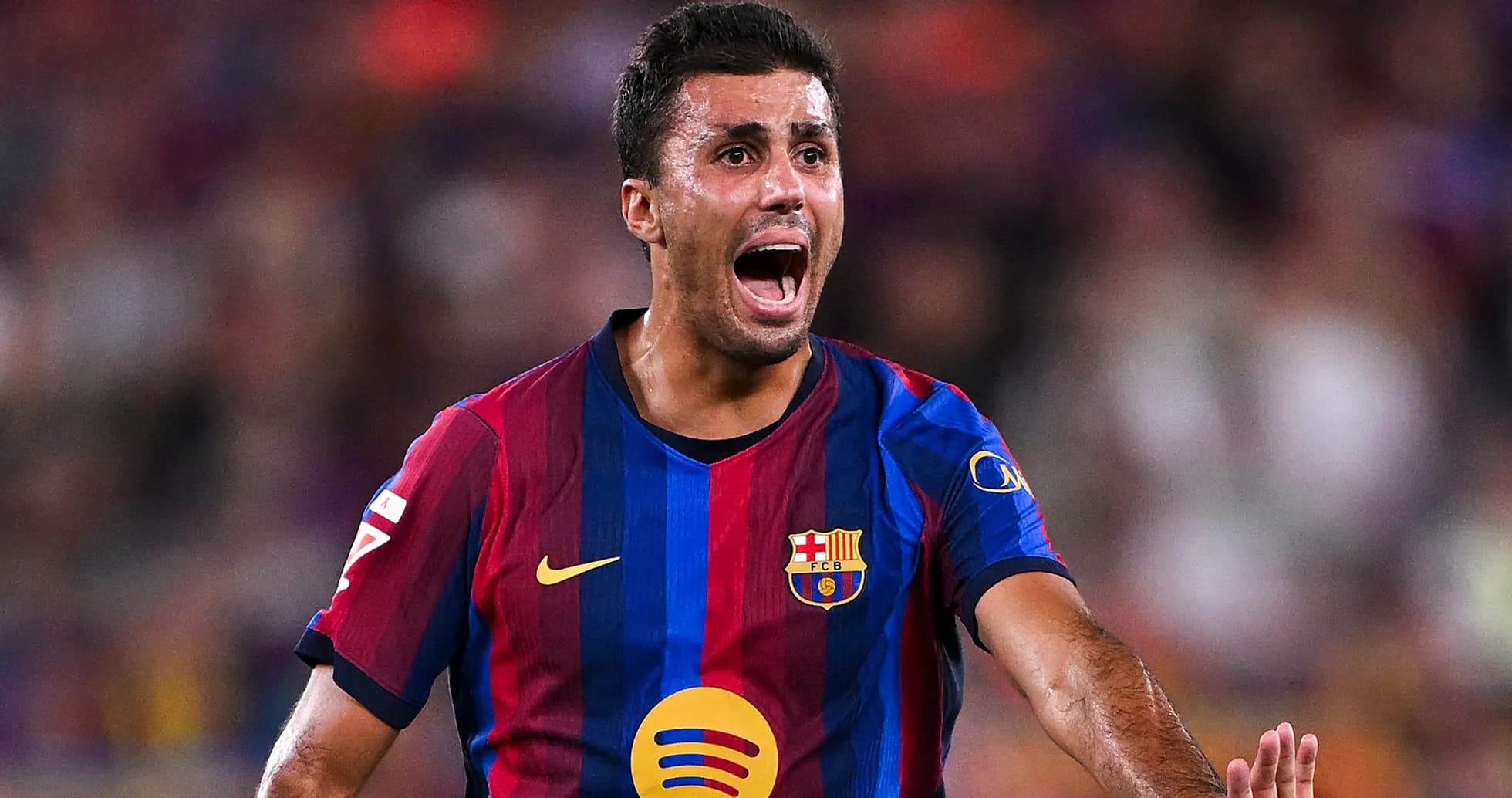
Rodri does not talk like a man who has just cashed in. He talks like a man who has chosen a cause.
The 2024 Ballon d'Or winner walked away from the comfort of Manchester City and the Premier League this summer, swapping a dynasty he helped build for a Barcelona side still trying to rediscover its own. At 30, with every major club in Europe willing to move mountains for him, he chose Camp Nou. He chose Hansi Flick. And, pointedly, he chose against Real Madrid.
A process, not a bombshell
From the outside, it looked like a thunderclap: City’s midfield metronome, the best holding midfielder in the world, suddenly bound for La Liga. Rodri paints a slower picture.
“It’s been a process, rather than a decision,” he told Mundo Deportivo. First came the realisation that his time in Manchester was coming to a natural close, that the itch for a new challenge had arrived. Only then did Barcelona step in with an offer that felt, to him, like a footballing fit rather than a financial coup.
“From there, the moment the opportunity at Barcelona arose, I realised it was the best thing for me for many reasons,” he said. No drama, no last-minute twist. Just a player at his peak deciding where the next phase of his career should be written.
Flick, Deco and a football-first project
Rodri has never hidden how he thinks the game. He is a strategist in boots, someone who reads structures and systems as much as scorelines. So when he explains his move, he keeps returning to the same word: sporting.
“I’ve always based my decisions on sporting considerations – where I believe I’ll be able to win, be happy and, above all, develop as a player,” he said. Barcelona, in his mind, ticked every box.
What drew him in was the axis at the top of the club: head coach Hansi Flick and sporting director Deco. He spoke of “the generation of players they have and what Hansi is building there,” describing how the pair “convinced” him that Barca’s project would stretch him, not just decorate his CV.
This is not a veteran winding down. This is a Ballon d’Or winner choosing the hardest road.
Saying no to Madrid
All of which makes his rejection of Real Madrid even more pointed.
Madrid wanted him. Badly. A Spanish international at the height of his powers, schooled in elite positional play and forged in City’s winning machine, is exactly the kind of signing the Bernabeu hierarchy normally does not miss. This time, they did.
“I had to weigh up a lot of things and make such an important decision between two of the best clubs in the world,” Rodri admitted. The pull of Madrid, the prestige, the promise of titles under the lights of the Bernabeu – he did not pretend it was easy to turn down.
“In the end, I made my decision based on sporting considerations – on what sparked a bit more enthusiasm in me and on understanding where I could win and develop the most as a player,” he said. Then came the line that will sting in the capital: “It wasn’t an easy decision at all; saying no to Madrid wasn’t easy, especially as they treated me exceptionally well.”
They did almost everything right. It still wasn’t enough.
A family club, not a pressure cooker
What tipped the balance? The way Barcelona courted him.
Rodri described a club that did not harass or hound, but welcomed. “Very homely, like a family club,” is how he put it. For a global giant often accused of chaos at board level, that is quite a statement.
“At no point did they put any pressure on me whatsoever; everyone expressed their desire to have me on board, to work together, and to see what I could bring to the team,” he said. No ultimatums, no media briefings to force his hand. Just football conversations.
“It was more about the football itself – what they understood I could bring both on and off the pitch, and I really liked that.” For a player who has built his reputation on control, clarity and intelligence, that kind of approach matters.
Ballon d'Or storm left at the door
His move came in the shadow of Real Madrid’s highly publicised boycott of the Ballon d'Or ceremony, a night when Rodri beat Vinicius to the prize and the politics around the award flared into the open. It would be easy to draw a line from that snub to his choice of Barcelona over Madrid.
Rodri shut that door.
“Anyone who knows me knows that I try to distance myself from that sort of thing, like the media hype,” he said. He insisted the noise around the Ballon d’Or played no part in his decision, that he lives in a different space to the headlines and the talk shows.
“I focus on football. In that sense, I’m very English, aren’t I? The Premier League is football and little else.” It is a revealing comment from a Spaniard returning home: a quiet warning that he will not be dragged into the storm that often surrounds the Clasico divide.
He has chosen Barcelona for what happens between the white lines. The rest – the politics, the narratives, the lingering Madrid frustration – will swirl around him regardless. How long he can keep it all at arm’s length will define not just his legacy in Catalonia, but the balance of power in Spain for years to come.