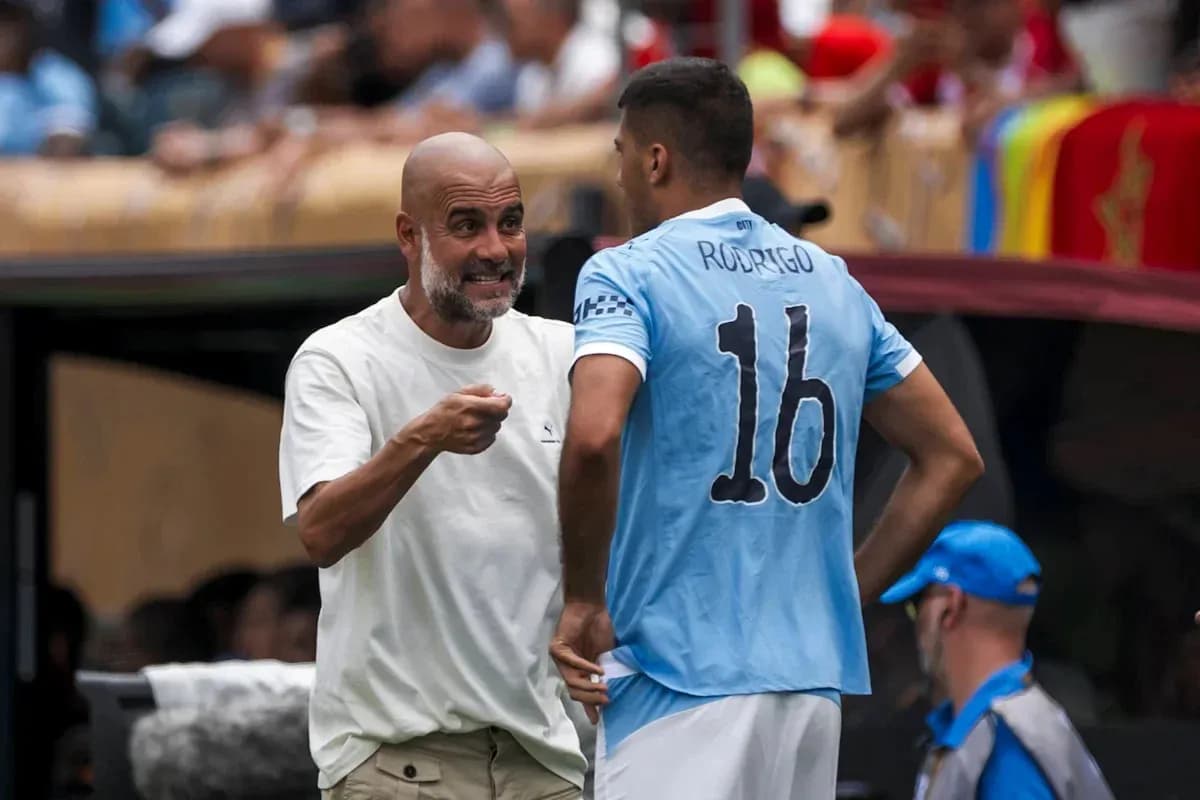
Rodri’s decision to join Barcelona already feels like one of those transfers people will still be talking about in a decade. Not just because of the player, or the price, or the shirt presentation photos to come, but because of who he turned down and why.
According to MUNDO DEPORTIVO, the Spain midfielder weighed up offers from both Barcelona and Real Madrid before choosing the Camp Nou. That choice, and the way he explained it, offers a sharp snapshot of how the very best now measure their careers.
This was not a romantic return to Spain. It was not a late twist in a soap opera. Rodri described a process that sounded cold, methodical and entirely football-driven after a tense break in which both Spanish giants tried to prise him from Manchester City.
In the end, he went with what he believed was the clearest sporting route: the project that stirred him just a little more, the place he felt he could win more, grow more, and stretch himself again as a player.
In a market obsessed with wages, followers and presentation videos, that matters.
Barcelona win the argument, not the lottery
Inside Barcelona, the key figures were Deco and Hansi Flick. They convinced him. Not with slogans, but with a plan. With detail. With a clear idea of what his role would be and how the team would be built around that axis.
Transfers at this level are rarely settled by a single phone call. They are won in the margins: who explains the project better, who shows more conviction, who can paint the most convincing picture of the next three or four years. On that front, Barça beat Madrid.
Rodri did not frame the move as an escape from Manchester City or a reaction to tension elsewhere. He presented it as a pull towards Barcelona. That nuance is crucial. It strips away the idea that Barça simply exploited a problem and instead casts them as the club that made the strongest sporting case.
They did not stumble into this. They persuaded him.
Respect for Madrid, and a nod to Mourinho
None of this came wrapped in disrespect for Real Madrid. Quite the opposite. Rodri was careful to underline how difficult it was to say no to them and how professional the club had been throughout the talks. That is the language of someone who understands scale and history.
Turning down Madrid still means something. He did not pretend otherwise.
His comments about José Mourinho, who tried to lure him to the Bernabéu, added a sharper edge. Rodri said:
"Bueno, no creo que sea lo suyo desvelar una conversación privada, pero evidentemente expresó sus ganas de que fuera y de lo que podía aportar al equipo. El trato fue muy bueno. Cuando tomé la decisión también le llamé para agradecer el interés y el trato. Me parece un grandísimo entrenador, ya lo ha demostrado allá donde ha ido en sus grandes etapas y el Real Madrid va a ser un duro rival para esta Liga."
It was a polished, grown-up answer. Diplomatic, but not empty. He praised Mourinho, recognised Madrid’s effort, then explained that he still picked another path. He even made the courtesy call once his mind was made up.
Top-level football can strip away those gestures in an instant. Rodri kept them.
Blocking out the noise
Around Madrid’s pursuit, the usual swirl of theories and off-field narratives gathered quickly. Rodri refused to feed any of it. He pushed the spotlight back onto football, his national team, and his own trajectory.
That is the response of a player who has lived for years at the very top and learned the value of distance from the circus. He also drew a subtle line between England and Spain, noting that in the Premier League, football largely stays about football.
The remark hinted at something else. A player forged in the intensity of English football, now ready for a different type of pressure, a different type of scrutiny, a different kind of stage.
La Liga’s balance of power shifts
On the pitch, the implications are obvious. If Rodri hits his usual level, Barcelona have just added control, intelligence and steel to the heart of their team. They have not only signed an elite midfielder; they have taken him off the table for their greatest rival.
That changes the temperature of the biggest games. It may even bend title races.
Beating Madrid to a player like this carries a meaning that goes beyond one name on a squad list. It sends a message about pull, planning and the enduring weight of the Barcelona badge at a time when both clubs are fighting to define their next era.
For Madrid, there will be irritation, but no humiliation. They went hard, they presented their case, and they were treated with respect. They lost a battle, not their aura.
For Barcelona, the satisfaction runs deeper. This is not just the thrill of unveiling a star. It is the knowledge that he saw the alternative up close, understood exactly what Madrid were offering, and still walked towards the Camp Nou.
The Manchester City void
From Manchester, the story lands differently.
For City supporters, there is pride first. Pride that their midfielder has become the player both Barcelona and Real Madrid wanted most. That status tells its own story. At the Etihad, he became the calm in the storm, the organiser with the ball, the metronome who made a great side feel balanced and almost inevitable.
He did not arrive as that finished article. He became this version of Rodri in Manchester: hardened by the Premier League, trusted with enormous responsibility, and shaped into one of the most influential midfielders on the planet.
But there is also that familiar flicker of annoyance when Europe’s old giants circle around a City player as if he naturally belongs in their orbit. City made him central. City put him under the brightest lights and watched him thrive.
If he really has gone, most City fans would probably wish him well, then stare at the bigger question: how do you replace that kind of authority?
Who slows games down now when the tempo runs wild? Who dictates the rhythm when the midfield starts to fray? Who brings that sense of certainty when everything around starts to shake?
That is Rodri’s true legacy at City. He leaves a vacuum. Barcelona and Real Madrid can argue over who won the chase, Spain can prepare for a new chapter in La Liga, but at the Etihad the problem is brutally simple.
Someone has to step in and take control.