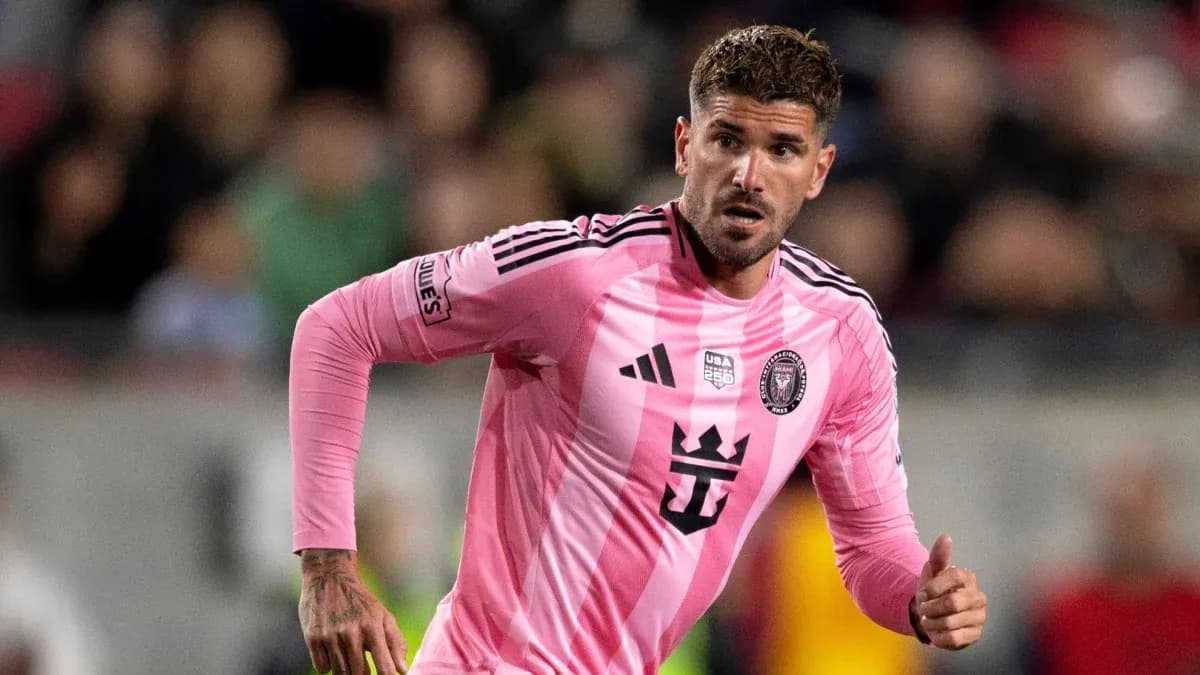
The flashpoint came late. A routine 1-1 draw between Inter Miami and the Chicago Fire suddenly crackled into something far more personal, and at the center of it all stood Rodrigo De Paul, eyes blazing, chest out, ready to fight a battle that was never about the scoreline.
Robert Lewandowski and Ian Fray had already collided, shoving and jostling as tempers frayed. Then De Paul arrived, sprinting into the frame, going straight for the Polish striker. No hesitation. No diplomacy. He squared up, visibly furious, making it abundantly clear that anyone going after his teammate would have to go through him first.
That visceral reaction told a familiar story. This is who De Paul has become: Messi’s bodyguard in boots, a midfielder who treats every confrontation as a matter of loyalty. Yet the scene also dragged another part of his life back into focus — the long, winding road that turned a combative kid from Argentina into one of the highest-paid players in MLS.
From Racing to riches
De Paul did not arrive in Miami as a fringe name riding on Messi’s coattails. He built a serious career, and a serious fortune, before ever pulling on the pink shirt.
His estimated net worth stands around $25 million, according to Celebrity Net Worth. It is not a forensic breakdown of his bank accounts, but it does sketch the outline of a player who has spent more than a decade turning performances into paychecks in Argentina, Spain, Italy, and now the United States.
The clearest snapshot of his current earning power sits in black and white on MLS paperwork. The MLS Players Association lists De Paul with a base salary of $7.57 million and roughly $9.69 million in guaranteed annual compensation for 2026. Only two men in the league earn more: Lionel Messi and Son Heung-min. That is the financial neighborhood he now lives in.
The climb to that bracket took time. It started at Racing Club, where he broke through in Argentina. From there came the first big leap to Valencia, a move that could have defined him as another South American talent lost in translation. Instead, he rebuilt himself at Udinese, grinding through five seasons in Serie A until Atlético Madrid decided he was worth a major investment.
The Spanish club paid around €35 million to sign him in 2021. Four years later, Inter Miami spent about €14.5 million to bring him to MLS on a permanent deal. Those transfer fees never landed directly in his pocket, but they chart the rise of his market value — and with it, his leverage at the negotiating table.
Capology estimates that De Paul has earned close to $29.9 million in gross base salary across his career, not counting bonuses, endorsements, or image rights. That is the guaranteed money, the foundation. The rest, especially at his level, can be substantial but remains hidden behind private agreements and federation secrecy.
The champion beside Messi
De Paul’s reputation, and likely a healthy portion of his off-field income, soared with Argentina’s golden era.
FIFA paid the Argentine federation $42 million for winning the 2022 World Cup, but it never disclosed how much went into each player’s pocket. The same goes for the bonuses tied to Copa América triumphs in 2021 and 2024. Those numbers stay locked away, leaving only educated guesses about how much those medals added to his fortune.
What is clear is what those tournaments did for his status. While Lewandowski piled up club trophies in Europe — a Champions League title, Bundesliga championships, seasons spent near the top of scoring charts — De Paul built something different. He became the tireless engine next to Messi, the man who ran, tackled, argued, and protected. He turned work rate into identity.
That identity was on full display against Chicago. The push, the rush toward Lewandowski, the refusal to back down — it all fit the image he has crafted since pulling on the Argentina shirt. Not the most glamorous name on the team sheet, but the one you want when things turn nasty.
Life beyond the touchline
Away from the noise of stadiums, De Paul’s story is rooted in family. He is the youngest of three sons born to Mónica Ferrarotti and Roberto De Paul. His personal life has often shared the spotlight with his football, especially in Argentina, where his relationship history and family dynamics have drawn intense coverage.
He has two children, Francesca and Bautista, from his former relationship with Camila Homs. Their lives, and the public interest around them, have at times rivaled the attention on his performances. For a player who built his game on control in chaos, his off-field world has not always offered the same stability.
His professional journey, though, followed a clear path through Europe. From his move to Valencia in 2014 to his departure from Atlético Madrid in 2025, De Paul spent roughly 11 years on the continent. Those seasons did more than sharpen his tactical understanding. They also shaped his tastes and image.
He developed a strong interest in fashion and tattoos, leaning into a style that mirrors his personality: bold, unapologetic, impossible to ignore. One ink stands above the rest — the date of Argentina’s 2022 World Cup victory, etched into his neck. It is not subtle. It is not meant to be. It is a permanent, visible reminder of the night that changed his career and his place in football history.
So when he storms into a confrontation in an MLS match, bristling with anger in defense of a teammate, it is not an isolated moment. It is the same thread that runs through his entire story — from Racing to Europe, from World Cup glory to Miami’s glitz.
The money, the medals, the spotlight: they all orbit around a simple truth. Rodrigo De Paul has built a fortune and a reputation by doing exactly what he did in that clash with Lewandowski — running toward the fire, never away from it.