
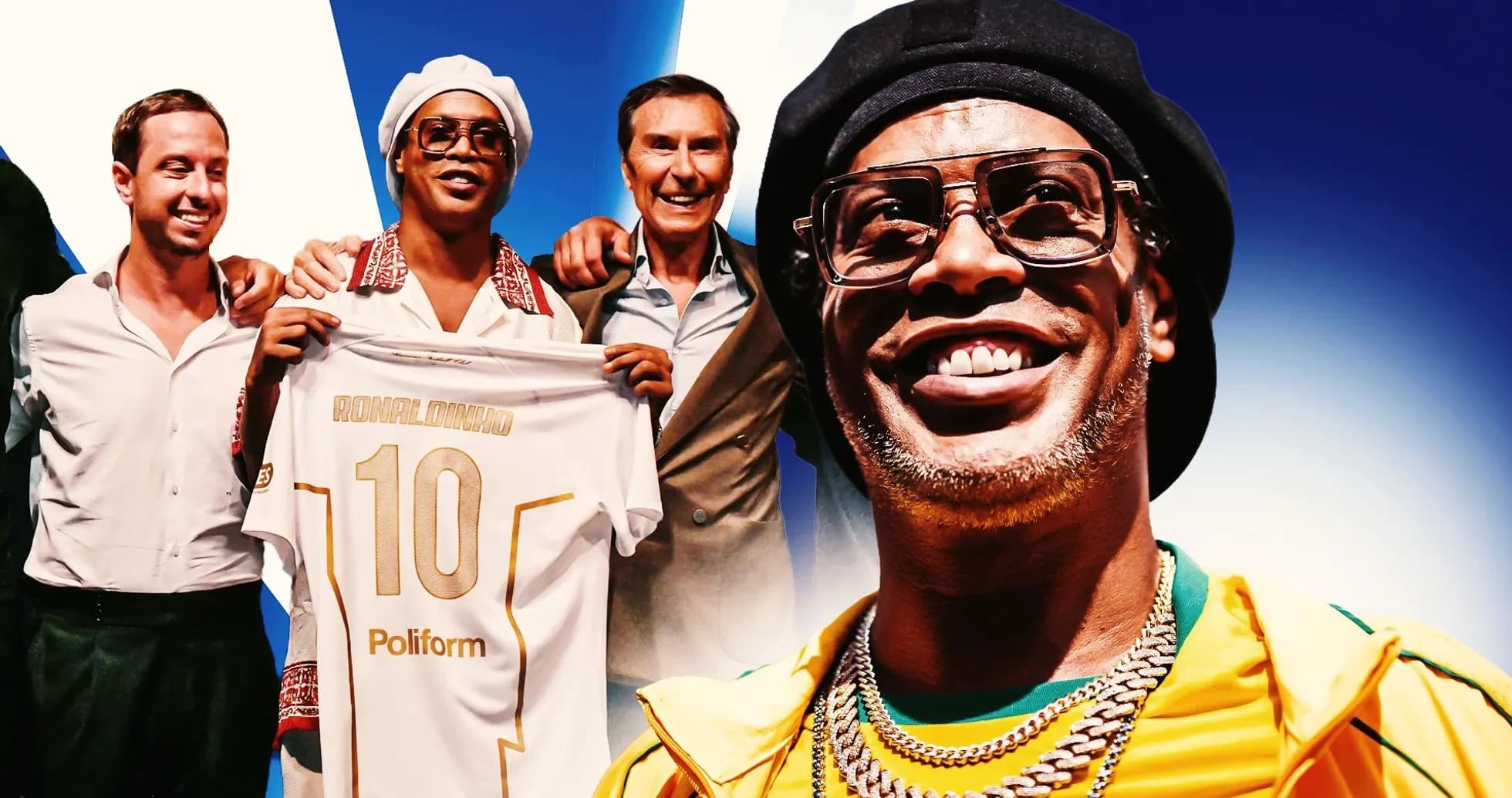
The old hero is coming back for one last dance, and he has chosen a provincial stage.
When Alessandro Cipriani bought his hometown club Ravenna in June 2024, he spoke like a romantic rather than a hard-nosed investor. His mission, he said, was simple: make the young people of Ravenna fall in love with football. His solution was anything but simple. He wanted to bring back the player he had adored as a boy.
Ronaldinho.
“I don't think there’s any other player who inspires such a love for the game as Ronaldinho does,” the New York-based businessman told Gazzetta dello Sport. Few would argue. Within the game, Ronaldinho occupies rare ground: almost universally liked, the living embodiment of jogo bonito, a one-man carnival who turned football into theatre.
There was, of course, one glaring issue with Cipriani’s dream. Ronaldinho stopped playing professional football years ago. He retired in 2018 at 37 and has not kicked a competitive ball since a brief, unhappy spell at Fluminense in 2015. This was not a legend winding down his career. This was a retired icon being asked to lace up his boots again.
What tipped the balance was not money or marketing, but friendship. The two men had grown close after being introduced by Lorenzo Tonetti, the former co-owner of the famed Milan restaurant “Giannino”, a haunt of Ronaldinho during his two-and-a-half seasons at AC Milan between 2008 and 2011. Out of that relationship came something Cipriani calls “a genuine friendship”.
So when he floated the idea of a comeback with Ravenna, the response was pure Ronaldinho. The World Cup winner “said yes immediately”.
“That’s just how things go with Ronnie,” Cipriani told Il Resto del Carlino. “If there's a chance to have fun and excite people, he's all in.”
The Brazilian’s appetite for joy is hardly a secret, and it burst into view the moment he arrived in Ravenna in August. At a lavish media event, greeted like a conquering hero, he drank in the adulation.
“This is why I came back!” he told reporters, gesturing towards the fans who had flooded in just to see him. “Do you understand now?”
What nobody quite understood was how much he would actually play. Was this a serious sporting move or a nostalgia tour dressed up as ambition? Cipriani promised at least one appearance, perhaps more “depending on how Sunday goes”, but he did not hide that the project stretched far beyond the pitch.
Ronaldinho, he revealed, plans to launch his own sportswear brand, R10, with Ravenna as the first club to wear it. “Think along the lines of the Michael Jordan model,” Cipriani said. The comparison is bold, but the commercial spark is already there.
Back in August, Damiano David, frontman of Italian rock band Maneskin, went public on social media with a simple question: “Where can I buy the [R10 Ravenna] shirt?!” He couldn’t. The first limited-edition batch had already sold out.
The shelves have since been restocked. The club shop and online store are now packed with Ronaldinho-branded merchandise. At the stadium, new suites have been installed to cope with the rush for this weekend’s derby. Every extra seat, every shirt, every scarf means more money for the club – and for the man at the centre of it all, who is not just turning up as a guest star.
“Ronaldinho is here with a specific, romantic goal: to try and score the final goal of his career,” Cipriani said. “However, his involvement is not just a superficial gesture or a marketing ploy to get people talking about us. Ronaldinho is going to become a shareholder in the club.”
That is the twist. This is not a testimonial; it is an entry point into a long-term project.
For now, though, everything narrows to Sunday. Ravenna coach Andrea Mandorlini has already nailed his colours to the mast: Ronaldinho will play “around half an hour”. The detail that jars is the preparation. The Brazilian has trained only once with the first team, having arrived on Friday by private jet.
None of that has dampened demand. Tickets are selling for more than twice their usual price. A temporary stand has gone up, naturally christened the “R10”. The small city, used to living in the shadows of Italy’s football giants, suddenly finds itself under the floodlights of global attention.
Cipriani revels in that shift. He knows the league his club plays in often goes “unnoticed”. Now, thanks to a 44-year-old magician, it is on screens and timelines all over the world.
“When Ronaldinho and Ravenna made headlines worldwide during the World Cup, it showed that provincial football can capture attention anywhere,” he said. “If we can draw focus toward us, the entire league stands to benefit – from TV rights and sponsorships to attendance.”
This, in his eyes, is only the beginning.
“I’ll state it clearly, because I work better when I make a public commitment: Ravenna must reach Serie A and, in time, compete at a European level,” Cipriani declared. “It will require patience and a solid structure, but that is the direction we are heading in.
“Ronaldinho is more than just a player wearing the jersey for a single night. He is our global ambassador and a long-term partner in this project.”
The ambition is startling for a club rooted in Italy’s lower tiers. Cipriani knows that Ronaldinho’s smile and stepovers alone will not drag Ravenna up the ladder. That is why another name on the letterhead carries almost as much weight as the Brazilian’s.
Ariedo Braida.
The former AC Milan CEO and sporting director, now 80, has agreed to become vice-president. His track record speaks for itself, and his mere presence gives the project a layer of credibility that money cannot buy. No surprise, then, that people have started to whisper about Ravenna as “the next Como”.
Cipriani does not shy away from the comparison, but he draws a clear line.
“That’s certainly something that makes us proud, but the fundamental difference is that our ownership is local and deeply rooted in the community,” he told Gazzetta. “Ravenna is my home, and my lifelong dream has always been to turn every young football fan in the area into a supporter of our city’s club. We have a lot of work ahead of us, starting with our facilities.”
The work is already under way. General manager Paolo Scocco, praised by Cipriani as doing “an outstanding job”, is overseeing the construction of a new, modern training centre, scheduled for completion in January. Once that is done, attention will switch to the matchday stage.
The Stadio Benelli is currently undergoing renovation, but the club’s vision stretches beyond a facelift. The plan is a brand new stadium, equipped with offices and a Hotel Cipriani attached. A local club with global branding, a small city thinking on a grand scale.
“So, we have plenty of ideas and grand ambitions,” Cipriani said. “The Ronaldinho project is just the starting point.”
On Sunday, somewhere between the temporary R10 stand and the old concrete of the Benelli, a retired genius will jog onto the pitch in Ravenna colours, chasing what his new president calls “the final goal of his career”.
If he finds it, in front of a generation that only knows him from highlight reels, what might that single swing of his right foot ignite in this forgotten corner of Italian football?





