San Antonio Spurs Establish Identity with 10-Game Winning Streak
The San Antonio Spurs walked out of Chicago on Wednesday night with a 10-game winning streak and something even more valuable: a clear sense of who they are.
A rough opening week has been buried under a surge that looks anything but accidental. This isn’t just a hot team. It’s a team that suddenly knows exactly what it wants to be.
The Wemby System Takes Shape
Everything starts with Victor Wembanyama, but it no longer revolves around guesswork.
Last season often felt like a live experiment. Possessions drifted into “let’s see what Wemby does” territory, with four teammates reading and reacting on the fly. That kind of improvisation produced flashes of brilliance, but it also clogged the half court and showed up as a real problem when the game slowed down in the playoffs.
That version of the Spurs is gone, at least for now.
The current offense runs through Wembanyama with purpose. Teammates aren’t waiting to see what he’s thinking; they’re moving in concert with him. Cuts are sharper and better timed, guards are carving out cleaner angles for lobs, and Wembanyama is operating off two feet with far more control. The whole thing looks less like a collection of ideas and more like a system.
It helps that the early schedule has been forgiving. Tougher defenses will test how sturdy this structure really is. But the contrast is unmistakable. The actions around Wembanyama flow, the spacing holds, and the ball doesn’t stick nearly as often.
They still need to shoot the ball better to fully cash in on all this organization. The framework, though, is exactly what a franchise dreams of when it drafts a generational talent: an identity that makes sense.
Three Guards, One Statement
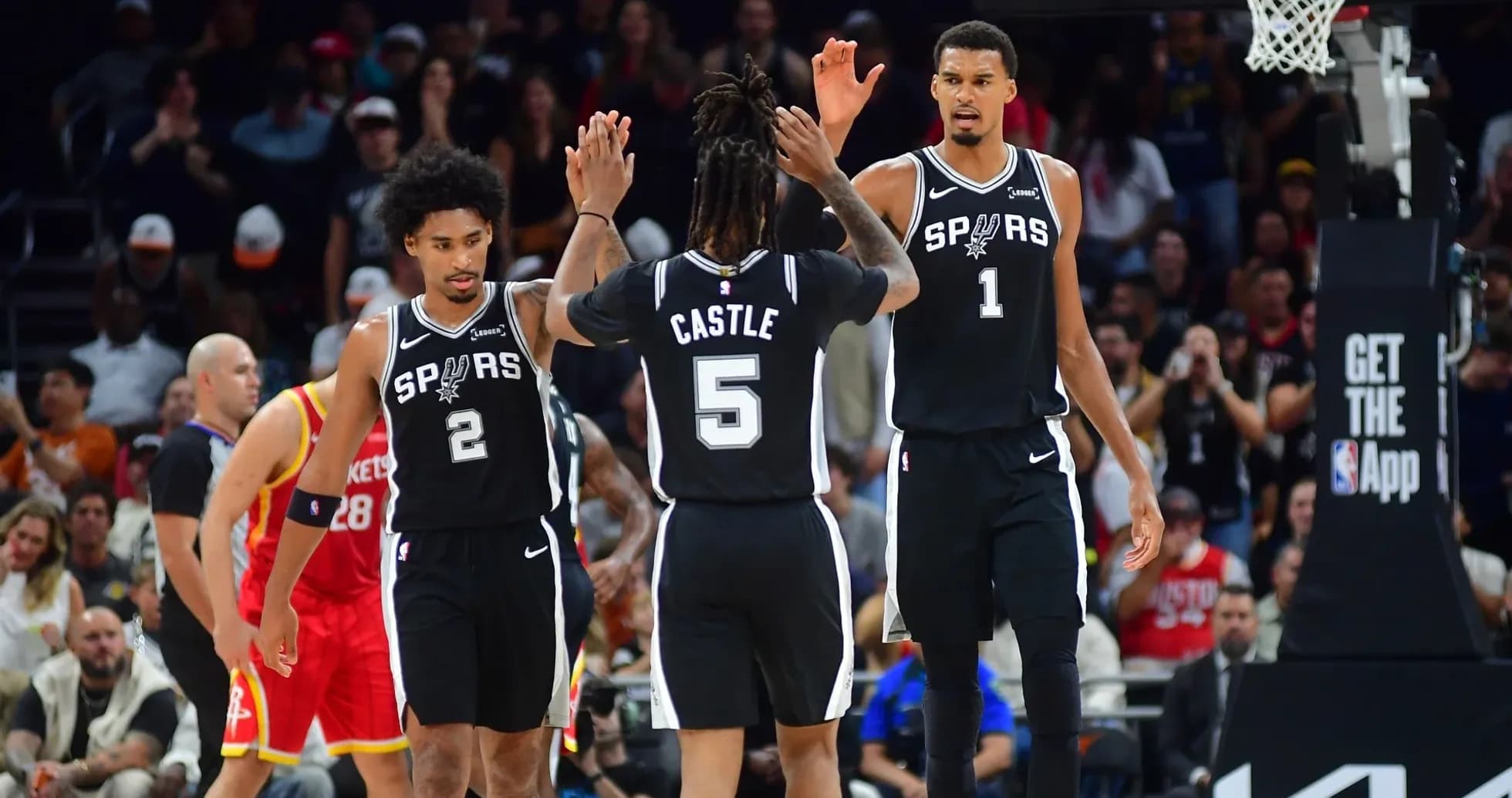
On paper, starting De’Aaron Fox, Stephon Castle and Dylan Harper together looks like a gamble. On the floor, it’s been a hammer.
Through 10 games, that trio in the starting lineup owns a plus-30.3 net rating, seventh-best in the league among heavily used groups. The raw plus-minus is even louder: plus-68, comfortably ahead of the Los Angeles Lakers’ top unit at plus-42.
The numbers match the feel. When that group is on the court, the Spurs choke off the paint and dare opponents to solve a problem that keeps growing: how do you guard Wembanyama while dealing with three active, physical guards?
The offense isn’t pretty from outside. This lineup doesn’t shoot it well. Defenses have sagged off, walled up the lane and lived with open 3s from Castle. He’s been solid enough on those looks to keep the concept alive, and the Spurs have leaned into the bargain: if you’re going to load up on Wembanyama, we’ll live with our young guard taking rhythm shots.
On the other end, they’re merciless. Opponents are shooting just 32.4 percent on 2-point attempts against this starting group, a number that barely sounds real. Pick-and-rolls die on the perimeter. Isolations get swallowed. Anything that does break through meets Wembanyama, who’s become a constant presence around the rim rather than a roaming curiosity.
There’s still growth ahead. Castle is learning when to shoot, when to drive and when to swing. But 10 games of this kind of dominance is enough to move the idea from “interesting” to “legitimate.”
Mitch Johnson Finds His Rotation
Mitch Johnson has spent the opening weeks tinkering, but not in reaction to whoever stands on the other sideline. His adjustments have been about his own locker room, about how to manage a roster that changed shape the moment Dylan Harper moved into the starting lineup.
Harper used to be the spark in the middle of quarters, the scoring jolt that stabilized the offense when starters sat. Pulling him into the first five created a vacuum on the second unit. The Spurs had relied on that mid-quarter temperature change; suddenly, they had to find it elsewhere.
The solution has been to rewire De’Aaron Fox’s nights.
Fox now checks out early in the first quarter, grabs a quick rest, then returns around the four-minute mark to steer the second unit. The same pattern repeats later: Fox stretches through the second and fourth quarters while Castle takes longer, more demanding shifts. Fox gets shorter, more frequent breathers. Castle is asked to redline for longer stretches.
Around them, the bench is settling into a recognizable shape: Fox with Julian Champagnie, Keldon Johnson, Luke Kornet and one of Harper or Castle. Carter Bryant and Harrison Barnes slide in during early second and fourth quarters, often when Wembanyama returns, giving the Spurs a brutal short-roll combination of Fox and Wembanyama while the young guards recharge.
It looks organized. It looks sustainable. It should look even better when Tobias Harris is back in uniform.
Why Tobias Harris Matters
If anyone needed a reminder of why the Spurs went and got Tobias Harris this summer, the early struggles of the second unit provided it.
This team needs another scorer who can bend a defense in different ways. Someone who doesn’t have to live off pick-and-rolls, who can create from a standstill, change angles in the air and give the offense a different focal point when Wembanyama sits or the guards are bottled up.
Right now, the post game belongs mostly to Wembanyama, with the occasional Castle possession mixed in. Fox and Harper can operate with their backs to the basket, but usually as a brief hold-up, a way to shield the ball before attacking again. It’s functional, not foundational.
Harris changes that geometry. Put him in the high post and the gravity of the play shifts. Defenders have to honor his scoring and his passing. The other Spurs wings are straight-line attackers, dangerous but fairly predictable in how they get downhill. Harris plays with a different rhythm, a natural flow that injects uncertainty into a defense.
That kind of variety is exactly what a second unit needs in the grind of an 82-game season. When he’s back, the Spurs won’t have to lean so heavily on their point guards to manufacture everything.
No Finals Hangover
The most impressive part of this 10-game run might not show up on any stat sheet.
The Spurs look like the same team that rode their chemistry all the way to the NBA Finals last season. That kind of run can warp a locker room. Roles shift, expectations balloon, egos expand. The wave crashes, and sometimes it never comes back.
So far, it has.
Inside that room, the dynamics haven’t twisted. The jokes still fly. Honesty still cuts through the noise. Johnson’s voice still booms, still gets laughs. Harris, sidelined but present, organized a team burger run after the win in Chicago, pushing everyone to hurry up, get dressed and enjoy the streak together. His teammates, naturally, gave it right back to him.
The hierarchy remains intact. Wembanyama is still spoken about in the same terms: centerpiece, not celebrity. Barnes still plays the role of veteran sage. The playoff run doesn’t seem to have disturbed the balance.
The mood is light, as you’d expect during a 10-game winning streak, but it isn’t fragile. Last season, when the schedule turned ugly, the energy barely dipped. It didn’t waver after two losses to open this season, either.
Wembanyama admitted on Wednesday he expected to feel some sort of emotional hangover from the Finals. He hasn’t.
It didn’t look that way in the preseason or on opening night against Oklahoma City. Back then, the identity was fuzzy and the execution frayed. Now, the Spurs have a clear system, a rotation that makes sense and a star who knows exactly how he wants to play.
Only a handful of players are truly in rhythm, and they’re already piling up wins.
If this is the baseline in November, what does it look like when everything actually clicks?