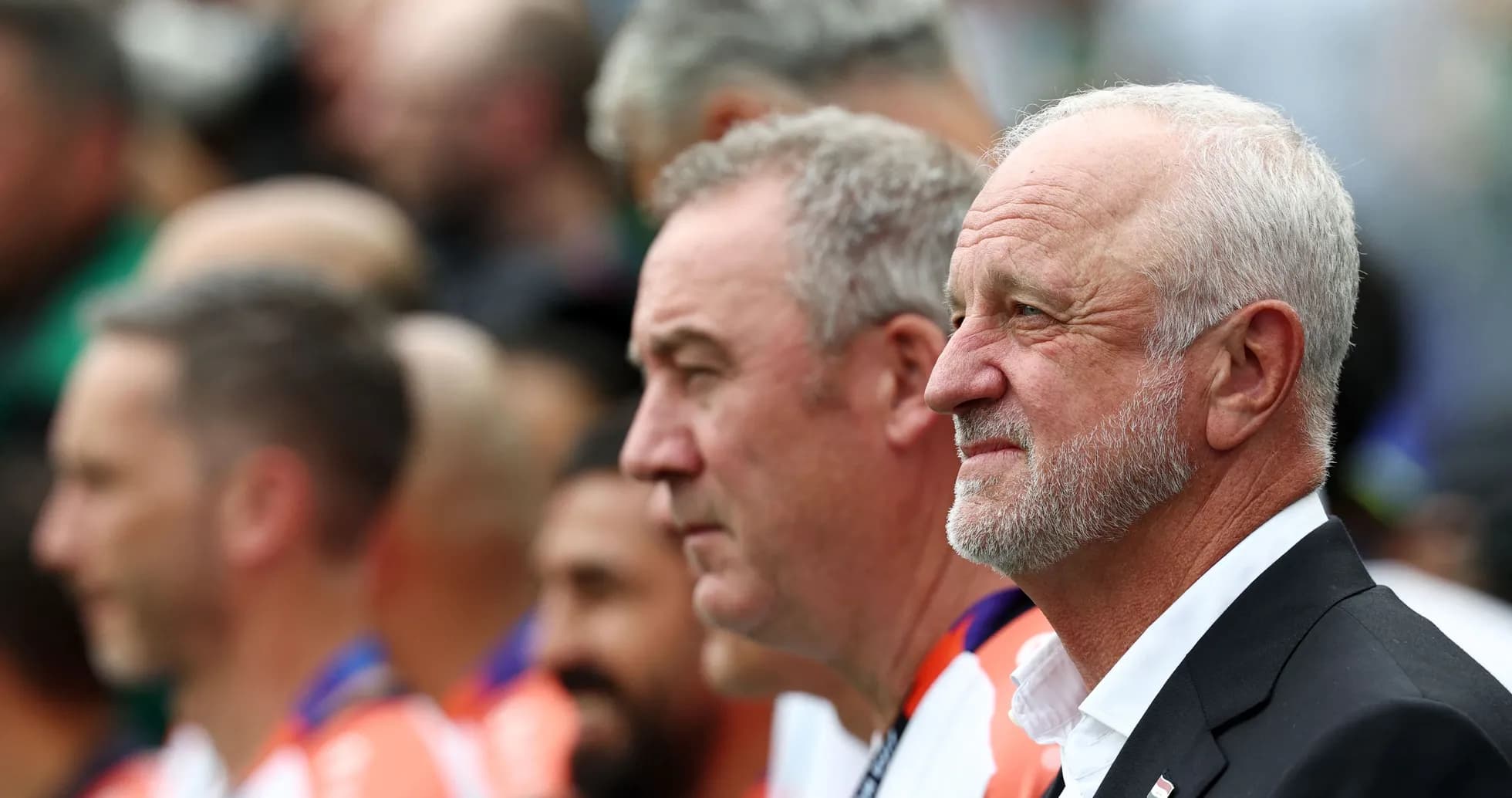
Sebastien Pocognoli has wasted no time putting his stamp on Scotland.
In his first squad since taking the job, the Belgian has ripped up the old script, ushering in a new wave of talent while leaving a dozen World Cup names on the outside looking in. Established figures are absent, fresh faces are everywhere, and the message is clear: reputations no longer pick the team.
New era, new names
Five players have been handed their first full call-ups, headlined by Sevilla striker Robbie Ure and Brondby captain Luis Binks.
Ure’s rise has been anything but conventional. Let go by Rangers as a youngster, he rebuilt himself in Sweden with Sirius, where he rattled in 20 goals in 20 games and earned a move to LaLiga with Sevilla. Now 22 and also eligible for Ukraine through a grandparent, he arrives as the most intriguing of Pocognoli’s new attacking options, a forward whose route has demanded both courage and conviction.
At the other end of the pitch, Binks brings authority. The 25-year-old, who captains Danish SuperLiga side Brondby, once wore Scotland colours at U18 level before switching into England’s youth setup. Pocognoli has persuaded him back, and a left-footed defender with leadership experience in Europe’s more tactical leagues is not the sort of profile Scotland have often been able to call upon.
Celtic right-back Colby Donovan, Hearts winger Josh McPake and Swansea City defender Stephen Welsh complete the list of debutants. Donovan has featured in every Celtic game this season and steps in for club-mate Anthony Ralston, while McPake’s sharp start at Hearts after his summer move from St Johnstone has been rewarded. Welsh, fresh from a successful loan spell at Motherwell last season and now at Swansea, gets his first crack at senior international football.
This is not tinkering. It is a reset.
McBurnie back in from the cold
Alongside the new blood comes a long-awaited return. Hull City striker Oli McBurnie has been recalled for the first time since 2021, a decision that immediately changes the conversation around Scotland’s centre-forward position.
Once a lightning rod for criticism, McBurnie has rebuilt his reputation and his game, earning his way back to the Premier League and, now, back into the national squad. Former Scotland forward James McFadden, speaking on Sky Sports News, backed the call, insisting McBurnie “deserves his opportunity” and underlining the striker’s passion for playing for his country.
For a team that has wrestled with the number nine role for years, McBurnie’s return, alongside the emergence of Ure, injects long-missing competition and variety at the top of the pitch.
Big absences, bold calls
The scale of Pocognoli’s overhaul is stark. Twelve players from Scotland’s World Cup squad are missing.
Some absences are enforced. Napoli midfielder Scott McTominay is sidelined as he recovers from minor heart surgery, stripping Scotland of one of their most prolific recent scorers from midfield. Rangers striker Lawrence Shankland is out with a hamstring issue, while Torino forward Che Adams is also injured.
Others are simply not selected. Rangers defender John Souttar, Celtic’s Anthony Ralston, Hibernian’s Grant Hanley, Wrexham’s Dominic Hyam, Manchester United youngster Tyler Fletcher, Millwall forward Lyndon Dykes, Stoke’s George Hirst and Swansea striker Ross Stewart are all omitted.
It leaves the squad lighter on familiar faces, heavier on opportunity.
Midfield brains, defensive reshuffle
There is at least some welcome continuity in the middle of the park. Billy Gilmour returns after a knee injury ruled him out of Steve Clarke’s final squad. Now at Napoli, the playmaker’s presence feels central to any attempt to evolve Scotland’s style without losing their competitive edge.
Lennon Miller of Udinese is back, as are Bologna captain Lewis Ferguson, Aston Villa’s John McGinn, Norwich City’s Kenny McLean, Bournemouth’s Ryan Christie and Hearts’ McPake. It’s a midfield group that can press, pass and hurt teams between the lines, even without McTominay’s penalty-box threat.
At the back, the picture is changing. Luke Graham, who impressed with Dundee and took part in Scotland’s pre-World Cup training camp, has been promoted into the senior setup. The Stoke City defender has played every minute of his club’s recent run of three wins and a draw in the Championship and now finds himself in a crowded but open competition for minutes.
Binks joins him in a defensive unit that still leans on familiar names: Andy Robertson, now at Tottenham, Kieran Tierney back at Celtic, Aaron Hickey of Brentford, Scott McKenna at Dinamo Zagreb, Nathan Patterson of Torino and Jack Hendry of Al-Ettifaq. Josh Doig and Kieron Bowie, both at Sassuolo, return, offering depth and balance on the flanks and in attack.
Welsh’s inclusion adds another centre-back option, while the full-back areas, long a position of strength, look even deeper.
Goalkeepers and the post-Gordon landscape
Between the posts, Scotland enter a new chapter. With Craig Gordon retired after the World Cup, the door has opened again for Scott Bain and Jon McCracken, who rejoin a goalkeeping group that already includes Angus Gunn and Liam Kelly.
Gunn, now at San Jose Earthquakes, remains the likely first choice, but the presence of Bain, Kelly and Bradford City’s McCracken gives Pocognoli a blend of experience and potential to work with as he shapes the position for the next cycle.
Forwards with something to prove
Up front, the picture is suddenly crowded. Alongside McBurnie and Ure, Hearts forward James Wilson returns, as do Sassuolo’s Bowie, Rangers youngster Findlay Curtis and Bournemouth’s Ben Gannon-Doak.
McFadden believes Ure, in particular, has taken “an unconventional route” that demands respect. Leaving Rangers, heading to Sweden, then making the leap to Sevilla is a path that speaks of a player willing to step out of his comfort zone. Now he walks into a national team that has long searched for a reliable, ruthless striker.
If McBurnie can finally translate club form into international consistency, and if Ure adapts quickly, Scotland’s attack could look and feel very different by the end of this Nations League campaign.
The fixtures that will set the tone
Pocognoli’s first tests come fast and hard in the Nations League:
- Slovenia vs Scotland – September 26, 2pm
- Scotland vs Switzerland – September 29, 7.45pm
- N. Macedonia vs Scotland – October 3, 7.45pm
- Scotland vs Slovenia – October 6, 7.45pm
- Scotland vs N. Macedonia – November 13, 7.45pm
- Switzerland vs Scotland – November 16, 7.45pm
These are not friendlies to ease into a new job. They are competitive fixtures that will shape seeding, confidence and the public’s verdict on this new era.
Pocognoli has promised to make Scotland fans smile. He has started by shaking up the squad list. The real question now is whether this bold blend of returnees and risk-takers can turn that promise into points when the anthem stops and the campaign begins.