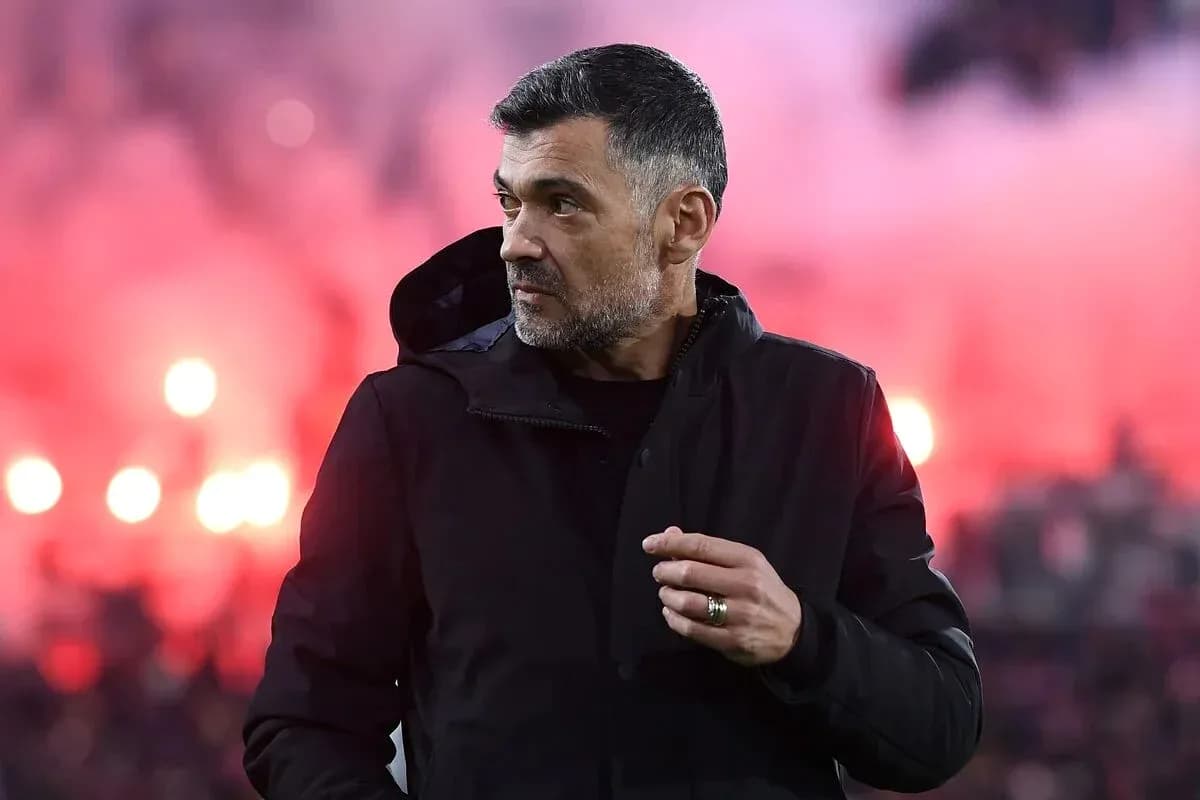
Sergio Conceição does not romanticise his brief spell at Milan. He does not sugar-coat it either.
“I wouldn’t say it went well,” he admits. Yet the former Rossoneri coach is adamant about one thing: the man on the bench is far from the only problem at San Siro.
Speaking as a guest analyst on DAZN’s Portuguese coverage of the Champions League this week, Conceição looked back on his turbulent six months in charge and sent a pointed warning to the new man in the hot seat, Rubem Amorim.
“It won’t be easy at all,” he said, “especially because of the atmosphere at the club. There’s a lot of pressure, people think they should be winning the league and Champions League every year.”
A short reign, a quick trophy, a hard fall
Conceição arrived in the second half of the 2024-25 season and made an immediate impact on paper. Within his first two games, Milan had lifted the Supercoppa Italiana. The club had a new voice, a new edge, and a new piece of silverware to parade.
The glow did not last.
Milan slumped to eighth in Serie A, missing out on European football altogether for 2025-26. For a club that still sees itself as a continental heavyweight, eighth place is not a blip. It is a scar.
Conceição does not hide from that. He knows what the table said. But he also refuses to let those six months be reduced to a single damning line.
“I was in Milan for six months and things went… I wouldn’t say well,” he reflected, “but we managed to win a Super Cup and got to the final of the Coppa Italia.”
The image of him walking past the Coppa Italia trophy at the Stadio Olimpico in May 2025, after defeat to Bologna, sums up his Milan story: close enough to touch glory, yet ultimately empty-handed in the moments that matter most.
Allegri’s fall and a wider indictment
If Conceição’s tenure could be dismissed as a short, chaotic chapter, what followed makes his argument harder to ignore.
Milan turned to a serial winner in Massimiliano Allegri for 2025-26. No European distractions. A squad that had spent long stretches of the campaign in second place. Stability, on paper.
The season still ended in disappointment. Fifth in Serie A, and with it another year of underachievement for a club that measures itself in titles and deep Champions League runs.
The response from the hierarchy was brutal and sweeping. Allegri was dismissed the day after the season ended, along with sporting director Igli Tare, technical director Geoffrey Moncada and CEO Giorgio Furlani. Not just a change of coach, but a clear-out of the club’s sporting leadership.
For Conceição, it was confirmation of what he has been saying between the lines.
“It’s been confirmed that the coach is not the problem,” he argued. “Obviously, I take my fair share of the blame and I don’t want to shy away from my responsibilities, but we’ve now seen Allegri and the whole management team fall.”
When a club burns through ideas, coaches and executives in such quick succession, the question stops being “who failed?” and becomes “what is fundamentally wrong?”
History, expectation and a heavy shirt
Amorim knows the numbers. He recently pointed out that Milan have won just two league titles in 20 years. Conceição seized on that detail to underline his own contribution.
“One of their two most recent trophies was mine,” he said, referencing the Supercoppa Italiana. It is a small line, but a revealing one. In a club so starved of major honours in the modern era, even a Super Cup becomes a stake in the ground.
That is the paradox facing Amorim. Milan’s recent record is modest, yet the expectations remain enormous. The badge still carries seven European Cups. The stadium still fills with people who grew up on tales of Sacchi, Capello and Ancelotti. The demand has not recalibrated to the reality.
Conceição’s warning cuts straight through that tension. The pressure is not abstract. It shapes the “atmosphere at the club,” as he put it. It frames every substitution, every dropped point, every press conference. It devours patience.
He sends his compatriot a “big hug” and genuine good wishes, but behind the warmth sits a clear message: the job is bigger than tactics and training sessions. It is about managing a giant that no longer behaves like its modern CV suggests.
Conceição leaves Milan with a Supercoppa, a lost final, an eighth-place finish and a conviction that the dugout is only one piece of a much deeper puzzle. Amorim steps into the same arena now, with the same expectations swirling around him.
The question is not whether Milan will demand trophies. They always will. The question is whether this time, the club around the coach will finally be strong enough to help deliver them.