
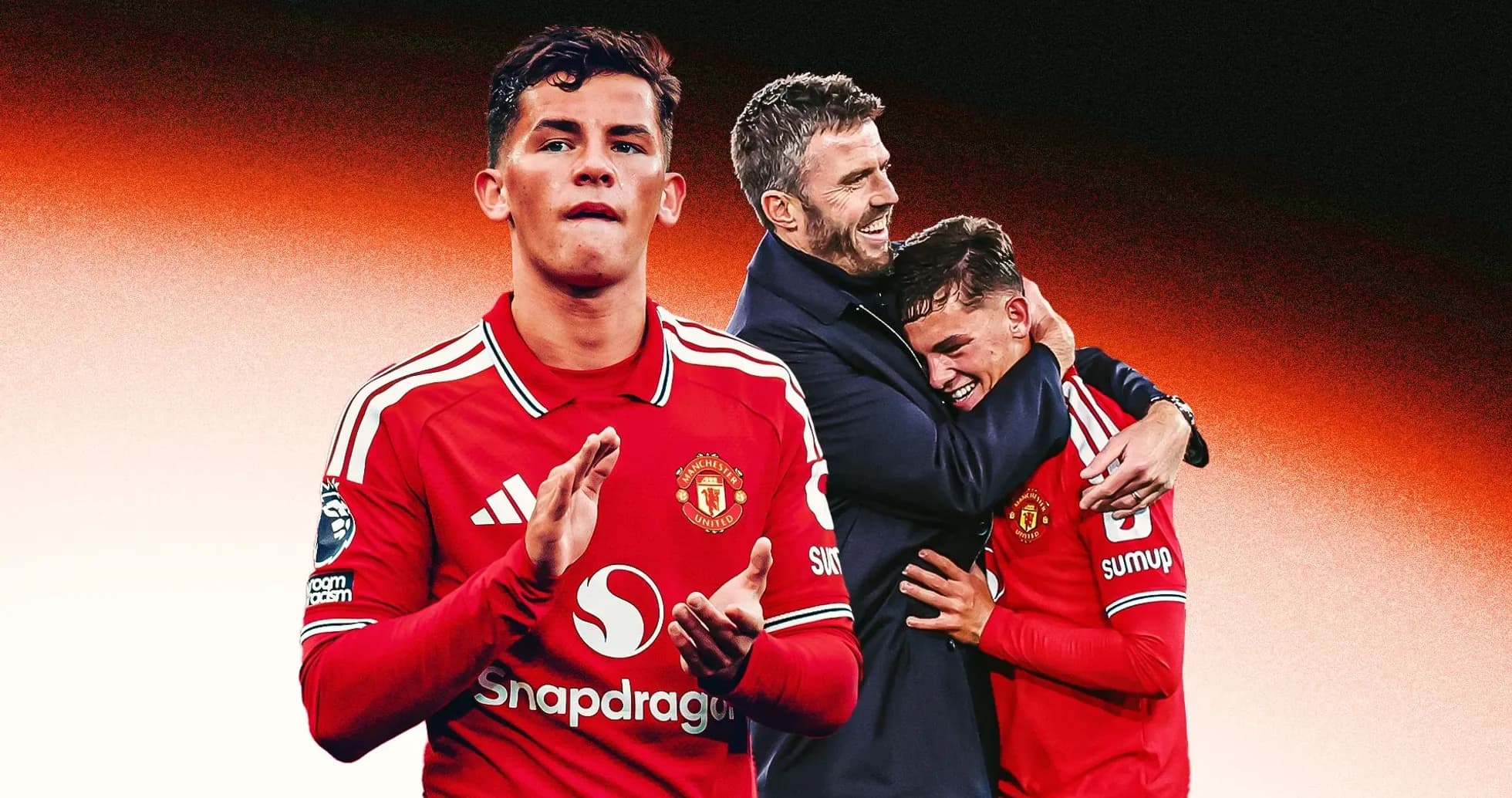
Old Trafford had come armed with tennis balls and anger. Nine games without a win had drained the patience from a fanbase already seething at the club’s ownership, and Roma looked ready to twist the knife.
Seventeen minutes in, United were 2-0 down. Another European night turning sour, another chorus of boos loading in the chamber.
On 21 minutes, the protest hit the pitch. Green and gold balloons and tennis balls rained down in a choreographed show of dissent towards the Glazer family and INEOS. The game paused; the fury did not. When the half-time whistle went, the players trudged off to a soundtrack of hostility. A ninth straight game without victory felt less like a threat and more like a promise.
Then the second half started, and something changed.
A penalty, a retake, and a pulse
United emerged with a different edge, with Bruno Fernandes snapping into spaces he’d drifted out of in the first period and Matheus Cunha playing as if his career depended on it. Cunha drove into the box and won a controversial penalty, the kind that sparks as many arguments as replays.
Fernandes missed the first spot-kick. Old Trafford groaned. But Roma had encroached, and the retake handed United a lifeline. This time Fernandes buried it. 2-1, belief creeping back into a stadium that had spent 45 minutes bracing for another post-mortem.
United surged forward, wave after wave, but the final ball betrayed them. Crosses flashed, passes overhit, good positions wasted. The comeback felt possible, but not inevitable.
Then Michael Carrick made the change that flipped the night on its head.
Lacey arrives, and the game tilts
Off went Amad Diallo. On came Shea Lacey.
The teenager took up station on the right flank and instantly rewired United’s attack. No nerves, no hiding. He wanted the ball, demanded it, and when he got it, he ran at Roma with a directness that had been sorely missing.
Two completed take-ons. Every pass finding a red shirt. Three out of four duels won. Those numbers only tell part of the story. The rest was in the way he hunted second balls high up the pitch, in the way his energy dragged United 10 yards further forward and dragged the crowd back into the contest.
Roma began to creak. The pressure finally told.
Leonardo Balerdi, under little real threat, produced a catastrophic error at the back. Cunha pounced, levelled the game at 2-2 and ripped the lid off Old Trafford. From despair to parity, from boos to belief.
United smelt blood. And Lacey, still barely into his stride at this level, delivered the moment that will be replayed for years if his career follows the trajectory many inside the club expect.
A pass only the special ones see
Kobbie Mainoo drove through midfield and slid the ball wide to Lacey. One touch to set, one step inside to open the angle, and then a pass that cut Roma in two.
He fizzed it between defenders, threading the needle into Cunha’s stride with the kind of precision that separates prospects from players destined for the elite. Cunha did the rest, smashing a thunderous finish in off the post on 86 minutes.
Old Trafford exploded. From 2-0 down to 3-2 up, from mutiny to mayhem.
Cunha’s brace rightly earned the headlines, even with the sting in the tail of his late red card for two rapid yellow cards. Yet anyone who watched that second half with a clear head knew the game had turned on Lacey’s entrance. Few players on the pitch would even have seen that pass. Fewer still would have had the nerve to attempt it, let alone execute it.
He played like he belonged. Like he’d been waiting for this stage, not fearing it.
Carrick’s glint of mischief
Carrick did not hide his admiration afterwards. “We love him to bits, you know,” he said, asked about Lacey’s impact. “He’s a great young man; he’s got great ability and he’s desperate to do well. He’s got that little glint in his eye, he plays with a bit of mischief.”
That mischief is only half the story. Carrick was just as keen to talk about the teenager’s work without the ball.
“I was just as happy seeing him defending as a right-back when we needed it. As a rounded footballer you’ve got to be able to do that. He gave everybody a bit of a lift coming on the pitch. It was fantastic to see, and he made the most of what he had.”
Cunha, the match-winner, tried to push the spotlight away from himself and back onto the academy graduate. “Unbelievable, Shea is a young guy. He comes from the academy, and then we saw like the stadium come with him,” he told MUTV. “I feel like they are part of the family, they follow him from the beginning, and yeah, we want to help him to push him to be this player that everyone wants. And yeah, him in the Champions League give the first assist. I feel like to be part of this is something incredible.”
The bond between crowd and kid was obvious. Every touch grew louder. Every sprint fed the noise.
The new standard-bearer
United’s academy has always lived with expectation. Right now, that weight is sharpening around Lacey.
The club is on the verge of losing 16-year-old JJ Gabriel to Real Madrid, another bright hope looking elsewhere for a clearer path to senior football. For a fanbase used to seeing homegrown talents define eras, that kind of departure stings.
Lacey is already being cast as the next great hope. That can crush a youngster. So far, it seems to be sharpening him.
He signed his first professional deal in April 2024, but had to wait until December for his senior debut – six late minutes in a 2-1 home defeat to Aston Villa. Four appearances followed last season, the most vivid coming in the FA Cup against Brighton.
On that day he was United’s one spark in an otherwise lifeless performance. He glided through tight spaces, showed sharp movement and vision, and looked every inch a player ready to skip a few steps on the development ladder. Then came the sting: two yellow cards in three minutes, a red card that soured the entire occasion.
Suspension hit. A calf injury followed. Momentum gone.
He could have disappeared into the background. Instead, he fought back, returned in time for United’s final-day league win over Brighton and then lit up pre-season. A slick goal in a 5-0 demolition of Rosenborg stood out, but the broader pattern mattered more: confidence, end product, consistency.
Everything said he was ready. Carrick, though, chose caution.
Caution, or a missed opportunity?
This season, Lacey has been drip-fed minutes. Just 22 of them across United’s first nine Premier League fixtures. A single start in the Carabao Cup, again against Brighton, where he scored a superb goal with his left foot into the bottom corner and repeatedly twisted defenders inside out.
He was United’s best attacker that night, constantly showing for the ball, constantly asking questions. Carrick still took him off midway through the second half. United collapsed, surrendered a two-goal lead and crashed out.
The contrast on the right flank has become impossible to ignore. Amad Diallo, entrusted with the starting role, has laboured. Since returning from an ankle injury in early October, he has logged 448 minutes across competitions, started the last five games, and produced just one assist – in a 4-1 Champions League defeat to Como that was already gone.
No goals since last December. No conviction in the final third. Against Roma, the same pattern: no shot on target, no key pass, possession coughed up nine times. The positions are good; the decisions are not.
Lacey stepped in and did what Amad has not: he changed a game that mattered.
Wayne Rooney, watching on for Amazon Prime, cut to the heart of it while analysing Cunha’s winner. “It’s all about that first touch [from Lacey], takes the defender out and that pass is incredible. Amad does some really good things, but it’s that end product, that is what takes you to the next level. Lacey has got something in there, that little touch and little pass which United needed to get them over the line in this game.”
That “something” is exactly what United’s attack has been missing.
A front four waiting to be unleashed
The blueprint is obvious. Cunha and Bryan Mbeumo rotate seamlessly between the left and the centre. Fernandes owns the No.10 space. Lacey, on current evidence, should be the final piece on the right.
That quartet offers movement, pressing, invention and, crucially, goals. It also offers Carrick something he badly needs: a clear attacking identity.
Aston Villa visit Old Trafford on Sunday. If those four are not on the teamsheet together and United stumble again, the questions will not be kind. Carrick is managing for his job now. Safety-first selections will not save him.
He needs calculated risks. Lacey is not one of the wild ones.
This is not a teenager drunk on his own hype. Those inside the club talk about a level head, a willingness to work, a player who listens as much as he talks. His own words after the Roma win backed that up.
Told he was already being seen as a “success story of the academy”, Lacey pushed back. “Not yet. We’re building towards it and it’s going well – nights like this definitely help. But there’s still a long way to go.”
That is the language of someone who understands that one electric night doesn’t define a career at Manchester United. It starts one.
United’s greatest academy products carried that same mix of swagger and humility. They didn’t just break into the team; they changed what the team could be.
Now the question hangs over Carrick and his staff, not the teenager: will they trust Shea Lacey to do the same?





