By 1am, the Padang is quiet. The last guitar chord has faded, the fireworks smoke has drifted over the bay, and the howl of Formula 1 engines is a memory. But on the Marina Bay Street Circuit, the real sprint has just begun.
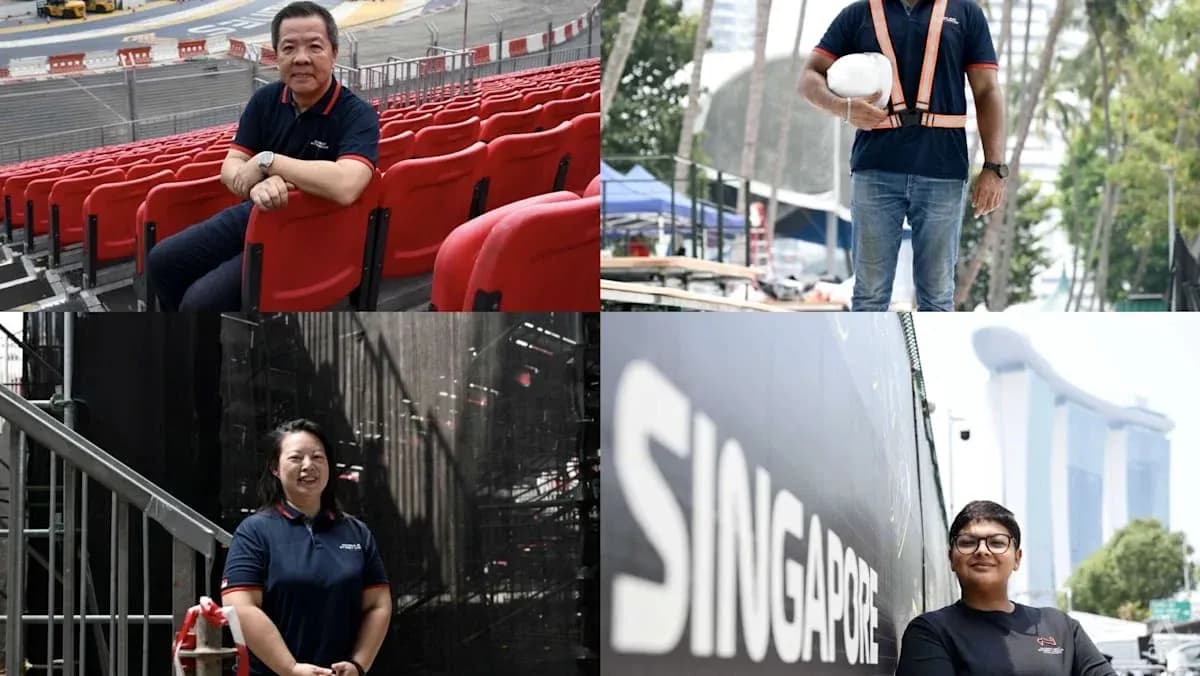
Four and a half hours. That is all that senior manager Shiv Raj Panday and his technical crew have to rip out chunks of a world‑class racetrack and hand Singapore’s city streets back to its commuters. By 5.30am, the same tarmac that saw cars blast past at over 300 km/h will be filled with buses, taxis and sleepy office workers.
The Singapore Grand Prix looks like a three‑night festival. In reality, it never stops.
The race that lasts 362 days
For Singapore GP, the race promoter, the chequered flag is not an ending. It is a reset.
As one of 70 full‑time staff, Raj spends the rest of the year buried in feasibility studies and layout plans. His technical department needs two to three months just to plan before a single barrier is bolted together. Space is tight in the circuit park, so every grandstand, hospitality suite and access route is argued over, tested and re‑drawn.
He knows the drill. He worked for one of the race’s contractors from 2010 to 2023 before joining Singapore GP. The post‑race tear‑down, the pre‑race build‑up, the overnight sprints on “live” roads – this has been the routine since Singapore lit up the F1 calendar in 2008, broken only by the pandemic cancellations in 2020 and 2021.
This year’s race, from Oct 9 to 11, is the latest it has ever been held. The city is in it for the long haul: a fresh deal signed in January 2022 locked in hosting rights until 2028.
The show may last three nights. The work stretches across 12 months.
Ticketing that never sleeps
Ask Clarence Lai how long it takes to prepare for a night race and he will tell you straight: it’s enormous.
Lai, Singapore GP’s director of ticketing and accreditation, oversees a cycle that barely pauses. “Super early bird” sales for one race begin in race week of the previous year. From there, it runs non‑stop until lights out, before the loop begins again.
His team controls the keys to the circuit – public tickets, accreditation for vendors and contractors, access to every grandstand and hospitality deck. They pore over seating capacity, decide if new grandstands are needed, and dissect customer feedback to tweak the experience.
Last year, they made a decisive change: mobile ticketing. It cut down on scams that had plagued fans buying from third‑party sellers, where duplicate digital PDFs could be sold again and again.
Getting people in is only half the story. Getting the product right is the other half.
Selling the same race, differently
Senior director for marketing and partnerships Sasha Rafi has lived this project almost from the start. She joined in October 2007, before the first car ever turned a wheel at Marina Bay.
The moment one race ends, her team is already dissecting it. What worked? What fell flat? They go through marketing, sustainability, stakeholder engagement with government and private partners – nothing is left untouched.
Then comes the big question: how do you sell the same event, in the same city, in a way that feels new?
Her department spends months scanning trends in tech and entertainment, tracking what people are spending on, and watching global events that can shift demand. A war, an economic shock, a travel squeeze – all of it can hit ticket sales for a race like Singapore.
This year, they have a new hook: the sprint.
Singapore hosts one of six sprint races on the F1 calendar, with sprint qualifying on Friday and the sprint itself on Saturday. It is a short, sharp 100 km dash – about a third of a full race distance – roughly 30 minutes, no pit stops. To match that, Singapore GP has rolled out a two‑day sprint bundle ticket. It is a rare move for a circuit that has traditionally sold three‑day or single‑day passes.
The thinking is clear. The sprint format is still relatively new to F1 and making its debut in Singapore. Not everyone wants to commit to all three days, but many will want to feel that compressed, high‑stakes shootout. The bundle is for them.
And the long game continues: super early bird tickets for the 2027 race will again go on sale this year.
Building – and unbuilding – a circuit around a city
Marina Bay is not a purpose‑built facility. It is a living, breathing downtown. That makes the engineering choreography brutal.
Some grandstands go up as early as six weeks before the race. They are exposed to wind, rain and humidity. When crews rebuild them, even on the same footprint, rows can shift, layouts can change. Lai’s team has to walk through every block: are all the seats there? Are they labelled correctly? Are they safe?
Time is the enemy.
Raj’s crew works around events and stakeholders who still need their spaces. They negotiate handover windows, then squeeze construction and dismantling into the margins.
Connaught Grandstand, at the end of Esplanade Bridge, is a prime example. It sits along a “live” road still open to traffic. On race week, the road closes only in the small hours of Wednesday morning. The crew dives in, races the clock to build, then clears out before the morning rush. The same happens in reverse on Sunday night: Esplanade Drive and key stretches of track must be ready for public use by 5.30am.
The spectacle ends with fireworks. The overnight shift starts with jackhammers.
Training an army in racecraft
Operations director Melissa Phua has been in the thick of it since 2008. Her job stretches far beyond barriers and fences.
Each year, Singapore GP brings in nearly 1,000 students from the Institute of Technical Education and Republic Polytechnic, offering training and employment across the circuit park. They become grandstand and gate officials, front‑line staff responsible for the welfare of paying fans.
It is a huge moving crowd, night after night, in a temporary environment that looks nothing like the city those fans know.
Phua’s team studies how people move, where they bunch up, how they leave. One of their key performance indicators is simple and unforgiving: everyone must get out safely, and they must feel they were treated well.
The crunch comes after the Padang concerts. Tens of thousands pour out at once, most of them funneled towards MRT stations for the last trains home. On the ground, Phua and her staff open and close gates, redirect flows, and hold firm on diversions that can irritate spectators who want to leave the way they came in.
The priority is clear: no one gets crushed, no one gets screamed at, everyone gets home.
Staying on the calendar – and in fans’ plans
In the early years, Sasha and her team had a different battle. Formula 1 was unfamiliar to many Singaporeans and, to some, it looked like an elitist playground.
The response was strategic. Singapore GP built a wide range of products: affordable tickets for pure sports fans, premium options for corporate guests, and packages aimed squarely at locals more interested in the concerts than the grid.
The night race became more than a grand prix. It became a weekend festival.
Sasha points out that Singapore was the first circuit in F1 to weave major entertainment acts into the race weekend. That move helped shift perceptions and fill the stands. Now, the challenge has evolved. The Marina Bay race is firmly on the global map. The task is to keep fans coming back and to convince international travellers to pick Singapore from a packed calendar of 24 races.
The city itself keeps changing, and the circuit has to keep up. In 2023, the track was re‑routed behind the Floating Platform as one of F1’s largest grandstands made way for the development of NS Square. Each change triggers a cascade: new sightlines, new ticket categories, new pressure on capacity.
For Lai, that is the essence of working with a temporary street circuit. This is not the National Stadium, where seats are fixed and familiar. Here, the arena appears and disappears every year.
Chasing lost seats, finding new views
One issue still nags at the ticketing team: the loss of the Bay Grandstand. Those seats have not been fully replaced, and Singapore GP continues to search for ways to squeeze more capacity and better vantage points out of the limited footprint.
This year, the Turn 2 grandstand – just after the pit straight – will be merged from two blocks into one larger structure. Extra viewing platforms will sit alongside it, a small but significant tweak for fans chasing the perfect angle on the opening laps.
On paper, a city race offers more escape routes than a remote circuit. In reality, when the fences go up and roads close, Marina Bay becomes a maze. Even regulars can feel disoriented. For foreigners, it can be bewildering.
Phua admits that even staff can lose their bearings once the track is fully sealed. The 2022 race, delayed by an hour due to heavy rain, underlined how fragile the best‑laid plans can be when weather and crowds collide.
Yet the machine kept moving. It had to.
Because once the last fan leaves, once the last car crosses the line and the last song echoes off the skyscrapers, the countdown starts again. The city wakes up, the traffic returns, and somewhere in an office overlooking the bay, the team behind Singapore’s night race is already drawing up the next version of a circuit that only exists for three days – and defines a season for the other 362.