
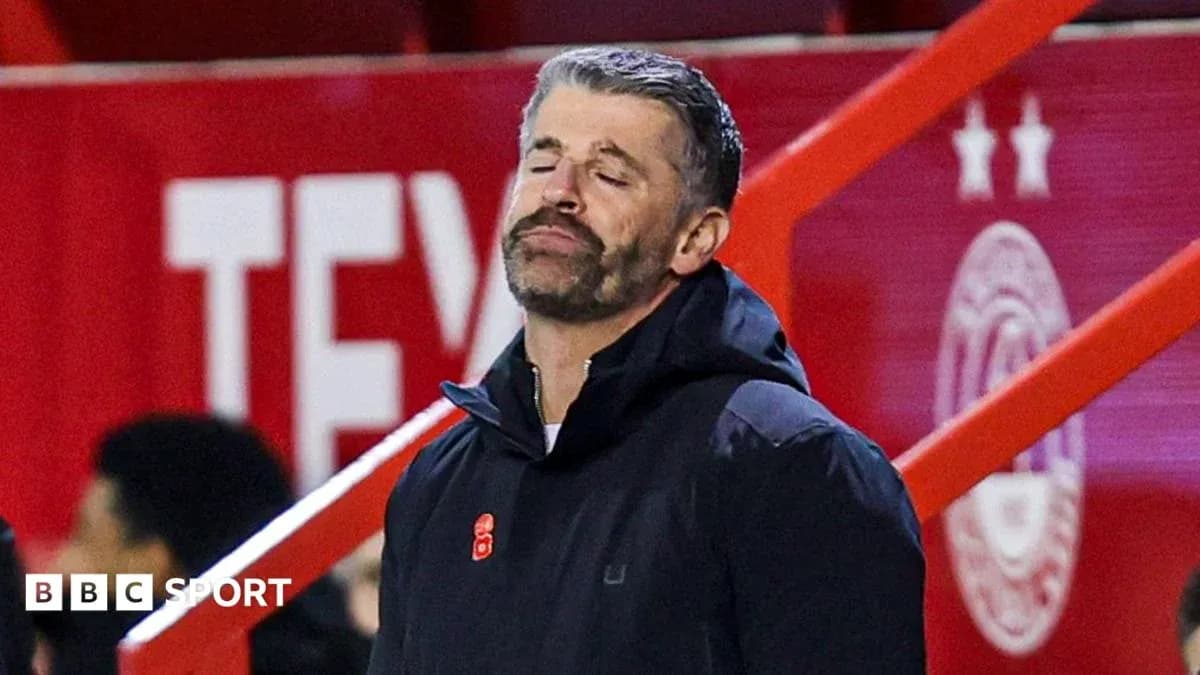
Stephen Robinson’s time at Aberdeen is over before it ever really started.
Eight months after he walked into Pittodrie with a long-term contract and a mandate to steady a listing ship, the 51-year-old has been sacked, undone by a grim run of three wins in 12 Premiership matches and a team sinking towards the bottom.
Saturday’s 4-0 capitulation at home to Hibernian felt like the point of no return. It was Aberdeen’s fourth straight defeat in all competitions, and it stripped away whatever patience remained in the stands and the boardroom. By full-time, the boos were venomous. By Monday, the decision was made.
Brian Kerr and Stephen Craigan have gone with him. Stuart Duff steps up in the short term, handed the unenviable task of coaxing life from a squad that looks drained of belief and direction.
A project unravels
Robinson did not arrive as a novice. His CV carried Oldham Athletic, Motherwell, Morecambe and, most recently, St Mirren, where he had delivered three consecutive top-six finishes and a League Cup triumph. That success earned him the Aberdeen job in March and a deal running until the summer of 2029 – a statement of faith from chairman Dave Cormack that this, finally, was the man to lead a new era.
He became the sixth permanent manager since Cormack took control in November 2019. Like several before him, he inherited a team glancing nervously over its shoulder. To his credit, he did what was asked in those first months, steering the club away from immediate relegation danger.
Then came the reset. Fifteen players out, fifteen in. A full-scale rebuild sanctioned by the board and driven, as club legend Willie Miller suggested, largely by Robinson’s assessment of what was needed.
“It is a huge turnaround of players,” Miller told BBC Sportsound. “Was that all Stephen Robinson? I would imagine probably yes but I don't know because I am not privy to that information.”
The bet was bold. It has not paid off.
No stability, no identity
Aberdeen are joint lowest scorers in the league. Confidence has drained with every misstep. Robinson shuffled between a back four and a back five, but found only two clean sheets in the Premiership for his trouble. The constant tinkering never hardened into a recognisable style or a settled structure.
Of the glut of summer arrivals, only goalkeeper Marius Muller and full-back Nesta Guinness-Walker have started every league game. Top scorer Kevin Nisbet, captain and focal point, is the only other ever-present. When he was substituted against Hibs, a section of the home support cheered. It was a raw, telling moment.
For Miller, the issue cut deeper than tactics.
“The players aren't up to scratch, not up to playing at this level and dealing with high-ish expectations,” he said. “I'm not talking about trophies, I'm talking about being in the top six and they're nowhere near that.”
Former Aberdeen defender Alex McLeish struck a slightly different note, defending the board’s intent but highlighting the same glaring fault line.
“Recruitment is absolutely key and if you've bought a bunch of players and then they're not performing then that is a real worry,” he said. “There's a few players in there that are already at a good level but can the others jump on that wagon and get Aberdeen rolling again because it's a very difficult time for them.”
Rinse, repeat, and regret
For Aberdeen supporters, this feels horribly familiar. The phrase “rinse and repeat” no longer belongs in the bathroom; it sits squarely over the club’s managerial strategy.
No-one can accuse Cormack of apathy. He has invested time, money and emotion trying to drag Aberdeen back towards a standard befitting their history. A Scottish Cup win last season stands as a rare high point. Yet the revolving door in the dugout has undermined any sense of continuity. Each new appointment has carried hope. Too many have ended in the same weary post-mortem.
Under Cormack, the managerial hit rate is low. That’s the polite version.
Robinson’s tenure never quite escaped that mood of scepticism. His arrival, after a protracted search to replace Jimmy Thelin’s aborted move, felt to many like a compromise, a decision born of pressure rather than conviction. The Red Army were never fully sold, and as results dipped, the grumbling hardened into open hostility.
On the touchline, Robinson began to look like the criticism described him – “a man lost”, in Miller’s words. His post-match interviews in recent weeks were painful, the language of a coach running out of solutions and time.
Across 28 games in all competitions, he leaves with 11 wins, five draws and 12 defeats. On paper, that is not catastrophic. On the pitch, the trend is unmistakable. Aberdeen are second bottom and sliding.
What comes next
Now the responsibility passes to new chief executive Adrian Bevington and sporting director Lutz Pfannenstiel. Both arrive with reputations built on deep networks and sharp recruitment. They will need every contact in the book.
The brief is stark. The next manager inherits a fragile dressing room, a disjointed squad and a fanbase that has had its patience shredded by false dawns. The first job is brutally simple: stop the slide towards a “relegation mire” that no one at Pittodrie expected to be discussing so soon after a cup win.
The fixture list offers no comfort. After the international break, Aberdeen go to Kilmarnock on 21 November, then Ibrox to face Rangers three days later, before Dundee visit Pittodrie on 28 November. These are not games that allow a gentle bedding-in period.
This, then, is the crossroads. Another reset, another new face in the technical area, another attempt to break a cycle that has dragged a proud club into mediocrity and now threatens something far worse.
Aberdeen have gambled on change again. The question now is whether anyone can finally turn off the rinse and repeat.





