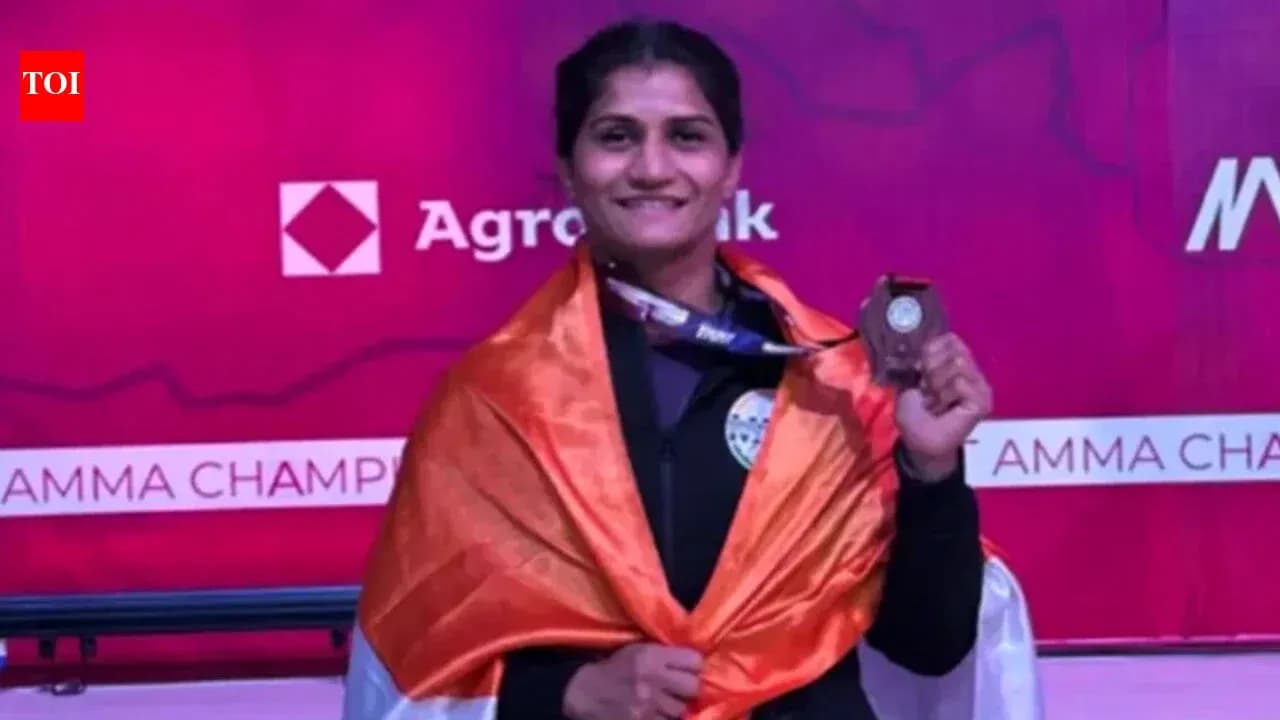
Suchika Tariyal’s long road back to the big stage has delivered India its first medal of the Aichi-Nagoya Asian Games – and it came in a sport that is itself making its debut.
On Sunday, the 36-year-old beat Mongolia’s Altanchimeg Baigalmaa 2-0 in the women’s Traditional Mixed Martial Arts 60kg quarterfinal, a composed, almost clinical display that sealed her place in Monday’s semifinals and, with it, at least a bronze medal. In this format, both losing semifinalists stand on the podium, so Tariyal has already guaranteed India a return from Aichi-Nagoya with metal in the bag.
A medal at the first attempt
Traditional MMA is stepping into the Asian Games programme for the first time at Aichi-Nagoya 2026, and India’s first chapter in the sport now has a clear protagonist. Tariyal never looked flustered against Baigalmaa, using her experience and mat awareness to keep the contest under control and close out a straight 2-0 win.
Baigalmaa, ranked 92nd in the Eurasia region, struggled to break through that composure. Every time the Mongolian tried to force the pace, Tariyal steadied the exchanges, managed distance, and steered the bout back to her terms. It was the performance of an athlete who has seen almost everything combat sport can throw at her.
On Monday, she will fight again with a shot at upgrading bronze to something brighter. The medal, though, is already secure.
A career built on reinvention
This is not a typical MMA story. Tariyal has stitched her career together across four different disciplines, moving between sports that share a language of throws, locks and leverage, but demand different rhythms and instincts.
She represented India in judo at the 2022 Commonwealth Games. A year later, she switched to kurash for the 2023 Asian Games. In 2024, she rose to the top of yet another code, becoming a Jiu-Jitsu world champion.
Then she walked away.
At least for a while. Friends persuaded her back into the arena, and when she returned, she chose perhaps the toughest route of all: MMA, with its unforgiving blend of striking and grappling, its constant demand for adaptation. The comeback was not smooth. A knee injury threatened to halt the new chapter before it could properly begin, and selection for India’s Asian Games contingent demanded another round of rehabilitation and reinvention.
She made it. And now, on MMA’s Asian Games debut, she has turned that gamble into a guaranteed place on the podium.
A new benchmark for India
For India, Tariyal’s run is more than a solitary medal. It plants a flag in a new discipline at a multi-sport event that often shapes funding, attention and opportunity. An athlete who has worn the tricolour in judo, kurash, jiu-jitsu and now MMA has once again pushed the boundaries of what an Indian combat sport career can look like.
Her semifinal on Monday will decide the colour of the medal. The statement, though, has already been made: in a brand-new Asian Games sport, India is not just participating. It is on the board, and it is there because a 36-year-old refused to let her story end before she had tried one more fight.