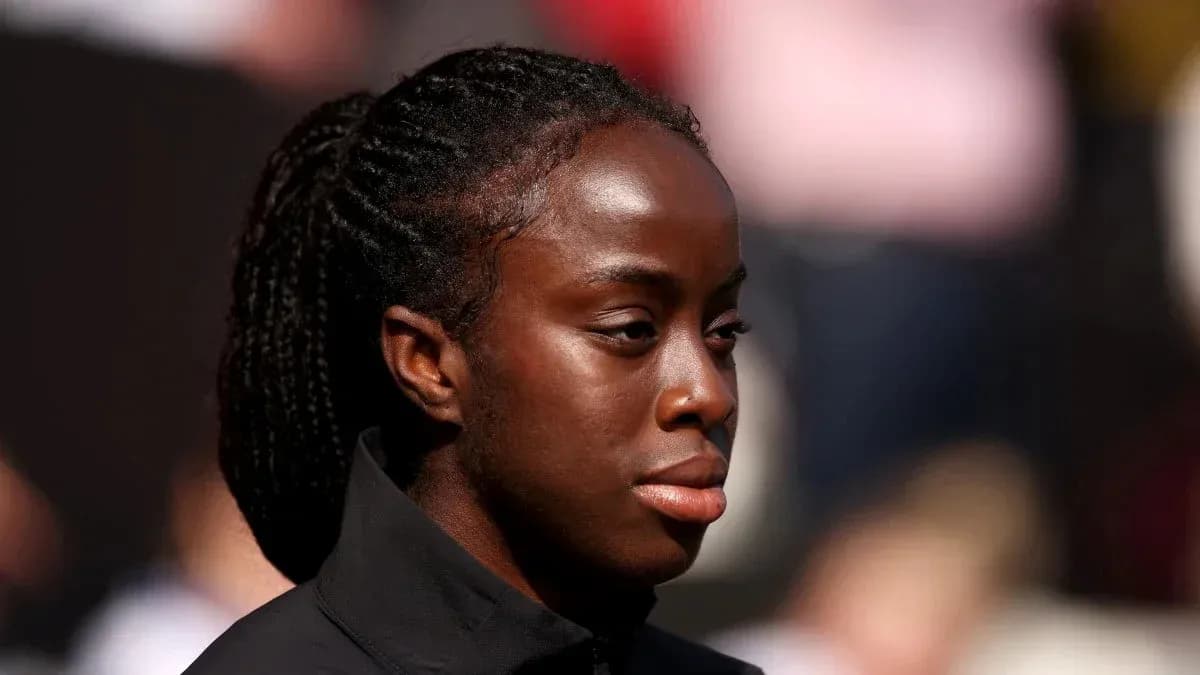
Unai Emery didn’t hesitate. “His time is coming,” he said of Taylor Harwood-Bellis.
Now it has to.
The £30m defender is expected to finally pull on an Aston Villa shirt from the start at Coventry in the Carabao Cup on Wednesday, after two weeks of watching, waiting and wondering where he fits in. Signed from Southampton to fill the void left by Ezri Konsa’s £51m move to Arsenal, he arrives at a club that suddenly looks fragile in the one area Emery has tried hardest to control.
A debut born out of chaos
This is not the gentle introduction Harwood-Bellis might have imagined. No easing in with late cameos. No low‑pressure minutes when the game is already won.
Villa are coming off a bruising 2-1 defeat at Nottingham Forest in which they allowed 22 shots. That followed the 21 they faced in the opening-weekend collapse at Brighton. Two games, 43 efforts conceded. For a coach who builds his reputation on structure and control, that is a siren blaring in the night.
The numbers from the City Ground sting. Forest posted an expected goals figure of 1.92. Villa won only 35.3% of their tackles. They finished with 10 men after Ian Maatsen’s late ankle injury, just before Igor Jesus struck a late winner. Pau Torres had already limped off with a hamstring issue.
In a single afternoon, Emery lost his left-back, his senior left-sided centre-back and, with them, much of his defensive balance.
Maatsen is out until November. Torres is expected to miss three weeks, with the home game against Brentford on 10 October, after the international break, pencilled in as a possible return. Matty Cash has been managing a muscle problem that kept him out of the 3-2 Champions League win at Club Brugge and the defeat to his former club Forest.
So the reshuffle is not tactical; it is enforced. At the CBS Arena, Villa will field an untried back line, with left-back Matteo Ruggeri likely to make his full debut and Harwood-Bellis stepping into the centre.
The stakes are obvious. The opportunity is, too.
From Champions League omission to Carabao spotlight
For Harwood-Bellis, these first weeks at Villa have been a test of temperament as much as talent. Left out of the Champions League squad, yet to kick a ball since arriving, the 24-year-old has had to swallow disappointment and wait his turn while others struggled.
He did not come as a project. He came as Konsa’s replacement, a defender trusted to bring stability and progression from the back. A former Manchester City prospect, he has been groomed to take responsibility on the ball, to step in and play. Villa paid for that profile.
But timing has a way of twisting careers. Instead of slotting into a settled side, he walks into a defence that has been opened up twice in two league games and is missing key pillars. The margin for error shrinks.
Victor Lindelof, the one constant in Villa’s back line so far, has started all six matches this season, including the Super Cup defeat to Paris St-Germain. Emery is expected to rest him at Coventry. That places even more weight on Harwood-Bellis’ shoulders. He is not just making a debut; he is becoming the reference point for a makeshift unit.
Scars from Southampton, lessons for Villa
Harwood-Bellis arrives with something to prove in the Premier League. His last full campaign in the top flight, with Southampton in 2024-25, ended in relegation and bruised reputations. The Saints collected only 12 points and finished bottom. In that chaos, his own errors were laid bare: four mistakes directly leading to goals.
The raw data from that season shows a defender working under siege. He averaged 0.9 tackles per game, close to Konsa’s 1.0, and produced 1.4 blocks and 4.5 clearances per 90 minutes. Those numbers came in a side constantly on the back foot, chasing games and chasing shadows.
What stood out, even in a failing team, was his use of the ball. A ball‑playing centre-back by design, he averaged 67.6 passes per match, far ahead of Konsa’s 50. That volume speaks to responsibility: he was the man teams played through, the defender asked to start attacks as well as end them.
Last season in the Championship, as Southampton’s promotion bid imploded amid the Spygate scandal and a play-off expulsion, his defensive workload shifted again. He averaged 7.4 clearances, 0.8 tackles and 0.9 interceptions per game. Less tackling, more sweeping up. More fire-fighting in his own box.
Now he steps back into the Premier League with those experiences etched into him. The mistakes, the scrutiny, the feeling of being targeted. The numbers tell part of the story; the scars tell the rest.
England glimpse, Villa demand
There is also the reminder of his ceiling. On his only England appearance, against the Republic of Ireland in 2024, Harwood-Bellis scored. One cap, one goal. A brief glimpse of what many inside the game have long believed he can become.
Emery clearly shares that belief. His comment – “His time is coming” – was not a throwaway line. It sounded like a promise, but also a challenge.
Because this is the dilemma facing the Villa manager right now. He must integrate new signings quickly while chasing results in multiple competitions, all against the backdrop of a stuttering start. Rotate too little and players break down. Rotate too much and the structure disintegrates.
The Carabao Cup tie at Coventry offers no hiding place. A misstep and the criticism sharpens: recruitment questioned, rotation questioned, the decision to omit Harwood-Bellis from the Champions League squad dragged back into focus. A commanding display, and the narrative flips. Suddenly, Villa have a new pillar at the back, a defender who can help drag their numbers in the right direction and their season back on course.
For Harwood-Bellis, this is more than a debut. It is a reset. A chance to show that the version of him defined by Southampton’s collapse is not the one Villa have bought.
His time is coming, Emery said. On Wednesday night, it finally arrives.