Team USA Dominates FIBA Women's World Cup Opening Night
The United States arrived at the FIBA Women's World Cup carrying the weight of history and the comfort of habit. Eleven titles. Four straight golds. Only a single bronze in 2006 breaking up a run of dominance that has stretched across generations. This is their tournament, and on opening night, they played like it.
Spain, France, and the U.S. all announced themselves with the blunt force of contenders who know exactly who they are, ripping through their first opponents by 30-plus. No easing in. No feeling out. Just statement wins.
And then there was Caitlin Clark.
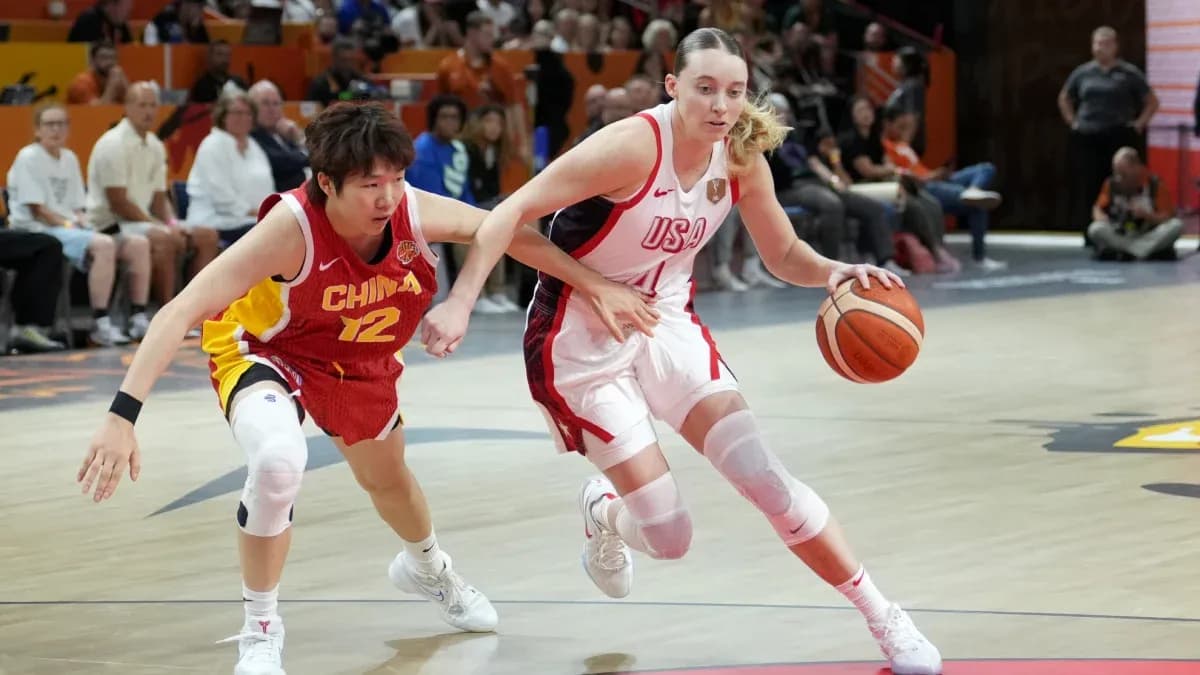
In Team USA’s 94–61 dismantling of China, Clark came off the bench and seized the game by the throat. She logged a team-high 25 minutes, orchestrated everything, and walked away with Player of the Game honors. Eleven assists — the most by an American at this tournament in 28 years — and a game-best 14 points, matched only by her backcourt partner Paige Bueckers.
The numbers told one story. The chemistry told another.
Clark and Bueckers Light Up the Backcourt
This was not a star taking turns with another star. It was a partnership, already humming on the world stage.
Bueckers, now with the Dallas Wings, fed off Clark’s gravitational pull. When she spoke after the final buzzer, the explanation was simple and sharp. She pointed to Clark’s ability to draw defenders, to see the floor, to free everyone around her. The quote matched exactly what unfolded on court: Clark pulled in double-teams, Bueckers slipped into the gaps, and China spent the night chasing shadows.
The box score backed every word. Those 11 assists weren’t empty numbers; they were the product of elite floor-mapping, the same vision that has made Clark the leading assist-maker in the WNBA. Defenses collapse the moment she rises behind the arc or turns the corner with the ball. Help comes, then comes again. Passing lanes open. Teammates feast.
On this night, Bueckers was the primary beneficiary.
The game also produced one of the viral snapshots of the tournament so far: Bueckers, standing next to China’s 7-foot-3 center Zhang Ziyu, craning her neck upward in disbelief. A brief, almost comic moment in a game otherwise defined by American control and cutting edge.
A Familiar Power, a New Edge
For all the history the U.S. carries into every World Cup, this group has a fresh sharpness to it. The perimeter shooting is ruthless. The ball security is tight. When Clark handles the ball, the risk is low and the threat is constant. That combination forces opponents into uncomfortable choices — pick your poison, then live with it.
China felt that early. Once the U.S. spread the floor and Clark settled into a rhythm, the contest turned from competitive to inevitable. The lead grew, the rotations deepened, and the Americans never loosened their grip.
The wider field will have taken note. Spain and France looked strong in their own openers, but the U.S. didn’t just win; they imposed themselves, again, in a tournament they have owned for decades.
Italy Next, Then Czechia
The schedule offers no time to admire the opening act. On Sunday, Team USA faces Italy, who arrive with confidence after beating Czechia in their first outing. It’s a different test, a different style, but the stakes are the same: control the group, set the tone, keep the standard.
On Monday, the Americans close Group D against Czechia. By then, the rest of the field will have a clearer idea of just how high this U.S. team’s ceiling sits.
The United States came to defend a dynasty. With Clark and Bueckers already in sync and the scoreboard reflecting it, the real question is no longer whether they are favorites.
It’s who, if anyone, can stop them from adding another chapter to an already staggering World Cup legacy.