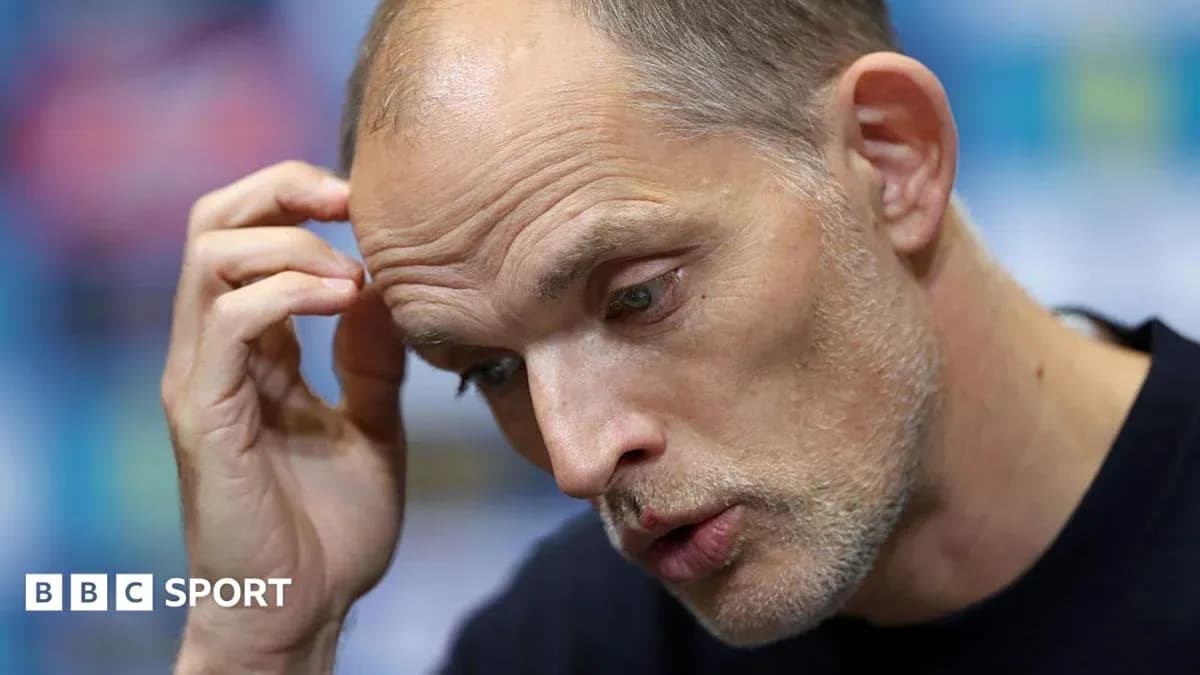
Thomas Tuchel walked out of the United States in July craving control. Two months on, he is talking about chaos.
At his first England squad announcement since that World Cup bronze in America, the German sat behind a microphone and smiled at the contradiction. “Embrace the chaos,” he said. The same coach who left the semi-final defeat by Argentina lamenting his team’s failure to manage the game after Anthony Gordon’s opener now seems willing to loosen the reins.
Controlled chaos. Tuchel wants to see if such a thing can exist in international football.
From heartbreak to “6-4 football”
England’s third-place finish was their best World Cup showing since 1966, but the abiding image is not the bronze medal. It is the collapse against Argentina, a semi-final that slipped from their grasp when composure deserted them.
Back then, Tuchel’s post-mortem centred on control: England scored first, then lost their grip. The manager’s diagnosis was clear – his side could not slow the game, could not dictate the rhythm, could not ride out the storm.
Now he is holding up that wild 6-4 win over France in the third-place play-off as something to learn from, not just to survive.
“Football is about adapting to situations,” he said. The 6-4, a coach’s tactical nightmare, has been embraced by fans as pure spectacle. Tuchel can feel that pull. If the people loved it, maybe there is something in it for him too.
So he talks about compromise. About letting a bit of chaos in. About the possibility that England’s best version is not a perfectly ordered machine, but a side that can live on the edge without falling off it.
Mixed messages? Not quite. It sounds more like a manager trying to sharpen his team’s unpredictability without abandoning the principles that got them this far.
A squad that screams control
Then you look at the names on his latest squad list, and the story twists again.
Spain, the Czech Republic and Croatia await in the Nations League. Tuchel’s selections for those four games hardly resemble a manager throwing the doors open to anarchy.
Trent Alexander-Arnold is back. Cole Palmer is back. Two of the most technically polished English players of their generation. Both bring structure, passing angles, rhythm. They are control in human form.
Alex Scott, the Bournemouth midfielder, joins them. So does Newcastle left-back Lewis Hall. Two more footballers who want the ball, who can keep it, who can dictate with it. These are not chaos merchants. These are possession players, the sort you pick when you want your team to think, not just run.
Tuchel is not abandoning his core. He is reinforcing it.
He insists this is no admission that he misjudged his World Cup squad. Injuries, not regret, have forced his hand. Reece James, Dan Burn, Dean Henderson, John Stones, Jordan Henderson, Djed Spence – all key figures in the “brotherhood” he believes powered England deep into the tournament – are unavailable.
Those absences matter to him. They were, in his words, crucial in building spirit and mentality. He is adamant that part of England’s identity will not be compromised. Others, he says, will have to step up and protect that culture.
His message on shape and structure is just as firm: do not expect sweeping tactical revolution. “My mindset at the moment is not to change too much within the formations,” he said. The frame stays the same. The picture inside might start to look different.
Injecting chaos out wide
If Tuchel’s back line and midfield lean towards order, his attacking choices tell a more adventurous story.
Rio Ngumoha’s first senior call-up is the clearest sign. The 18-year-old Liverpool winger has lit up the early season under Andoni Iraola, his direct running and improvisation down both flanks demanding attention. He brings something England have often lacked: raw, unpredictable one-v-one threat from wide areas.
Ngumoha will not define this camp on his own, but his presence changes the feel of the forward line. Suddenly there is a wildcard option, a player who can break the pattern when games grow stale.
Tuchel also revealed that Fulham attacker Josh King is close to his first senior call-up. Another hint. The England manager wants more spark in the final third, more players who can disrupt defensive structures rather than just move the ball around them.
He is not ready to “let go of the handbrake” completely, as he put it. But he is clearly edging it upwards a notch or two.
England between Spain and the Premier League
Asked whether his England can play with Premier League pace but with more control, Tuchel did not hesitate to outline the ideal.
“That would be the wish,” he admitted – to have a side that can look, for 10 minutes here and there, a little more like Spain. A team that can put its foot on the ball, not just on the accelerator.
Yet when he reflects, he keeps coming back to England’s own strengths. To the second half against Croatia. To the first half against France. To those stretches where his team played with ferocity and connection, where the style mirrored what supporters watch every weekend.
He knows this is what the Premier League sells to the world: relentlessness. Not the most economical football, but football that demands you “max out every single match” to compete for titles. He sees that in his players. He feels it in the way the fans respond.
So he stands in that tension, describing his mindset as “still a bit ambiguous”. He wants more control, but not at the cost of England’s identity. He wants more chaos, but not the kind that destroys game plans and tournaments.
Spain, Czechs, Croatia – and a test of identity
Now comes the hard part: turning theory into points.
England open this Nations League run at Wembley against World Cup winners Spain on Saturday, 26 September. A side built on control, on endless passing lanes and positional play, walking into the national stadium to face a coach wrestling with how much of that he wants to copy.
Then it is the Czech Republic away on Tuesday, 29 September. Croatia away on Saturday, 3 October. And finally the Czechs again, this time in England, on Tuesday, 6 October.
Four games. One month. A perfect laboratory for Tuchel’s experiment.
He has his core. He has his technicians. He now has a little more chaos on the wings. The formations will not change much. The mentality, he hopes, will.
England know how to be brave. They have shown they can go toe-to-toe with the best and live in the kind of games that end 6-4. The next step is to prove they can choose when to open the throttle and when to close the game down.
If Tuchel can teach this squad to live comfortably between those two worlds, the semi-final in the US might not be the story that defines this era.