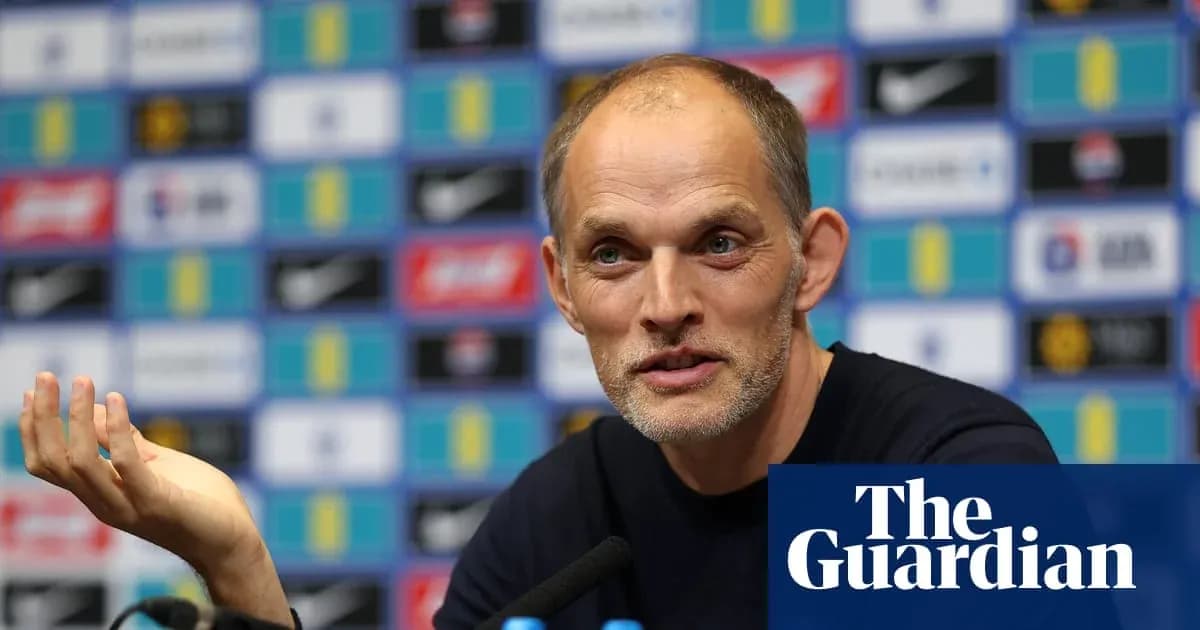
Thomas Tuchel insists he is hearing from the 99.9%. He should probably tune in to the 0.1% instead.
As he unveiled his first England squad since the World Cup, the head coach painted a rosy picture of life after Atlanta. The fans he meets, he said, want to talk about Mexico, about the Democratic Republic of the Congo, about knockout wins and a bronze medal. Not about Argentina. Not about the substitutions. Not about the retreat.
Out in the country, it does not feel quite so forgiving.
The ghost of Atlanta
Tuchel’s claim is impossible to measure, of course. Maybe 99.9% of his encounters really are positive. But anecdote cuts both ways, and plenty of supporters are still stuck in that semi-final, still replaying the moment England went 1-0 up against Argentina early in the second half and then shrank into themselves.
The national mood is not as upbeat as the manager suggests. The way England folded still stings. It is the kind of collapse that lingers, the kind that attaches itself to a coach’s reputation and refuses to let go.
Tuchel, though, is trying to push the narrative on. He has been bruised by the criticism, buoyed by the 6-4 chaos win over France that brought third place, and is desperate to bottle the togetherness he saw in Qatar. At Wembley on Friday, he joked about the Football Association hierarchy giving him a gentle telling-off for his defensive switches against Argentina. The smile slipped when the conversation turned serious. He wanted the story to be about France, not Argentina.
That is not how this works. Not when the first squad of a new cycle lands under the shadow of a World Cup that exposed deep tactical fault lines.
Continuity, then chaos
On paper, the squad for Spain, Czechia and Croatia looks coherent enough. Noni Madueke, Ollie Watkins and Ivan Toney are out from the summer’s 26. Injuries have ripped out a spine of experience: Dean Henderson, Dan Burn, John Stones, Reece James, Djed Spence and Jordan Henderson are all missing.
Tuchel’s initial plan, he admitted, was continuity. Stick with the group that went to the World Cup, reward the “brotherhood” and spirit he so often references. The injury list forced his hand. The gaps have opened the door to a fresher, more experimental feel.
That is where this squad becomes interesting.
Trent Alexander-Arnold is back. Dragged out of international cold storage, the Real Madrid defender is suddenly central to the conversation again. The recall is intriguing, but also awkward. Why now? Has Tuchel really changed his mind about a player he did not pick after June 2025? Or is this simply necessity, with Spence, James and even Ben White unavailable?
Alexander-Arnold has flickered rather than burned in Madrid under José Mourinho. He has never fully convinced with England, never nailed down a role. Tuchel has already ruled out using him in midfield. The 27-year-old’s challenge is clear: play well enough in these games to still be in the frame when the injured full-backs return.
The head coach has told all the newcomers the same thing: a call-up is not a prize, it is a test. You have to perform in an England shirt to stay.
England’s identity crisis
Tuchel insists he has not lost sleep over his World Cup selections. He keeps coming back to culture, to unity, to that elusive sense of “us against the world”. Yet the questions he faced at Wembley were not about spirit. They were about structure.
There was a telling pause when a reporter linked the inclusions of Alexander-Arnold, Alex Scott and Cole Palmer to one glaring issue from Qatar: England’s lack of forward passers. The memory of Tuchel’s post-Argentina line – that ball possession is not part of England’s DNA – still hangs in the air.
When he took the job, Tuchel spoke about harnessing the speed and power of the Premier League. At the World Cup, that promise flickered only once: in the second half of the opening win over Croatia, when England finally went full throttle. The rest of the tournament felt like a compromise. Sit deep, defend stoutly, and wait for Harry Kane or Jude Bellingham to conjure something.
They ended up in a no man’s land. Neither a sharp, Spanish-style possession side nor a wild, Premier League-style pressing machine. Just a team stuck between ideas, eventually dragged into a desperate 5-4-1 against Argentina.
Tuchel says he wants more balance now. He talks about “resting with the ball” at times but also about his instinct to “embrace the chaos”, to recreate the fury of that Croatia second half. It sounds good. It also sounds like a coach still wrestling with what he wants this team to be.
Midfield mistakes and second chances
One area where Tuchel clearly tied his own hands in Qatar was midfield. As Declan Rice tired against Argentina, England needed fresh legs next to Elliot Anderson. They had very few options.
Jordan Henderson, 36 and playing with a broken wrist, was never going to be the answer. Kobbie Mainoo, nimble and brave in tight spaces, was in the squad but never left the bench. Tuchel now admits he owes the Manchester United youngster a proper look this time. That admission feels like more than a minor oversight; it was a major missed opportunity in a World Cup semi-final.
There were other routes he could have taken even before the tournament. Myles Lewis-Skelly was finishing last season strongly in Arsenal’s midfield. Scott was impressing at Bournemouth. Both are in this squad now. Adam Wharton, though, remains on the outside looking in. Tuchel is still unconvinced.
Selection will always inflame debate. Morgan Gibbs-White and Josh King can feel harshly treated after being left out. Liam Delap had a case to edge out Dominic Calvert-Lewin as Kane’s understudy. Yet step back from the individual gripes and the overall picture is encouraging. This is a good squad, deep in quality, spiked with enough youth to jolt the group out of its comfort zone.
A new wave, a new risk
Rio Ngumoha, Liverpool’s teenage winger, headlines that new wave. Jarrad Branthwaite has muscled his way in at centre-back, looking every inch the new Burn after beating Levi Colwill to a place. Lewis Hall has a chance to make the left-back slot his own.
Up front, one decision stands out. Dropping Madueke for Palmer is a clear signal Tuchel wants more variety in attack. At the World Cup, he leaned heavily on like-for-like replacements, swapping wingers for wingers, strikers for strikers, systems for the same systems. It made England predictable.
Palmer changes that. Chelsea’s No 10 does not run in straight, chalk-on-the-boots lines down the flank. He drifts, he links, he plays between the lines. He is, bluntly, a better all-round footballer than Madueke. In a squad that already has pace and power, his touch and vision could be crucial.
England have technicians now. Real ones. The question is whether Tuchel will trust them when the pressure rises, or whether fear will drag him back towards the safety of deep blocks and late defensive changes.
The Nations League offers no soft launch. Spain come to town next Saturday. The stands will be full, the atmosphere charged, and far more than 0.1% of the crowd will be watching one man in particular.
Not just to see who he picks. To see if he has truly learned from Atlanta – or if Argentina still has a grip on his decisions.