NAGOYA – By the time Tiffany Teo finally stepped off the mat at the Nagoya City Inae Sports Centre, Singapore had its first gold medal of these Asian Games – and its MMA trailblazer had the moment she had chased for more than a decade.
This was not just a win. It was payback, a breakthrough, and a statement rolled into one.
Revenge and history in one night
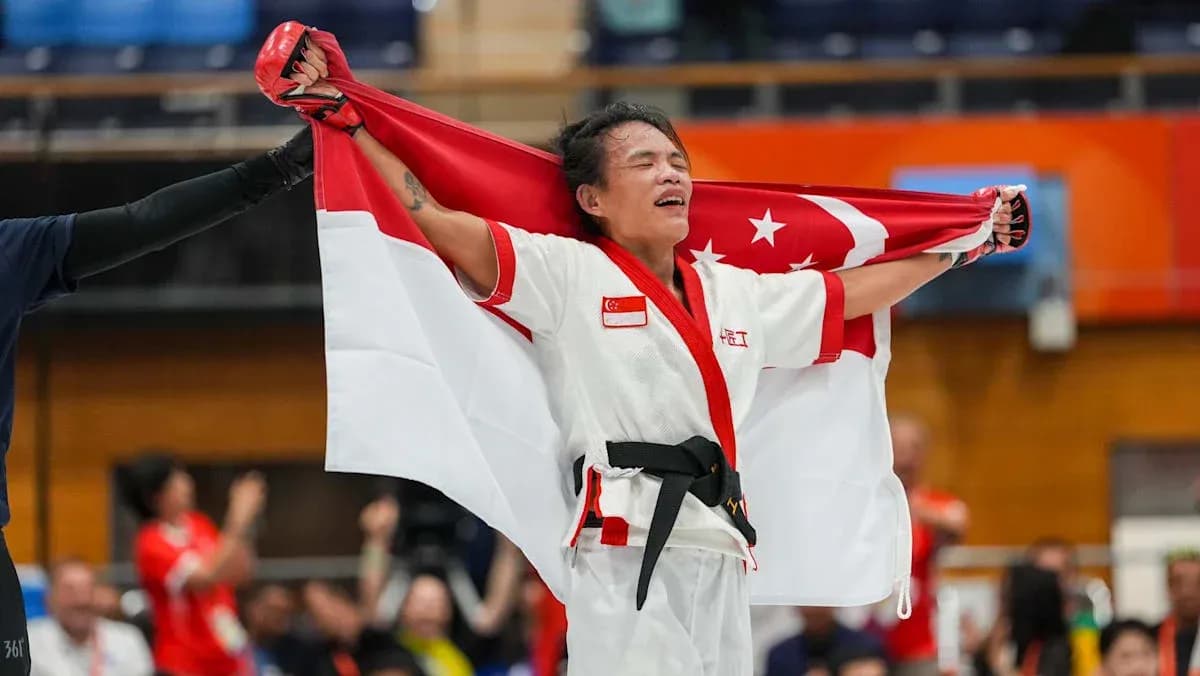
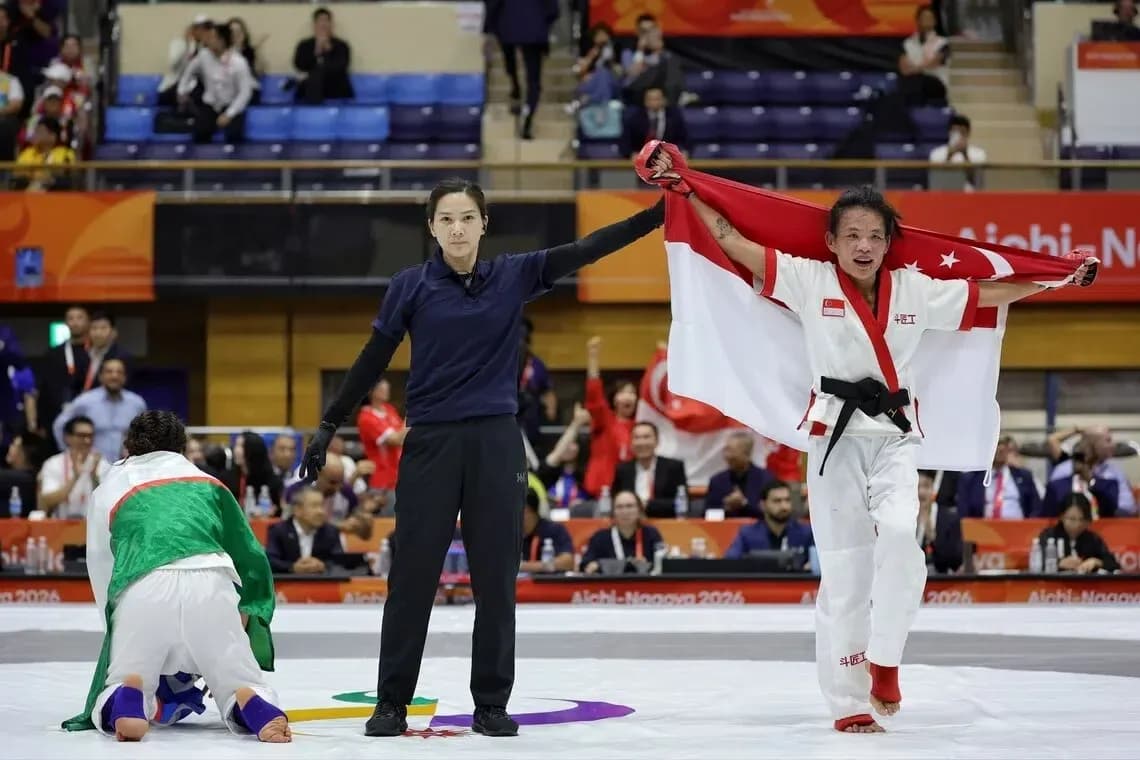
Teo, competing in the women’s traditional 60kg division, beat Uzbekistan’s Khilola Sobirova in the final on Sept 22 to cap a remarkable Asian Games debut. The bout went to overtime after both fighters were judged to have taken one round each. Under pressure, with the stakes higher than ever, Teo found enough to edge ahead and close the door.
For her, the opponent in front of her carried extra weight. Sobirova had denied Teo a continental title in May, winning their clash in the final of the 2026 Asian Mixed Martial Arts Championships. That loss lingered. In Nagoya, Teo rewrote the ending.
When the decision came, the 36-year-old crumpled. Tears streamed down her face before her husband and coach, Sim Kai Xiong, swept her onto his shoulders. Blood marked her uniform, but the emotion ran deeper than the bruises.
She admitted she “was really overwhelmed”, explaining that she had never cried after a fight before. Representing Singapore at the Asian Games, she said, brought a different kind of weight. Expectations. Pressure. A sense that this was bigger than her own career. The tears, she made clear, were tears of joy.
A pioneer fighting for more than medals
Teo has long seen herself as a pioneer for MMA in Singapore, and she did not hide her frustration that the sport has stalled in popularity back home. This gold, she believes, can change the conversation.
A major part of her decision to compete in the Asian Games, she said, was to help grow the sport domestically. She knows time is not on her side. After more than 10 years in the cage, she concedes she has only a few competitive years left.
Her hope is simple but ambitious: that this victory shows MMA can sit alongside boxing, wrestling and judo as a viable national pathway sport. Those disciplines already offer clear routes into national teams and major championships. MMA, in her eyes, needs the same structure – a target for young fighters to chase, a ladder to climb.
By standing atop an Asian Games podium, she has given Singaporean MMA something it has never had before: proof that such a pathway can lead to gold.
A wild route to the final
Teo’s road to the top step in Aichi-Nagoya was anything but routine.
She opened her campaign on Sept 20 with a composed win over Iran’s Arezou Salimighalehtaki, taking a unanimous decision in the quarter-finals. That alone was historic – it secured Singapore’s first Asian Games medal in MMA, a sport making its debut at the continental showpiece.
With both losing semi-finalists guaranteed joint-bronze, Teo knew she would leave Nagoya with at least a medal. But she wanted more, and the semi-final against India’s Suchika Tariyal on Sept 21 turned into a nerve-shredding ordeal.
The pair split the first two rounds, forcing an overtime round. Judges initially ruled in Teo’s favour, seemingly sending her into the final. Then came the twist. Tariyal’s camp challenged the decision, triggering a video review by a separate panel of referees.
The review overturned Teo’s overtime win and declared the bout a draw. Under Asian Mixed Martial Arts Association (AMMA) rules, that meant a weight tiebreaker. It came down to the morning weigh-in. Teo had checked in at 58.8kg; Tariyal at 59.85kg. By the slimmest of margins, the Singaporean advanced.
From almost out to still alive, Teo walked a tightrope. She made it count.
From wilderness to gold
This gold marks a sharp turn in a career that had drifted into uncertainty.
Teo turned professional in 2016 and built an 8-2 record with One Championship between 2016 and 2022, establishing herself as one of Singapore’s most accomplished MMA athletes. Then came a near three-year absence from competition. No cage walks. No fight weeks. Just the grind away from the spotlight.
She finally returned in June 2025 with Chinese promotion JCK MMA, beginning the slow climb back. That long stretch in the wilderness now frames her Nagoya triumph in stark relief. For a fighter who once seemed to have slipped off the radar, standing atop an Asian Games podium feels like a defiant answer to time and doubt.
Setting the tone for Singapore
Teo’s gold lit up the third day of action for Singapore’s 304-strong contingent and added a fresh shade to the country’s medal tally. It joins swimmer Gan Ching Hwee’s landmark silver in the 1,500m freestyle and a bronze from wushu exponent Zeanne Law in the women’s taijiquan-taijijian.
At the last Asian Games in Hangzhou in 2023, Singapore collected 16 medals – three golds, six silvers and seven bronzes. Teo’s victory in Nagoya does more than edge the Republic towards that mark again. It opens a new front.
For Singaporean MMA, this is no longer just about cages in small arenas or regional circuits. With one wiry fighter, blood on her gi and tears on her cheeks, the sport has stepped onto a continental stage.
The question now is whether the system back home will follow her lead.