Tony Bloom's Transformation of Brighton & Hove Albion: From Survival to European Ambitions
Two decades ago, Brighton & Hove Albion were fighting not for trophies, but for survival. The club were clinging to their league status, their stadium gone, their future a question mark.
Now they are heading back into Europe.
The journey between those two realities runs straight through one man: Tony Bloom.
From the Goldstone to Gillingham – and the brink
Around the turn of the century, Brighton’s problems were brutally simple. No money. No home. No guarantees.
The Goldstone Ground had gone. The club drifted to Gillingham, then back to Brighton to the makeshift surroundings of the Withdean Stadium, a converted athletics track that felt temporary because it was. Crowds watched from scaffolding and temporary stands while the club scratched around for transfer funds and clung to planning hopes for a new ground.
The threat to Brighton’s very existence was real. They were footballing nomads with little more than stubbornness and a cause.
Into that landscape stepped a local supporter with deeper pockets and a far bigger vision than anyone realised.
Bloom arrives – and changes the scale
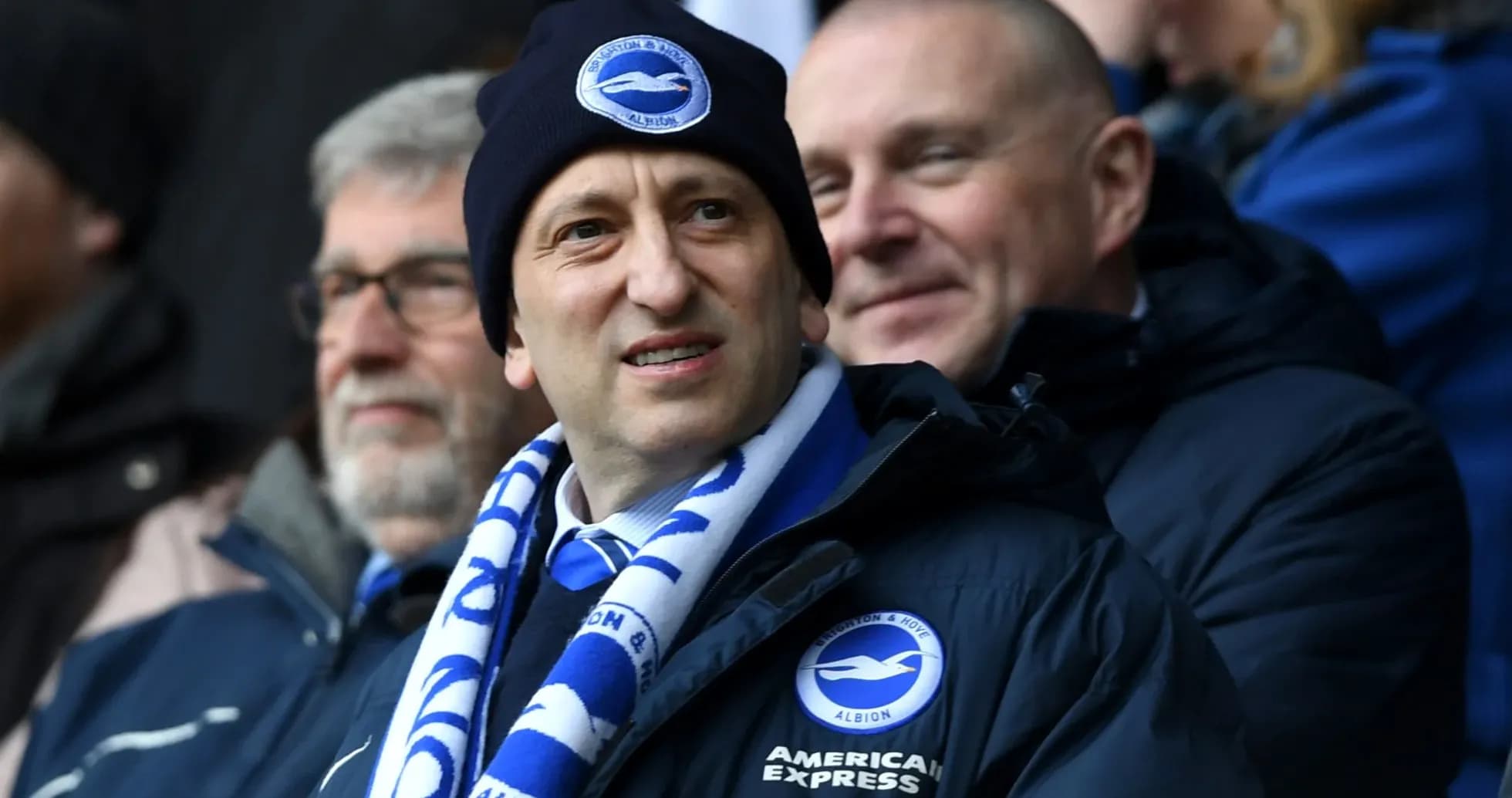
Tony Bloom, a lifelong fan, took control in 2009. On paper, he was the man who would finally deliver the stadium Brighton had campaigned for. In reality, he was about to redraw the club’s entire horizon.
The Amex Stadium, now a gleaming Premier League venue, did not simply appear. It came off the back of years of activism and graft. Former manager Mark McGhee, back in Brighton this week as the club’s 125-year history is marked with the opening of the “Brighton & Hove Albion: Stand or Fall” gallery, remembers that fight.
“We got the permission,” he recalls, crediting then-chairman Dick Knight and his seafront marches, the public meetings, the lectures, the lobbying. Brighton finally secured the green light for a new home.
Then reality bit. “We got the permission, but then had no prospect of building it. And then Tony stepped in, of course.”
At that stage, many thought Bloom’s role would start and end with bricks and mortar. A generous benefactor, yes. A stadium saviour, certainly. But that was the limit of the expectation.
“They didn't realise what he was bringing with him,” McGhee says. The ambition stretched far beyond a new ground. Bloom wanted a training base to match, a modern infrastructure, a club that could grow, then keep growing. “They didn't quite understand what they were getting, even when Tony stepped up.”
Seven seasons after his arrival, Brighton had climbed from League One to the Premier League. They have now spent nine straight years in the top flight. That is not an accident; it is the product of a long-term plan that began when the club still felt fragile.
A family club, rebuilt by one of their own
Bloom’s story is not that of a distant investor dropping in for a vanity project. His ties to the club run through his family.
McGhee smiles when he talks about those roots. He remembers Ray Bloom, Tony’s uncle, a director during his time as manager. “He used to regularly meet with Dick Knight and I for lunch on a Friday at Topolino's in Brighton,” McGhee says, and those lunches came with a recurring theme: this “genius young nephew” who was a mathematical prodigy.
“So I'd heard of Tony as a kid, long before I realised what he'd become,” McGhee adds. The Bloom name is stitched into Brighton’s history. The Harry Bloom lounge at the Amex, where McGhee watched the recent game against Aston Villa, is another reminder that this is a family entwined with the club’s story, not merely attached to its balance sheet.
“So, he's as much, I'm sure, done this for his family as he has for the Brighton public,” McGhee says. The romance matters here. So does the steel.
Bloom made his money in sports betting and poker, but at Brighton he has gambled with calculation, not recklessness. Investment in infrastructure, in recruitment, in coaching. A model that sells smart, buys smarter and keeps the football progressive.
The result? The Seagulls are not just staying up. They are soaring back into Europe, now qualified for the Conference League, a sentence that would have sounded fanciful when the club were begging for planning permission and scraping by on minimal transfer budgets.
From near-extinction to chasing silverware
Brighton’s honours list is modest but proud: titles in the third and fourth tiers, a Community Shield, runners-up in the 1983 FA Cup final. For a club that once feared extinction, those achievements carried weight.
Now the ambition has shifted again. Brighton want a serious piece of silverware, and they are no longer embarrassed to say so.
“I think that Tony's not in this to be a generous benefactor,” McGhee says. “I think he wants to win stuff, and he's putting things in place to create a team that can.” It is a blunt assessment, and an accurate one.
The domestic cups and Europe are where McGhee sees the opening. “They have a chance this year in Europe, they have a chance every year now in one of the domestic trophies,” he insists.
He draws a line, though, at the league title. “I don't think they have a chance of winning the Premier League,” he admits, but he does not see that as a ceiling so much as a staging post. Brighton, he believes, “could easily, with a fair wind and a good draw, find themselves in the final of the FA Cup. They've come close. Or the League Cup. I think that is the inevitable progression.”
The word “inevitable” would have sounded ludicrous in the Withdean days. Under Bloom, it feels more like a logical next step.
A club that stands, not falls
The timing of Brighton’s latest European adventure is fitting. A new permanent gallery, “Brighton & Hove Albion: Stand or Fall,” opened at Brighton Museum & Art Gallery on August 15, telling the story of one of English football’s most resilient clubs.
It is not a trophy room. It is a survival story.
The interactive exhibition pulls together iconic objects, cherished memorabilia, archive footage and personal accounts. Visitors walk through the triumphs and the setbacks, the defining moments that have shaped BHAFC and fixed it at the heart of the city for more than a century. From the Goldstone to Gillingham, from Withdean to the Amex, the club’s scars sit alongside its successes.
Now, the next chapter is being written on multiple fronts.
Brighton will face Manchester United in the Carabao Cup third round, an early, sharp test of their cup credentials. In the Conference League, they have been paired with Panathinaikos and Getafe, a draw that offers both jeopardy and opportunity.
Recent history shows what can be done. West Ham, Chelsea and Crystal Palace have all shown English clubs can turn that competition into a launchpad for European glory or, at the very least, a statement of stature.
Brighton once marched for the right to exist. Under Tony Bloom, they now walk into Old Trafford and European nights with something very different on their minds: not survival, not respectability, but the tangible prospect of lifting a major trophy at last.